Iran Declared the Strait of Hormuz Closed. Oil Went Up 3%
TL;DR
- Iran declared the Strait of Hormuz "closed until further notice" after a weekend of strikes: roughly 140 Iranian sites hit by the US, Iranian missiles at bases in five Gulf states.
- The waterway carries about 20% of the world's oil. The textbook response to closing it is $150 crude and a global recession scare.
- Actual response: Brent up ~3% to $78.50, WTI at $73-74. Gold fell 1.2% the same morning.
- The market is calling the bluff, and it has the receipts to justify it. But this is also the first time the bluff has been formally declared, and the tail risk deserves an actual price now.
The Chart That Explains The Whole Morning
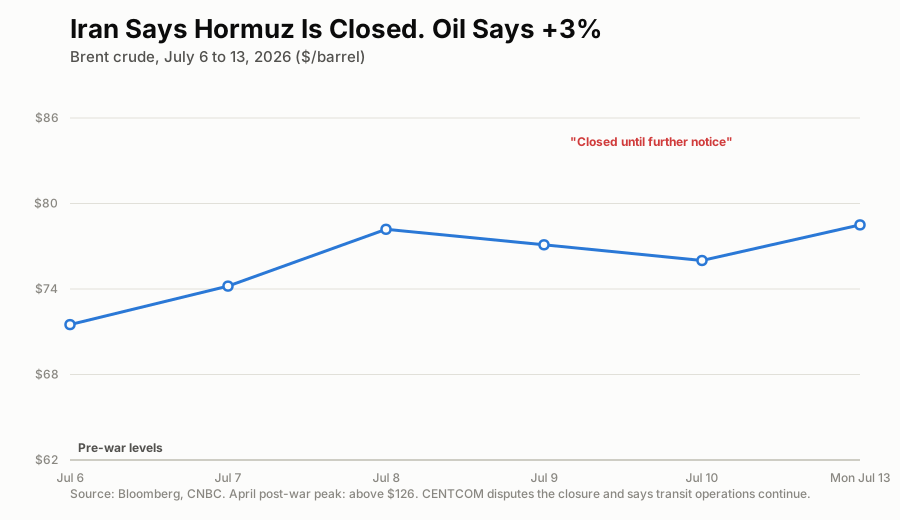
A declared closure of the world's most important oil chokepoint, priced at three percent.
Why The Market Isn't Buying The Closure
CENTCOM is escorting tankers through it right now. The US response to the declaration was to run freedom-of-navigation operations through the strait within hours. A closure that oil tankers are actively transiting is a press release, not a supply disruption, and crude prices settle on barrels, not statements.
Iran needs the strait open more than almost anyone. Iranian oil exports, the regime's only meaningful revenue while under renewed sanctions, flow through the same water. A genuine self-enforced closure is economic suicide with extra steps, which is exactly why the market assigns it low odds even mid-war.
The bluff has been priced before. April's panic above $126 WAS the closure scenario, priced at full terror. The market has since watched three escalation cycles fail to produce a physical disruption, and each cycle's premium has been smaller: the war-fatigue decay curve that's been visible in every asset class from defense stocks to the VIX.
Gold confirmed the read. Down 1.2% to $4,064 on the same morning. If institutional money believed Hormuz was actually closing, gold would have gapped $200 higher, not bled. The safe-haven complex has fully internalized "contained."
What Would Make This Real
The declared closure moves from bluff to crisis on physical evidence only:
- Tanker transits actually stopping. Ship-tracking data, not statements. This is the single cleanest indicator on earth right now.
- War-risk insurance premiums going vertical. Insurers price bodies-and-hulls risk without political spin. A step-change in Hormuz transit premiums is the professional market screaming.
- A tanker actually hit inside the strait post-declaration. The difference between "closed" as rhetoric and closed as enforcement is one strike on a commercial vessel. That headline is worth $15 on Brent inside an hour.
The Options Angle
- The base case is still the range trade: fade this spike like the last three. Short-dated USO puts after 3%+ headline pops have paid every escalation cycle since April, and nothing in the physical data says this one is different yet.
- But buy the tail this time. Far out-of-the-money USO calls, two to three months out, at the $90-Brent-equivalent strikes. A formally declared closure is a new escalation rung, and the entire market pricing it at 3% means the crisis scenario is nearly free. Cheap convexity against a headline that's one tanker strike away from validation is the best-priced hedge on the board this morning.
- Skip the middle. Naked long crude futures here is the worst of both worlds: you bleed if the bluff fades (likely) and you're under-leveraged if it's real (the calls do that job better).
The One-Line Read
The oil market just looked at a formally declared closure of its most important chokepoint and repriced by three dollars: total confidence in containment, zero premium for enforcement. The confidence is probably right, the zero is definitely wrong, and the gap between those two is this morning's trade.
Comments
0 totalNo comments yet. Be the first to drop a take.