How the Iran War Actually Ends, and What to Buy When It Does
TL;DR
- Where the war stands: the June 17 ceasefire (signed at Versailles, of all places) collapsed on July 8. The US has struck ~140 Iranian sites; Iran hit US bases in five Gulf states and declared Hormuz closed. CENTCOM is escorting tankers through it anyway.
- Read the incentives, not the rhetoric: both sides need the strait open, and the White House's own behavior is a strike-and-pause pattern aimed at a deal, not a conquest.
- Our call: no all-out war, and a second, harder-edged ceasefire within weeks, centered on strait access, with bursts of strikes as negotiating punctuation until Iran formally reopens it.
- The market playbook follows directly: keep fading war spikes, own the cheap tail, and pre-position for the "strait is open" headline, which is the single most tradeable scheduled-ish event on the horizon.
What The Tape Already Knows
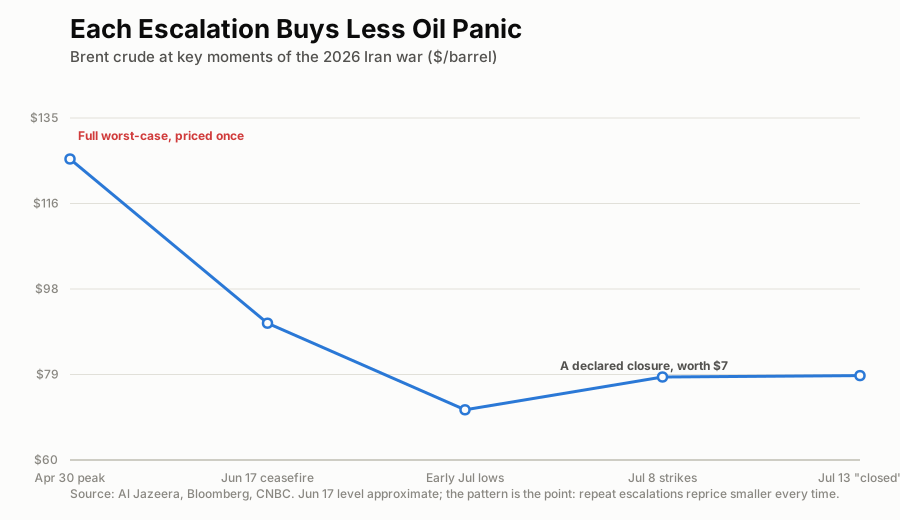
Every escalation has repriced smaller than the last. The market has been converging on "contained" for three months.
The State Of Play
Strip the noise and the war has a shape. February: Operation Epic Fury opens the conflict. April: oil peaks above $126 as markets price the full catastrophe. June 17: a ceasefire memorandum, signed by both presidents. July 8: it collapses, specifically because Iran kept the strait shut and hit ships transiting it. Since then: two-way strikes, a declared closure, and mediators (Qatar and Pakistan) already working both capitals.
Notice what the July 8 trigger was. Not territory, not the nuclear file, not regime rhetoric. The strait. This war's active phase is now, functionally, a fight about whether a shipping lane is open, and that tells you nearly everything about how it ends.
Reading The Decision-Makers
Set politics aside and read the incentives like a trader reads a counterparty.
The White House's own signals point at a deal, loudly. The stated grievance is the closed strait. The stated position is that talks continue even while striking. The president has publicly called further operations something that "would be over very quickly," has said he doesn't expect a return to all-out war, and is reportedly weighing a naval blockade, which is a pressure instrument, not an invasion plan. The military pattern all year has been strike, pause, negotiate. Add the domestic constraint: war-fed oil feeds CPI, CPI feeds the hike debate, and a hike-pressured economy into midterms is the one outcome the administration's own political calendar cannot absorb. Every incentive this decision-maker has converges on: force the strait open, bank the win, sign the deal.
Tehran's incentives converge on the same door. Iran's oil exports, its only meaningful revenue under restored sanctions, flow through the same strait it's threatening. The closure gambit is a fee-extraction and leverage play (control routes, collect concessions), not a sustainable position; a strait that stays closed bankrupts the closer first. Washington already expects a public "strait is open" statement from Tehran within days, per its own briefings. When your adversary's maximal threat is something they can't afford to sustain, the threat is a negotiating position.
The prediction, stated plainly: more strike bursts, each one framed as enforcement rather than escalation; a naval blockade if Tehran stalls; then a second ceasefire, tighter than Versailles, built explicitly around strait access and verification, inside weeks rather than months. No regime-change campaign, no ground war, no $126 oil. The catastrophic tail exists (a US warship or tanker sunk with mass casualties changes every incentive above), but it's a tail, and the decay pattern in that Brent chart says the market's probability weighting is right.
The Playbook
Keep fading the spikes. If the shape above is right, every escalation headline between here and the second ceasefire is a premium-selling event: oil call spreads sold above $85 Brent-equivalent, defense-stock covered calls into pops, the trades that have paid four times running.
Own the tail anyway, because it's nearly free. Far out-of-the-money oil calls two to three months out cost almost nothing with the market this convinced of containment. The one scenario that breaks the pattern (blockade enforcement going catastrophically wrong) is exactly the scenario those calls exist for. Sell the likely, own the unthinkable.
Pre-position for the "strait is open" headline. This is the trade most people won't have on. The moment Tehran formally reopens Hormuz, in a statement Washington is already telegraphing: oil gives back its remaining war premium fast, the won-pressured Korean market rips (EWY), the flushed memory complex gets its risk-on catalyst, and airlines and shippers gap on fuel relief. Cheap two-month calls on EWY and the beaten-down memory names ARE the peace trade, and they're on sale during a war panic, which is precisely when peace trades are mispriced.
Watch two indicators, ignore the rest. Tanker transit data and war-risk insurance premiums through Hormuz. They led every real move this year, in both directions. The speeches led nothing.
The One-Line Read
This is a war whose active phase is a negotiation over a shipping lane, run by two decision-makers who each go broke, politically or literally, if the lane stays shut. Trade it like a negotiation with artillery: fade the noise, price the handshake, and keep one cheap hedge for the day the artillery misses.
Comments
0 totalNo comments yet. Be the first to drop a take.