The KOSPI Just Crashed 9% and Took Every Memory Stock With It
TL;DR
- The KOSPI fell 8.95% Monday to close at 6,806.93, triggering a 20-minute market-wide circuit breaker. The seventh halt of the year.
- SK Hynix: down 15.4%, its biggest one-day decline on record. Samsung: down 10.7%. Foreign and institutional investors dumped 2.8 trillion won of stock.
- Tokyo joined in: Kioxia fell 12% and is now down over 30% from its June high. The Nikkei lost 1.9%.
- US read-through was instant: MU, SNDK and WDC all down around 4% premarket. Whether it continues depends on which of the three causes you believe, and only one of them is actually scary.
The Damage
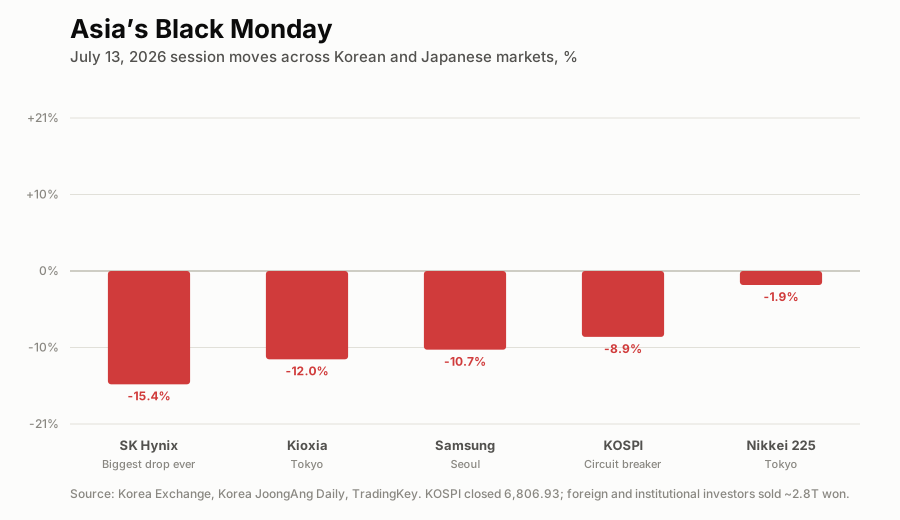
Asia's Black Monday. Note the gap between Korea's memory names and the Nikkei: this was a memory-stock event, not an everything event.
A 9% single-day drop in a major national index is a genuine crash, not a dip. The Korea Exchange halted all KOSPI trading at 1:28pm local time after the index crossed the 8% threshold. When it reopened twenty minutes later, it kept falling.
Three Causes, One Of Which Matters
Cause one: the SK Hynix hangover (mechanical, temporary). Korean investors rode SK Hynix up a blistering rally into its $26.5 billion Nasdaq debut. The ADR listed, the champagne popped, and the local shares became a sell-the-news event with a week's delay. This is the identical profit-taking wave that hit MU after its earnings pop, transplanted to Seoul with more leverage behind it. Mechanical flushes end when the sellers run out, usually within days.
Cause two: the war premium on Korean risk (real, contained). The weekend's US-Iran strikes and the Hormuz standoff pushed oil up and the won down, and a weakening won amplifies foreign selling in Seoul, hence the 2.8 trillion won exodus. Korea imports nearly all its energy; it's structurally the most oil-sensitive developed market on the board. But this factor caps the KOSPI, it doesn't cap NAND prices.
Cause three: the earnings whisper (the one to watch). A local brokerage projected SK Hynix's Q2 operating profit at 60.4 trillion won against a 65 trillion consensus. That's the first analyst suggesting the memory boom's earnings might land BELOW the hype, and it's the only one of the three causes that attacks the actual thesis. One brokerage note is not a broken cycle. But if SK Hynix's real print confirms it, the "memory supercycle" trade takes its first fundamental hit rather than another positioning flush.
Does It Continue?
The honest scorecard says the flush is closer to its end than its beginning. Kioxia is down 32% from its June peak. MU already round-tripped 22%. SNDK sits 18% off its record. SK Hynix just gave back 15% in a session. The complex has now paid back a huge chunk of its 2026 premium while the physical fundamentals (NAND contract prices up 70-75% quarter over quarter, supply sold out into 2027) haven't moved an inch. That divergence between price and physics is what bottoms are made of, and the full buy-or-bail breakdown is in today's memory-stocks piece.
The thing that would change the answer: SK Hynix's actual earnings confirming the 60.4 trillion whisper. Mark it.
The Options Angle
- Don't short the crash you just watched. A 15% one-day drop in the sector leader means the easy downside is spent and borrow costs are spiking. Late shorts fund the bounce.
- Sell puts on MU at the $850 strike, 30 to 45 days out. The Korean flush knocked MU premarket without a single US-specific data point. Fear premium on US memory names is at its richest since the IPO week, and you're being paid panic prices for a level 10% below an already-flushed stock.
- The KOSPI itself is the sharper bounce trade: EWY calls two months out. A 9% national-index drop on profit-taking plus currency stress, with the underlying export economics intact, mean-reverts hard historically. Two months clears the SK Hynix earnings risk and catches the recovery leg.
The One Thing To Remember
Circuit breakers measure panic, not damage to the business. Seoul just had its seventh halt of the year in a market that's still up enormously on the AI-memory boom, and today's sellers were locking in that boom, not calling its end. The end, if it comes, shows up in an earnings line: 60.4 versus 65. Watch that number, not the sirens.
Comments
0 totalNo comments yet. Be the first to drop a take.