Oil Price Forecast This Week: WTI and Brent Stuck in the $70s With Hormuz Still Live
Oil price forecast for the week of July 27: Brent near $78 and WTI in the low $70s despite an Iran war and a declared Hormuz closure. Why crude is a range trade and how to play it.
TL;DR
- Crude enters the week rangebound: Brent around $78 and WTI in the low-to-mid $70s, despite an active Iran war and a formally declared Strait of Hormuz closure.
- April's panic peak was above $126. The market has since priced three escalation cycles with progressively smaller reactions. Fear is decaying on schedule.
- Oil is a $70 to $80 range trade until something physically disrupts barrels. Statements don't move crude; missing cargoes do.
- The Fed matters here too: a hawkish decision strengthens the dollar and pressures oil. Levels and the trade below.
Will Oil Prices Go Up This Week?
The short answer: not without a genuine physical supply disruption. Crude has spent 2026 proving that headlines have stopped working. Iran declared the Strait of Hormuz closed and Brent rose about 3%. Tankers were attacked and the US resumed strikes, and Brent rose about 5%. Each escalation produces a smaller reaction than the last, because the market already priced the apocalypse once in April and got a refund.
Absent barrels actually going missing, expect the range to hold.
The Board
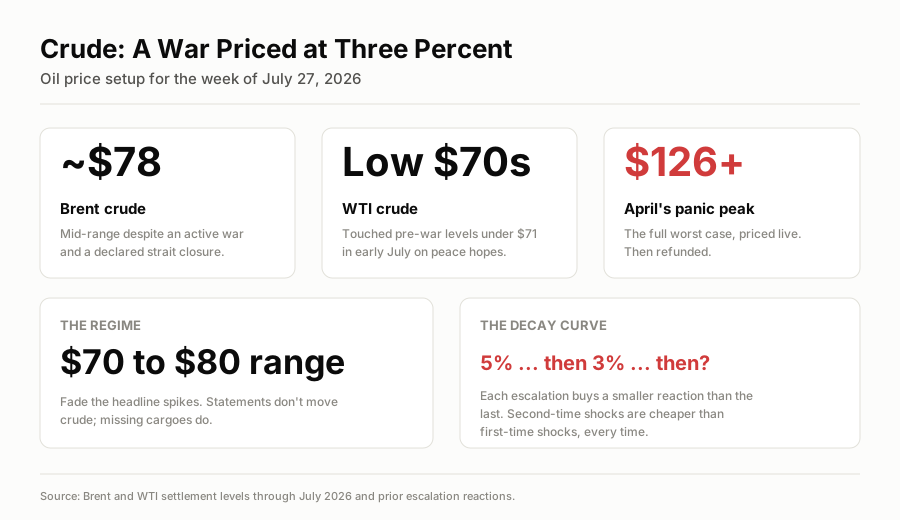
A war, a declared strait closure, and crude sits mid-range. That gap between headline and price is the whole trade.
Why the War Premium Keeps Shrinking
This is the most important dynamic in the oil market right now, and it generalizes beyond crude.
Second-time shocks are cheaper than first-time shocks. April's spike above $126 was the full worst-case scenario priced live, when nobody knew how bad it would get. Then diplomacy happened and crude gave most of it back. Every subsequent escalation starts from a market that has already run the experiment and watched the catastrophe not arrive.
A closure that tankers are transiting is a press release. When Iran declared Hormuz closed, US naval escorts were running vessels through it within hours. Crude settles on physical barrels, not announcements, and the market prices the probability of a genuine self-enforced closure near zero because Iran's own exports flow through the same water.
Fear decays with repetition. The same pattern showed up in gold, in the VIX, and in defense stocks. Markets habituate. We laid out the full case against $100 crude here.
The Levels That Matter
Range top: around $80 Brent. Every headline spike this summer has stalled near here. Selling strength into that zone has been the winning trade repeatedly, which is precisely why it's crowded and dangerous.
Range bottom: near $70-71. Crude touched pre-war levels under $71 in early July on peace hopes. That's where demand support and OPEC discipline have shown up.
The break that changes everything: a sustained move above $85 on confirmed physical disruption. That's not a headline, that's cargoes not arriving. Until then, treat breakouts as fades.
The Fed Angle Most Oil Traders Ignore
Wednesday's decision matters for crude, and not for the obvious reason. A hawkish Fed strengthens the dollar, and oil is priced in dollars, so a stronger dollar mechanically pressures crude even with supply unchanged. A hike also raises the odds of slower growth, which means less demand for barrels down the road.
So the Fed can push oil lower through two channels at once, while the war pushes it higher through one that keeps failing. That asymmetry is why the range has held.
The Options Angle
- Fading headline spikes has worked all year, but it's a crowded trade with a fat tail. Selling a rally that turns out to be the real disruption is how a whole year of small wins gets erased in one session. Define the risk.
- An iron condor on an oil ETF is the structural expression of a range view, collecting premium as long as crude stays boxed in. The risk is exactly the geopolitical gap the range has so far avoided.
- If you want protection against the tail, buy it while it's cheap. Out-of-the-money calls on crude are the market's hurricane insurance, and repeated failed escalations have made them affordable, which is precisely when insurance is worth owning.
- Don't confuse the range holding with the range being safe. Twenty percent of the world's oil still moves through a strait somebody just declared closed.
The One-Line Read
Oil sits in the $70s through a war, a strait closure declaration and repeated escalation because the market priced the apocalypse once in April and has been walking it back ever since, so crude stays a range trade to fade at the edges, with the Fed's dollar effect pushing down and only a genuine physical disruption, not another headline, able to break it higher.
More on Commodities & Crypto
The Sunday Setup
Enjoyed this breakdown? Don’t miss the next market setup.
Get deep-dive analyses delivered to your inbox every Sunday. Free, and built for retail investors.
Comments
0 totalNo comments yet. Be the first to drop a take.