When Does Cisco Report Earnings? August 19 After the Close, With $16.82 Billion Expected
Cisco reports fiscal Q4 2026 after the close on Wednesday August 19. Consensus is $1.17 EPS on $16.82bn revenue. The AI networking order book is what actually decides the reaction.
TL;DR
- Cisco reports fiscal Q4 2026 after the close on Wednesday, August 19.
- Consensus: EPS of $1.17 on revenue of about $16.82 billion, which sits inside Cisco's own guidance of $16.7 to $16.9 billion.
- This is a fiscal Q4, so it comes with full-year results and the first guidance for fiscal 2027. The guide will matter more than the quarter.
- The reason anyone cares about Cisco again is AI networking orders. Every accelerator in a data centre has to be connected to every other one, and that is Cisco's business.
- It reports between Home Depot and Walmart, and a week before Nvidia.
When Does Cisco Report Earnings?
The short answer: after the close on Wednesday, August 19, 2026.
Because this is the final quarter of Cisco's fiscal year, the release carries more than a quarterly update: full-year numbers, and the opening guide for fiscal 2027. Annual guidance from a company this large is a statement about enterprise IT spending generally.
What the Street Expects
| Line | Fiscal Q4 2026 |
|---|---|
| EPS consensus | $1.17 |
| Revenue consensus | ~$16.82B |
| Company guidance | $16.7B to $16.9B |
| FY2026 revenue guide | $62.8B to $63B |
| Report time | After the close, Wednesday August 19 |
| Also carries | FY2026 results and FY2027 guidance |
The Board
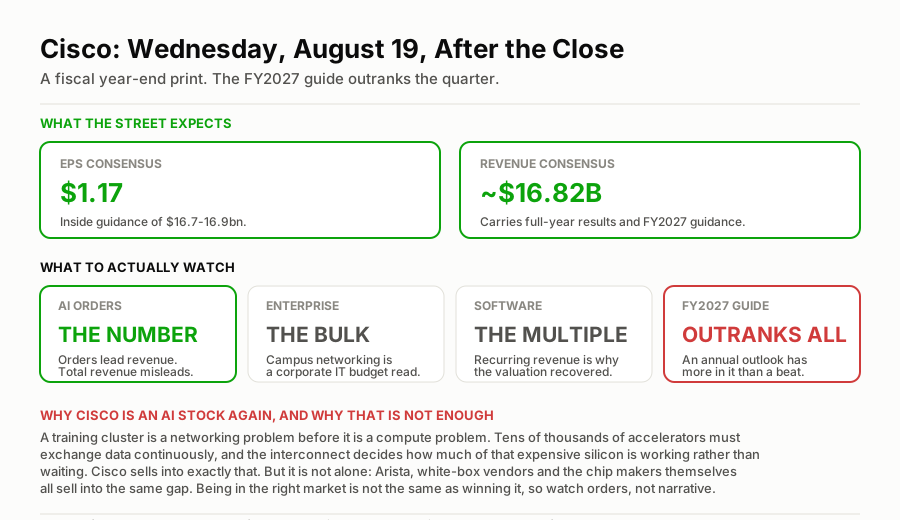
A fiscal year-end print. The FY2027 guide outranks the quarter.
Why Cisco Is an AI Stock Again
For most of the last decade Cisco was a value stock with a dividend and a slow-growing switching business. The AI build-out changed the argument.
A training cluster is a networking problem as much as a compute problem. Tens of thousands of accelerators have to exchange enormous volumes of data continuously, and the interconnect between them determines how much of that expensive silicon is actually working rather than waiting. Data centre networking has gone from a cost line to a bottleneck, and Cisco sells into exactly that.
That is the bull case, and it is real. The bear case is equally real: Cisco is not the only company that noticed. It competes with Arista, with white-box vendors, and increasingly with the chip makers themselves, several of whom sell integrated networking alongside their accelerators. Being in the right market is not the same as winning it.
So the number to look for is AI-related orders, which Cisco has been disclosing, rather than total revenue. Orders lead revenue, and they tell you whether Cisco is capturing the opportunity or merely adjacent to it.
There is a specific target to measure against. In May, Cisco raised its full-year AI infrastructure order outlook to $9 billion, from $5 billion. An 80% increase to an annual target, mid-year, is not a rounding adjustment; it is management saying demand arrived faster than they modelled. August 19 is where they either confirm that $9 billion or quietly walk it back, and that single line will do more to the stock than the EPS number.
The Rest of the Business Still Decides the Print
It is easy to over-index on the AI narrative when it is a minority of revenue.
Enterprise and campus networking remain the bulk of Cisco's business, and they are a direct read on corporate IT budgets. If enterprises are deferring refresh cycles, that shows up here regardless of how many AI orders arrive.
Security and software subscriptions are the margin story and the reason Cisco's multiple has recovered at all. Recurring revenue is what makes a hardware company look like a software company, and any deceleration there attacks the valuation at its foundation. That is precisely what happened to Reddit when its recurring story wobbled: the market punished the structural line and ignored everything else.
The Options Angle
- Cisco is a relatively low-volatility earnings name, and implied moves are usually modest. That makes buying calls or puts an inefficient way to trade it, since you pay event premium for a stock that typically moves a few percent.
- The genuine risk is the annual guide, not the quarter. A fiscal-year-end print is the one occasion Cisco can produce an outsized move, because a full-year outlook has far more information in it than a quarterly beat.
- For income-focused holders, Cisco is close to an ideal covered call underlying: a substantial dividend, moderate volatility, and a share price that rarely gaps violently.
- Cash-secured puts work for anyone who wants the yield at a better entry, and the assignment risk is the kind most investors can live with.
- Reporting after the close is a genuine advantage over the pre-open reporters this month. You get an after-hours session to see the reaction develop before you have to act.
The One-Line Read
Cisco reports fiscal Q4 after the close on Wednesday August 19 against consensus of $1.17 on about $16.82 billion, and because it is the fiscal year-end the first guidance for 2027 outranks anything in the quarter: the reason the stock is interesting again is that AI clusters are a networking problem before they are a compute problem, but being in the right market is not the same as winning it, so watch AI-related orders rather than total revenue, and watch software subscriptions for the recurring line the multiple actually rests on.
More on AI & Semiconductors
The Sunday Setup
Enjoyed this breakdown? Don’t miss the next market setup.
Get deep-dive analyses delivered to your inbox every Sunday. Free, and built for retail investors.
Comments
0 totalNo comments yet. Be the first to drop a take.