Covered Calls Explained: Renting Out Shares You Were Holding Anyway
Be Bob For Once
In the options primer, a guy named Bob sold you the right to buy his shares. A covered call is you becoming Bob.
You already own 100 shares of a stock trading at $200: you bought them, you're holding them, that's just your position. A neighbor thinks the stock is going higher, so he offers you $250 cash today for the right to buy your 100 shares at $220 any time in the next month. You take the $250. It's yours to keep no matter what happens. In exchange, you've promised that if the stock climbs past $220, he gets to take your shares at $220.
That's a covered call. You rented out the upside of shares you were holding anyway, and pocketed rent for it. It's called "covered" because you actually own the shares you're promising: no naked risk, no horror story. Drag the price around and see how it plays out:
At $210 you're up $1,250.
Read The Three Zones On That Chart
The stock drifts (say it lands at $210). Your neighbor's right to buy at $220 is worthless, so he walks. You keep his $250 and your shares, which are now worth $1,000 more than you paid. Monday you sell another call and collect rent again. This is the ending covered-call sellers plan their lives around, and on most stocks in most months, it's the one that shows up.
The stock rips (say it lands at $235). Your neighbor exercises. Your shares leave at $220. You made $20 a share on the stock plus the $250 premium (a tidy $2,250) and then you watched the last $15 of the move go to him. Look at the chart: above $220 your line goes flat. Nothing here lost money. It just capped a win, and caps sting more than losses do in the group chat.
The stock dumps (say it lands at $180). The call dies, the $250 is yours, and it cushions exactly $2.50 a share of a $20 fall. You're still down $1,750. The premium was a rebate, not a parachute, which is the whole point of the next section.
The Rent Is Real. The Armor Is Thin.
Slide the widget hard to the left. Watch the loss deepen with no floor in sight. That's the truth of the covered call that the "monthly income" crowd skates past: the risky part isn't the option, it's the 100 shares. Your max loss tile doesn't say "$250." It says something enormous, because if the stock goes to zero, so do you, minus a small rebate.
A covered call on a stock that drops 30% is a shareholder's loss with a coupon stapled on. Which gives you the one rule that matters: only sell calls on shares you'd be happy to hold with no premium at all. The strategy's dark pattern is premium chasing: hunting whatever ticker pays the fattest call prices. Fat premium is the market screaming danger, and the seller collecting 4% a month on a meme stock is just warehousing crash risk for tip money.
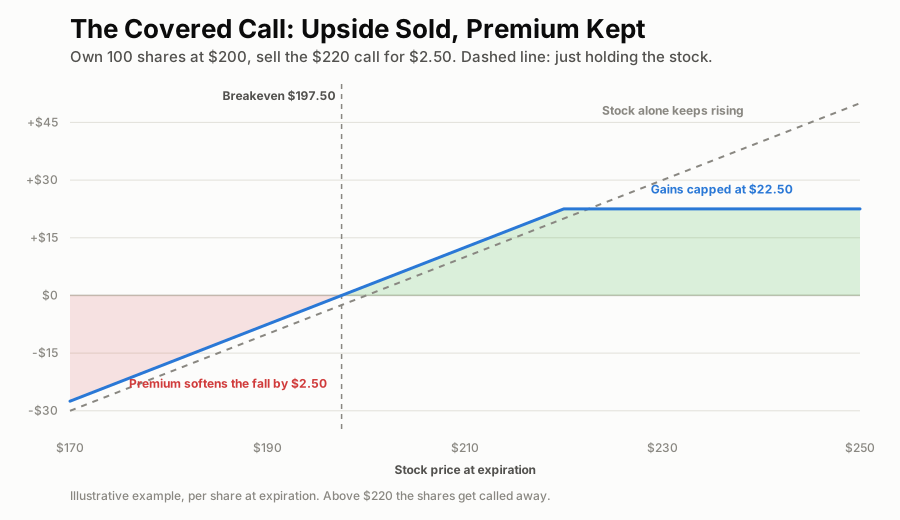
The kink at $220 is the deal: everything above it was sold for $2.50 a share.
The Two-Line Version
- Own 100 shares, sell one call against them, keep the premium no matter what happens.
- Stock stays under the strike: the call dies, and you run it back next month.
- Stock rips past the strike: your shares get called away at that price. You still profit. The moonshot just belongs to someone else.
- The premium is genuine income. It's also thin armor: the real risk is still the stock you're holding.
Strike Selection Is The Dial
Where you set the strike is the whole trade-off. Sell a call close to today's price and the rent is fat, but you get "evicted" often: your shares called away on any decent pop. Sell one far above the price and you keep more upside, but collect less. The boring default, thirty days out and modestly above the current price, is boring for a reason: it balances rent against the odds of losing your shares.
The sweet spot for the whole strategy is the slow grind: quality names moving sideways or gently up, where the calls keep expiring worthless and the rent keeps clearing. In a violent rally it becomes the most annoying trade in finance, capping winner after winner while your buy-and-hold friends do nothing and beat you. Selling upside is, by definition, a bet against your own moonshot (the exact opposite of the chaos-hunting straddle crowd) and it behaves accordingly: brilliant in boredom, expensive in euphoria.
Income Or Cope?
Run on stocks worth owning, at strikes you'd genuinely be happy to sell at, the covered call is one of the few options trades where the tourist and the professional make the same move. The premium is real, the cap is what it costs, and "I got called away with a profit" is the best worst outcome in this business. Just never let the rent talk you into a building you don't want to own.
The Week-Ahead Brief
Don’t miss next week’s setups. Get the Sunday brief.
Latest issue, Oct 11“September CPI, the big banks and TSMC: earnings season starts”
Every Sunday: next week’s earnings dates, Fed days and the trades worth watching, from the same desk that writes the week-ahead hub. Free, built for retail investors.