What Are Call And Put Options (for dummies!) ?
Imagine you have just 100$ to trade...
Apple is trading at $100. Your friend Bob owns 100 shares, and he offers you a deal. Any time in the next month, if you want to, you can buy his 100 shares for $110 each. You don't have to. It's your choice. But to lock in that choice, you have to pay Bob $100 right now, and that $100 is his to keep no matter what happens next.
That's it. That's an option. You just bought the right, but not the obligation, to buy 100 shares at a fixed price, and you paid Bob a fee for it.
Now play it forward:
- Apple ends at exactly $110. Buying from Bob at $110 is no better than buying from the market at $110. You gained nothing on the shares and you're out the $100 you paid him. Small loss.
- Apple ends at $111. You buy 100 shares from Bob at $110 and sell them at $111. That's $100 of gains, which exactly cancels the $100 you paid him. You broke even.
- Apple ends at $112. You buy at $110, sell at $112: that's $2 × 100 = $200 of gains, minus the $100 you paid Bob. You just made $100 of profit. You doubled your money in a month. And it keeps going: every extra $1 Apple climbs above $111 is another $100 in your pocket.
Drag the slider below and watch it happen.
At $112 you're up $100.
The Catch: The Floor Is Also A Trapdoor
Move that slider below $110 and you'll see the number stop falling. It just sits at −$100. That's the whole point of an option: your loss is capped at what you paid. Bob can't come after you for more. If Apple tanks to $80, you simply shrug, don't buy his overpriced shares, and lose the $100 and nothing else.
But "capped" cuts both ways. Anywhere the stock finishes under $110, you lose your entire $100. All of it. Apple could rise from $100 to $109 (a genuinely good month for a shareholder) and your option still expires worthless, because nobody buys shares at $110 when the market sells them for $109. The stock went up and you lost everything. Thats the risk - you can easily multiply your money with the right option at the right price...or lose it all.
Everything Above Already Has A Name
The trade you just did with Bob is the most common option in the world, and every piece of it has a name traders throw around:
- The $110 agreed price is the strike price: the fixed price you get to buy at.
- The $100 you paid upfront is the premium: the cost of the right, and your maximum possible loss.
- The one-month deadline is the expiration date: after it, the deal is dead.
- The $111 mark, where your profit crosses zero, is the break-even price: its the strike plus premium.
- The right to buy at the strike is called a call option.
In real-world trading: you don't buy options from a guy called Bob. You buy them on an exchange from a faceless seller (just like buying shares), and one contract covers 100 shares. The contracts themselves are brought and sold, just like the underlying shares themselves.
Puts: The Same Deal, Pointed Down
A put option is the mirror image. Instead of the right to buy at a fixed price, it's the right to sell at a fixed price. You buy a put when you think a stock is going to fall.
Same setup but put: Apple is at $100, one month expiry, $100 premium, but now your strike is $90, and you own the right to sell 100 shares at $90 no matter how low the stock goes. If Apple craters to $80, you can buy shares at $80 from the market and force the put seller to buy off you at $90, pocketing the difference. Slide it around:
At $85 you're up $400.
Notice the shape flipped. The put pays when the stock drops and dies when the stock holds up. The strike, premium, expiration and break-even all mean the same things; only the direction changed. This is how traders bet on a crash, and how you can buy insurance on shares you own without selling. Buying a put on a stock you own means that if the stock falls, the puts value goes up cancelling out your loss.
The Two-Line Version
- A call is the right to buy at a locked price. A put is the right to sell at a locked price.
- You pay a premium for that right. It's your max loss, and it's also the hurdle the stock has to clear before you make a dime.
- One contract controls 100 shares, which is why small option bets swing like leveraged positions.
- Most options expire worthless. The people selling them know this. Plan accordingly.
The Premium Is The Whole Game
Look again at the break-evens: $111 for the call, $89 for the put. The stock moving your way is not enough. It has to move your way by more than what you paid, before the clock runs out. Two forces decide how big that premium is:
Time. Every day that passes, an option bleeds a little value, because there's less time left for the stock to make its move. Traders call this decay theta. Hold an option through three quiet weeks and you lose money while being, technically, not wrong.
Expected drama. Options on a sleepy utility (stock not expected to move) are cheap. Options on a stock with earnings on Thursday are expensive, because the sellers read the calendar too. This is implied volatility, and it means the market pre-charges you for the move everyone already sees coming.
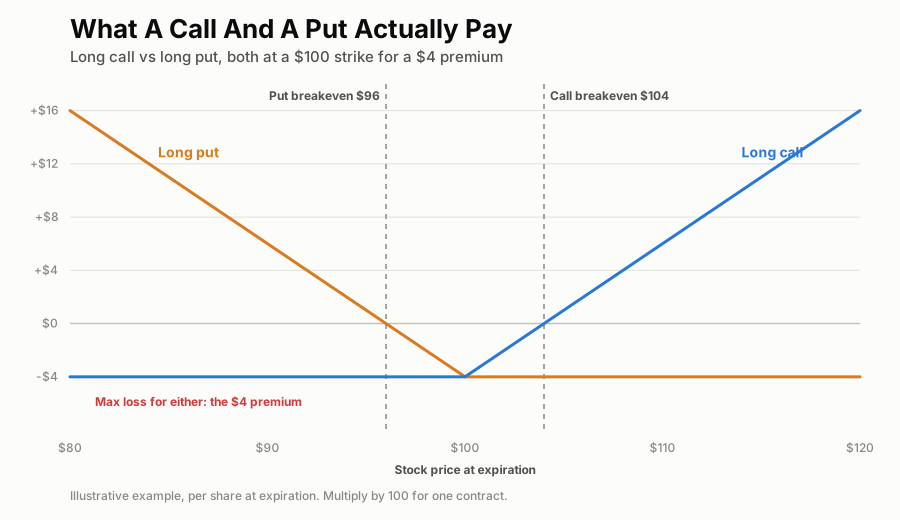
Both trades lose their whole premium in the middle. They just disagree about which direction pays.
So What Do You Actually Do With These?
Single calls and puts are the blunt instrument: pick a direction, pay the toll, pray. The interesting stuff starts when you combine them, and now that you've got the two building blocks you can play with more advances stretegies. Buy a call and a put together and you get a straddle, a bet on chaos in either direction. Spread the strikes apart and it becomes a strangle, the same bet on the cheap. Sell both sides with protection bolted on and you've built an iron condor, a bet that nothing happens at all. Already own the shares? Selling a call against them (Like bob did with his 100 Apple shares) is a covered call, the closest thing options have to collecting rent (you collect free premium money, until the stock goes above your strike by expiry and you have to sell).
Every one of them is just calls and puts wearing a costume. Read the links to learn how each works.
The Week-Ahead Brief
Don’t miss next week’s setups. Get the Sunday brief.
Latest issue, Oct 11“September CPI, the big banks and TSMC: earnings season starts”
Every Sunday: next week’s earnings dates, Fed days and the trades worth watching, from the same desk that writes the week-ahead hub. Free, built for retail investors.