Oil Price Forecast This Week: Brent $87.84 and WTI Near $85, Grinding Back Up From the Iran Pause
Brent closed at $87.84 and September WTI rose 1.29% to near $85, recovering from the post-pause lows. Why crude is climbing without a war headline, and the levels that decide this week.
TL;DR
- Brent closed Friday at $87.84, up 1.11%. September WTI rose $1.08, or 1.29%, to finish near $85, right at the resistance area it has been failing against.
- Both are higher than a week ago, when Brent sat around $86 and WTI around $83 after the US and Iran paused strikes.
- Crude is grinding higher without a fresh geopolitical headline, which makes this a demand and supply story rather than a war-premium story.
- The Brent-WTI spread is about $3, at the narrow end of its normal range, which usually signals US crude is being bid rather than the global barrel weakening.
- Chevron just showed what these prices are worth: profit near $12 billion, nearly quadrupled year over year, and the stock moved about 1%.
Where Crude Closed
| Contract | Friday close | Move |
|---|---|---|
| Brent | $87.84 | up 1.11% |
| WTI (September) | near $85 | up $1.08, or 1.29% |
| Brent-WTI spread | about $3 | narrow end of normal |
The number worth holding onto is the recovery. Crude collapsed from $102 when the US and Iran paused strikes in late July. It found a floor in the low $80s, and it has spent the last week climbing back without anyone firing anything.
The Board
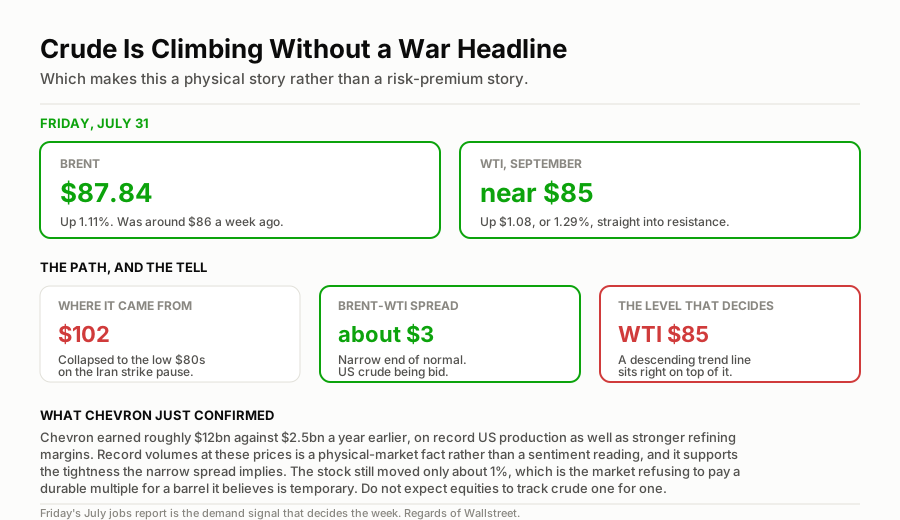
Crude climbing back without a war headline. That makes it a demand story.
Why This Recovery Is Different
The rally from $102 down to the low $80s was a war premium unwinding. Everybody understood it: a risk of supply disruption got priced in, then the risk receded and the price followed.
What is happening now is not that. There has been no fresh escalation, and yet both benchmarks closed the week higher. When crude rises in the absence of a geopolitical catalyst, you are usually looking at one of two things: stronger demand, or tighter physical supply.
The Brent-WTI spread narrowing to about $3 points at the second. That spread is essentially the cost of moving a US barrel to a global buyer, and it compresses when US crude is being bid hard relative to the international benchmark. It is a quieter signal than a headline, and a more durable one.
Chevron's quarter corroborated it. The company earned roughly $12 billion against $2.5 billion a year earlier, on record US production as well as stronger refining margins. Record volumes at these prices is a physical-market fact, not a sentiment reading. Our full read is in the Chevron breakdown.
The Levels That Decide the Week
- WTI at $85 is the line. It closed right underneath a descending trend line and the $85 resistance zone. A clean break above turns the recovery into a trend; another rejection makes the last week a bounce inside a downtrend.
- Brent above $90 would be the confirmation, and it would put the $102 highs back into the conversation.
- Low $80s WTI is the floor that has already held once. That is where buyers stepped in after the pause, so it is the level that matters if this rolls over.
What Could Move It
The July jobs report on Friday August 7 is the biggest scheduled item, because oil is a demand asset and payrolls are a demand signal. A strong labour market means more consumption; a weak one raises recession worries that hit crude harder than most assets. The rest of next week's calendar matters less here.
Any Middle East headline remains the wildcard, and it is the one that gaps rather than drifts. The pause is a pause, not a settlement, and crude reprices on those headlines faster than any other asset.
A stronger dollar caps it. Oil is priced in dollars, so dollar strength is a mechanical headwind. The same rate backdrop that has been holding gold down works against crude too, just less directly.
The Playbook
- Do not chase $85 into resistance. The level has rejected crude before. Buying immediately below a line the market has already respected is paying for a breakout that has not happened.
- The cleanest expression of a crude view is not crude. Oil ETFs that hold futures suffer from roll costs over time, so a multi-month bullish view often works better through producers than through the commodity itself.
- Chevron's 1% reaction to a quadrupled profit is the lesson for the whole sector. The market will not pay a durable multiple for prices it believes are temporary, so do not expect equity upside to track the barrel one for one.
- If you are short, respect the gap risk. Nothing in this market reprices faster or more violently on a weekend headline than crude.
The One-Line Read
Brent closed at $87.84 and September WTI rose 1.29% to near $85, both recovering from the post-pause lows without a single fresh war headline, which makes this a physical story rather than a risk-premium story: the Brent-WTI spread near $3 and Chevron's record US production point at genuine tightness, but WTI is sitting directly under the $85 resistance that has turned it back before, and Friday's payrolls print is the demand signal that decides which way it resolves.
More on Commodities & Crypto
$BTC · 2026-08-01
Bitcoin Price Forecast This Week: BTC $63,892 and Stuck Under $65K for the Fourth Time
$CVX · 2026-07-31
Chevron's Profit Nearly Quadrupled to $12 Billion. The Stock Rose 1%. That Gap Is the Whole Trade
$SLV · 2026-07-26
Silver Price Forecast This Week: Down 52% From the Record, Is Silver Finally Cheap?
The Sunday Setup
Enjoyed this breakdown? Don’t miss the next market setup.
Get deep-dive analyses delivered to your inbox every Sunday. Free, and built for retail investors.
Comments
0 totalNo comments yet. Be the first to drop a take.