Chevron's Profit Nearly Quadrupled to $12 Billion. The Stock Rose 1%. That Gap Is the Whole Trade
Chevron earned about $12bn in Q2, up from $2.5bn a year ago, with adjusted EPS of $6.06 against $5.57 expected. The stock moved about 1%. Why the market refuses to capitalise a war windfall.
TL;DR
- Chevron earned roughly $12 billion in the second quarter, against $2.5 billion a year earlier. Profit did not grow. It nearly quadrupled.
- Adjusted EPS of $6.06 against $5.57 expected, on record US production and refining margins inflated by the Middle East conflict.
- The stock rose about 1%.
- That gap between a 4x earnings increase and a 1% move is not the market being slow. It is the market telling you it does not believe the price of oil that produced it.
- CEO commentary that supply risks are escalating is a warning dressed as a bull point. Chevron is telling you the windfall came from disruption, and disruption is not a business model.
More on Commodities & Crypto: Why Is Strategy Selling Bitcoin? It Sold 6x More Stock, And Now MSCI Wants MSTR Out →
What Chevron Actually Reported
The scale first, because it is genuinely extraordinary.
| Line | Q2 2026 | Comparison |
|---|---|---|
| Profit | ~$12B | from $2.5B a year earlier |
| Adjusted EPS | $6.06 | versus $5.57 expected |
| US production | Record | |
| Refining margins | Sharply higher | on Middle East supply disruption |
| Stock reaction | About +1% |
An integrated oil major nearly quadrupling quarterly profit is the kind of result that in any other sector produces a violent re-rating. A software company that quadrupled earnings would gap 30%. Chevron got one percent.
The Board
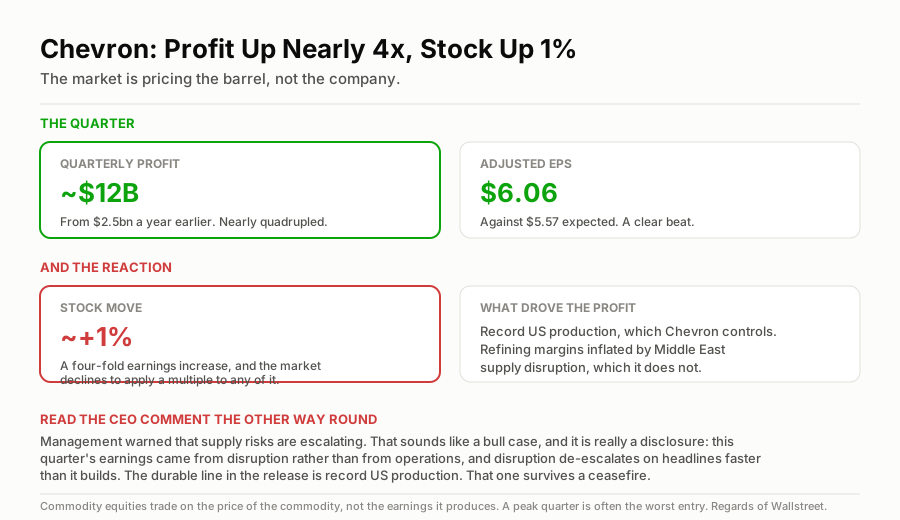
Profit up nearly 4x. Stock up about 1%. The market is pricing the barrel, not the company.
Why the Stock Barely Moved
Because the market is pricing the oil price, not last quarter's earnings, and it knows exactly where those earnings came from.
An energy major's profit is a leveraged function of a commodity it does not control. When crude and refining spreads spike on a geopolitical event, earnings spike mechanically. Nothing about the business improved. Chevron did not invent a product, win a customer or take share. The barrel moved, and Chevron collected.
Equity markets capitalise earnings by applying a multiple, and a multiple is a statement about durability. The market is refusing to apply a normal multiple here because it does not think this level of profitability persists. It is treating the quarter as a one-off cash transfer, not as evidence of a higher earnings base.
That is why the P/E on energy majors looks permanently absurd at cycle peaks. Investors can do the arithmetic fine. They just know the denominator is temporary.
The War Trade, Priced Out in Full
This quarter is the closing chapter of a story this site has been following since the conflict began, and it is worth tracing because the market's behaviour has been consistent throughout.
When the Strait of Hormuz closed and oil rose 3%, the reasonable expectation was an energy melt-up. It did not really arrive. We asked at the time why there was no $100 oil, and the S&P shrugged the whole thing off on its way to a record.
The market's judgement then was that the disruption would be contained and temporary. Chevron's $12 billion is the evidence that the disruption was real. The 1% move is the evidence that the market still thinks it is temporary.
Both of those can be true, and they are. The profits happened. The market simply declines to pay a durable multiple for them.
The CEO Comment Everyone Will Misread
Chevron's chief executive warned that supply risks are escalating.
That reads as a bull case. Escalating supply risk means higher prices means higher profits, and a management team saying so out loud sounds like guidance.
Read it the other way round. The CEO is confirming that this quarter's earnings were produced by supply disruption, not by operational improvement or structural demand. He is telling you the source of the windfall, and by implication its fragility. Supply risk that escalates can also de-escalate, and it does so on headlines rather than fundamentals, usually faster than it built.
The genuinely durable line in the release is a different one: record US production. That is volume Chevron controls, from assets it owns, that keeps producing whatever happens in the Gulf. It is the part of this quarter that survives a ceasefire.
Is Chevron Stock a Buy?
Our answer: yes for income, no for the war.
The case for owning it. Record US production is a real, controllable asset base. Integrated majors are structurally hedged: when crude falls, refining margins often improve, which is the point of owning the whole chain. Chevron is generating enormous cash at current prices, and energy remains the sector with the least exposure to the AI capex question that is currently deciding the rest of the market. In a week where Alphabet, Meta and Amazon all showed compressed cash conversion, a business drowning in free cash flow is a genuine diversifier.
The case against. You are buying peak-cycle earnings produced by a geopolitical event with no known duration. If the conflict de-escalates, crude falls, refining spreads normalise, and the $12 billion quarter becomes the comparison that every subsequent quarter fails to beat. That is the trap in commodity equities: the best-looking quarter is frequently the worst entry point.
Our read: own Chevron for the dividend, the balance sheet and the production growth, at a size you would hold through a 30% drawdown in crude. Do not own it because of the war. The 1% reaction is the market pricing that distinction correctly, and it is usually right about this.
The Options Angle
- Post-earnings implied volatility deflates, so buying calls on a continuation now means paying event premium for news the tape has already absorbed and declined to extrapolate.
- For holders, a covered call is unusually well suited here. The market has just told you it will not pay up for these earnings, which means capping upside costs you less than it normally would, and you keep the dividend.
- Cash-secured puts are the coherent way to build a position, because they get you paid to wait for the de-escalation dip that would make the entry sensible.
- Do not use options to express a view on the conflict. Geopolitical headlines arrive outside market hours, gap through strikes, and are the single worst thing to hold short-dated premium against.
The One-Line Read
Chevron nearly quadrupled quarterly profit to about $12 billion with adjusted EPS of $6.06 against $5.57 expected, on record US production and refining margins inflated by Middle East disruption, and the stock moved roughly 1%: that gap is the market declining to capitalise earnings it believes are borrowed from a conflict, which makes this a stock to own for the production and the cash flow and emphatically not for the war that produced the headline.
Next up:Fed decision, tomorrow →
More on Commodities & Crypto
Updated Every Saturday
The Week Ahead
Every earnings date, Fed event and setup for the current trading week, on one page.
Refreshed Weekly
Earnings Calendar
Who reports next, when, and what consensus and the whisper expect.
The Week-Ahead Brief
Don’t miss next week’s setups. Get the Sunday brief.
Latest issue, Sep 7“Week ahead in the stock market...”
Every Sunday: next week’s earnings dates, Fed days and the trades worth watching, from the same desk that writes the week-ahead hub. Free, built for retail investors.