When Does Novo Nordisk Report Earnings? August 5, Five Days After Losing Its Biggest Non-Obesity Drug
Novo Nordisk reports Q2 2026 before the open on Wednesday August 5, days after the ZEUS trial failed. Full-year guidance is for adjusted sales to fall 4% to 12%. What oral Wegovy must show.
TL;DR
- Novo Nordisk reports Q2 2026 before the open on Wednesday, August 5.
- It reports five days after the ZEUS trial failed. On July 31, ziltivekimab did not reduce major adverse cardiovascular events against placebo, and the stock fell sharply: about 7.3% on the Copenhagen line and closer to 10% in some reports, with roughly $30 billion of market value erased. The NVO ADR closed $47.08.
- Full-year 2026 guidance, raised at Q1, is for adjusted sales growth of −4% to −12% and adjusted operating profit growth of −4% to −12% at constant currencies. This is a shrinking company that just got less optionality.
- The one thing going right is oral Wegovy, which delivered DKK 2.26 billion (about $353.6 million) in its first US quarter on roughly 1.3 million prescriptions, about double the DKK 1.16 billion analysts expected.
- Q2 is historically Novo's worst print. The last two fell 6.7% and 5.4% on the day.
When Does Novo Nordisk Report Earnings?
The short answer: before the open on Wednesday, August 5, 2026.
It is the biggest obesity data point of a three-part week. Eli Lilly reports the same morning and Pfizer, whose entire growth case now rests on a $10 billion obesity acquisition, reported the day before. Three readings on the same market inside 36 hours, and Novo's is the one arriving in the worst mood.
A Note on the Consensus Numbers
We are not publishing a Q2 revenue consensus for Novo, and the reason is worth saying out loud.
The most widely syndicated figure available, DKK 76.438 billion representing 12.3% growth from DKK 68.06 billion, is from last year's preview, for the quarter ended June 2025. It is being recirculated as though it applies to this print. It also fails the simplest possible check: a company guiding full-year adjusted sales to fall 4% to 12% cannot be expected to grow 12.3% in a quarter. Analyst EPS estimates in circulation range from DKK 5.02 to DKK 6.11 and are not reconcilable with each other.
So the honest position is this: the reliable numbers for Wednesday are the ones Novo published itself, which are the guidance range and the Q1 product lines below. Trade those.
What Novo Has Actually Told You
| Line | Guidance or last reported | Note |
|---|---|---|
| FY26 adjusted sales growth | −4% to −12% at CER | raised from −5% to −13% |
| FY26 adjusted operating profit growth | −4% to −12% at CER | raised from −5% to −13% |
| Oral Wegovy, Q1 2026 | DKK 2.26B (~$353.6M) | about 2x the DKK 1.16B expected |
| Oral Wegovy prescriptions | ~1.3M in Q1, over 2M cumulative | strongest US GLP-1 volume launch on record |
| Injectable Wegovy, Q1 2026 | DKK 18.2B, up 12% | |
| Ozempic, Q1 2026 | down 8% | above expectations |
| Wegovy share of new US GLP-1 scripts | 65% | |
| NVO ADR, July 31 close | $47.08 | 52-week range $35.12 to $64.16 |
| Options implied move | ~8% | quoted against a spot near $48.77 |
Read the guidance range properly before anything else. Novo raised it, and it still describes a company whose sales fall by up to 12%. Both halves of that sentence are true and most coverage picks one.
The Board
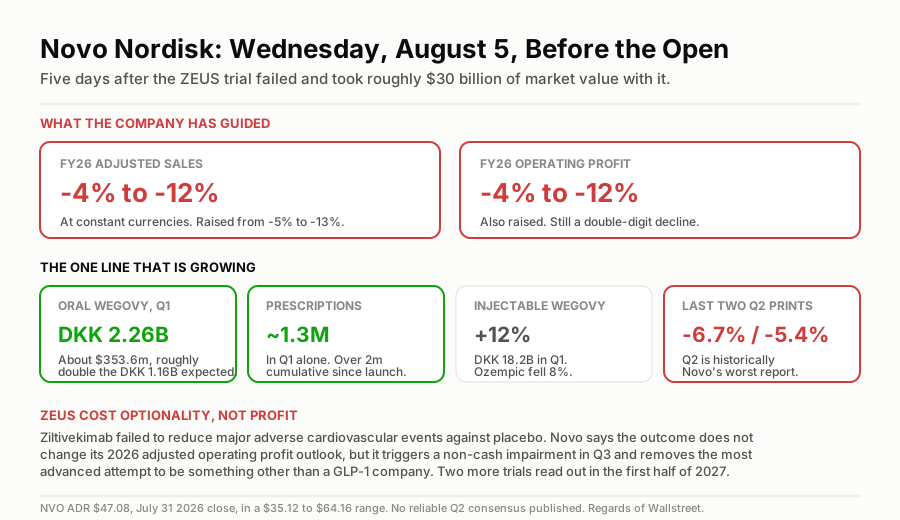
Guidance raised, and still describing a double-digit decline. The pill is the only line growing.
What ZEUS Actually Cost
On July 31, Novo reported that the Phase 3 ZEUS trial of ziltivekimab, an anti-inflammatory antibody, failed to reduce major adverse cardiovascular events (cardiovascular death, non-fatal heart attack, non-fatal stroke) against placebo in patients with atherosclerotic cardiovascular disease, chronic kidney disease and systemic inflammation.
Size the damage accurately, because the market's first reaction and the actual cost are different things.
- What it does not cost: Novo said explicitly that the outcome does not change its adjusted operating profit outlook for 2026. There is no revenue in the guidance from a drug that was not yet approved.
- What it does cost in the accounts: a non-cash impairment charge in the third quarter. That is Q3's problem, not Wednesday's, but management will be asked to size it and any number they give is new information.
- What it really cost: the diversification story. Ziltivekimab was the most advanced attempt to make Novo something other than a GLP-1 company. The failure does not make the obesity business worse. It makes the obesity business everything.
Two ziltivekimab trials continue, one in heart failure and one following acute heart attack, with results expected in the first half of 2027. Those are live shots, not dead ones, and they are also eighteen months away.
The Only Line That Matters on Wednesday
Oral Wegovy.
Novo has spent two years losing the injectable war on narrative, and the pill is the one asset where it is genuinely ahead. The Q1 numbers were not marginally good, they were double what the street modelled: DKK 2.26 billion against DKK 1.16 billion expected, on roughly 1.3 million prescriptions, described as the strongest GLP-1 volume launch in US history. Cumulative prescriptions have passed two million, and the Wegovy brand is taking 65% of new US prescriptions in the category.
Here is why the pill matters more than the percentages suggest. An oral GLP-1 removes the two barriers that cap the injectable market: manufacturing capacity, because tablets are vastly easier to scale than sterile injectables, and patient resistance to needles, which is a larger constraint than clinicians expected.
Three things to check in the Q2 line:
- The sequential trajectory. A launch quarter is not a trend. Q2 is the first quarter where refills matter as much as new starts, so the number tells you about persistence rather than curiosity.
- Whether it is additive or cannibalising. If oral Wegovy grows while injectable Wegovy and Ozempic shrink faster than they did, Novo is moving patients between its own products at a lower price. Read the three lines together, never one alone.
- The ex-US timeline. Geographic expansion beyond the US is targeted for the latter part of 2026, subject to approvals. Any firming of that date is worth more than a beat.
Is Novo Nordisk a Buy After a 10% Drop?
Not yet, and the reason is that the two things wrong with Novo were not fixed by the price falling.
At $47.08 the ADR sits in the lower part of a $35.12 to $64.16 52-week range, and Novo is genuinely cheap against its own history. But cheap against history is the wrong frame for a company guiding sales down as much as 12% while a competitor takes share.
The bull case is real and it is a single product. Oral Wegovy doubled expectations in its first quarter, addresses a market limited by manufacturing and needle aversion, and Novo owns the brand with 65% of new US scripts. If the pill compounds through the ex-US launches, the 2027 numbers look nothing like the 2026 guidance, and you are buying that at a depressed multiple with a broken narrative attached.
The bear case is that this is now a one-product company by accident. ZEUS was the diversification, and it failed. Management is under explicit pressure to buy growth, which historically means paying up at exactly the wrong moment. Meanwhile Eli Lilly reports the same morning and every share Lilly takes is a share Novo has to win back with price.
The verdict: wait for the Q2 pill number. It is the single fact that decides whether this is a value opportunity or a value trap, it arrives on Wednesday morning, and there is no reason to guess it 24 hours early.
The Options Angle
- Q2 is Novo's worst print of the year, historically. The last two second quarters fell 6.7% and 5.4% on the day. That is a pattern, not a coincidence, and it is the calibration anchor for anything you do here.
- Options price a move of about 8%, quoted against a spot near $48.77 rather than the $47.08 July 31 ADR close, so treat it as approximate. That is elevated for a good reason after a 10% single-day trial failure, which cuts against selling premium and also makes buying it expensive. There is no free structure here.
- If you want the pill without the print, the cleanest expression is a call spread expiring after Wednesday, sized so the loss is the premium and the win is the guidance raise.
- Covered calls on a stock down this much are the classic trap: you cap the recovery that is the only reason to own it. We made that same argument about Pfizer the day before.
- Live option prices could not be sourced at the time of writing, so the plays below are quoted against the July 31 ADR close and the historical Q2 reactions.
Trade log
| # | Stance | Structure | Strikes and expiry | Cost or credit | Spot at writing | Implied move | Breakeven |
|---|---|---|---|---|---|---|---|
| 1 | Bullish, defined risk | Call spread | ~$50 / ~$55, first monthly after Aug 5 | debit not sourced | $47.08 (Jul 31, 2026 ADR close) | ~±8%; last two Q2s moved −6.7% and −5.4% | needs a close above ~$50, +6.2% |
| 2 | Pass | Buying the shares before the print | n/a | n/a | $47.08 | ~±8% | scored against the Aug 5 close |
| 3 | Pass | Short premium into the print | any | credit not sourced | $47.08 | ~±8% | two consecutive Q2s cleared 5% |
Rows 2 and 3 are logged as passes so they get scored. We are telling readers to skip a beaten-down large cap for one day. If Novo gaps higher on Wednesday, row 2 was wrong and the scorecard will say so.
The One-Line Read
Novo Nordisk reports before the open on Wednesday August 5, five days after the ZEUS trial failed and took roughly $30 billion of market value with it, against full-year guidance that was raised in May and still calls for adjusted sales to fall between 4% and 12%: the failure costs nothing in this year's profit and everything in optionality, because it turns a company that was trying to be more than GLP-1 back into a company that is only GLP-1, and the single number that decides whether that is a disaster or a discount is the second-quarter revenue line for the Wegovy pill.
More on Earnings
$PPL · 2026-08-02
When Does PPL Report Earnings? August 7, and It Is the Boring Way to Own the Data Centre Power Trade
$TTWO · 2026-08-02
When Does Take-Two Report Earnings? August 7, and the Quarter Being Reported Barely Matters
$LNG · 2026-08-02
When Does Cheniere Report Earnings? August 6, and Its Last Quarter Was a $3.5 Billion Loss and a Guidance Raise
The Sunday Setup
Enjoyed this breakdown? Don’t miss the next market setup.
Get deep-dive analyses delivered to your inbox every Sunday. Free, and built for retail investors.
Comments
0 totalNo comments yet. Be the first to drop a take.