When Does PPL Report Earnings? August 7, and It Is the Boring Way to Own the Data Centre Power Trade
PPL reports Q2 2026 before the open on Friday August 7. Consensus is $0.35 EPS against full-year guidance of $1.90 to $1.98. Why a regulated utility beats a merchant generator this year.
TL;DR
- PPL Corporation reports Q2 2026 before the open on Friday, August 7, the same morning as the July jobs report.
- Consensus: diluted EPS of about $0.35, up 9.4% from $0.32. Full-year guidance is $1.90 to $1.98, and the street sits at $1.95, up 7.7% on fiscal 2025's $1.81.
- The stock trades around $36.50, paying $0.29 a quarter, or $1.16 a year, for a yield near 3.2%. That is a payout of about 60% of the guidance midpoint.
- PPL is in the data centre power trade too, and almost nobody prices it that way. It has committed $40.4 million to 500 acres in Pennsylvania with Blackstone for potential data centre generation.
- It reports the same morning as Vistra, which is the merchant version of the same bet and sits near its 52-week low. Reading them together is the point.
When Does PPL Report Earnings?
The short answer: before the market opens on Friday, August 7, 2026.
Five companies report pre-market that morning, into an 8:30am payrolls print: PPL, Vistra, Take-Two, Oklo and ACM Research. Three of those five are electricity companies, which tells you what this market has decided matters.
What the Street Expects
| Line | Q2 2026 and the year | Comparison |
|---|---|---|
| Diluted EPS | ~$0.35 | up 9.4% from $0.32 |
| Full-year guidance | $1.90 to $1.98 | |
| Full-year consensus | $1.95 | up 7.7% from $1.81 |
| Quarterly dividend | $0.29, or $1.16 annualised | payout about 60% of the guide midpoint |
| Dividend yield | about 3.2% | |
| Share price | around $36.50 | roughly 18.8x the guide midpoint |
The Board
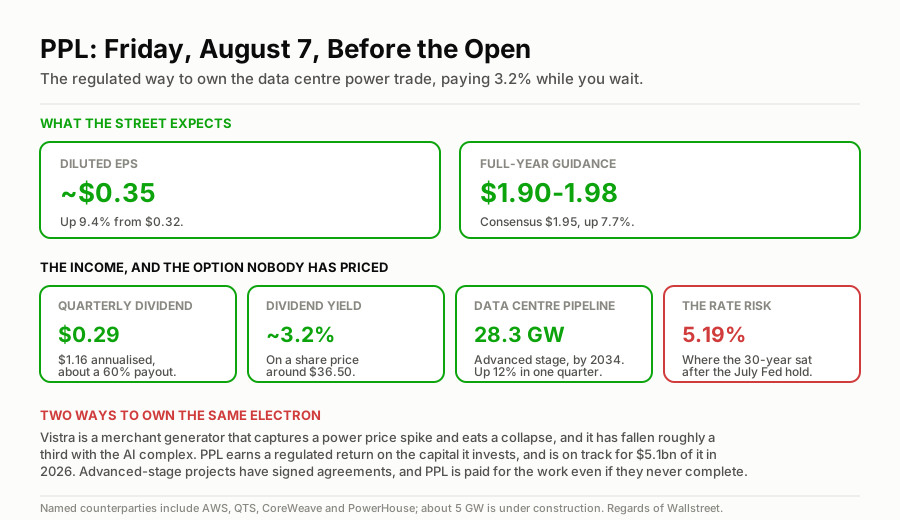
Mid single digit growth, a 60% payout, and a data centre land bank almost nobody has priced.
Two Ways to Own the Same Electron
This is the most useful thing to understand about Friday morning, and it is why PPL and Vistra reporting on the same day is genuinely informative rather than a coincidence.
Both companies benefit if data centres consume enormous amounts of electricity. They benefit in completely different ways, and one of those ways is much safer.
Vistra is a merchant generator. It sells power into competitive markets at whatever the market pays. If demand surges and prices spike, Vistra captures the spike, subject to how much it has already hedged away. If demand disappoints, it eats that too. High beta to the theme in both directions.
PPL is a regulated utility. It earns an allowed return on the capital it invests in the network, set by regulators. If data centres require new transmission, new substations and new generation interconnection, PPL builds them and earns a regulated return on the money it spends. It does not capture a price spike, and it does not suffer a price collapse.
The practical consequence is the one worth internalising. Vistra has fallen roughly a third from its 52-week high as the AI trade was repriced. A regulated utility does not have that exposure, because its earnings do not depend on the power price at all. They depend on how much it is allowed to invest.
So if you believe in electricity demand growth but do not want to underwrite hyperscaler capex forecasts, the regulated version is the position, and it pays you 3.2% while you wait. That is not a more exciting trade. It is a more honest one.
The Blackstone Land Bank
PPL has committed $40.4 million to acquire 500 acres in Pennsylvania alongside Blackstone, for potential data centre power generation.
Size that properly before getting excited. Against a company earning around $1.95 a share, $40.4 million is a rounding error, and it is land, not a plant. This is an option, not a project. It costs almost nothing, it does not appear in guidance, and it does not become material unless and until a hyperscaler signs.
But options on scarce assets are exactly what is valuable right now. The binding constraint on US data centre construction is not chips or capital, it is interconnection: usable land with a viable path to grid connection and generation. PPL's Pennsylvania service territory sits in the middle of the most contested power market in the country. Owning developable acreage there, with Blackstone providing the capital and the tenant relationships, is a cheap claim on a genuinely scarce thing.
What to listen for on Friday: any indication of a counterparty, a timeline, or capital expenditure attached to it. A regulated utility's capital plan is its growth rate, because it earns a return on the plan. An upsized capital plan driven by data centre load is the single most bullish thing PPL can announce, and it would arrive quietly in a slide rather than in a headline.
The Three Things to Watch
1. The capital investment plan, not the quarter. For a regulated utility, EPS growth is a nearly mechanical function of rate base growth. The number that matters is how much PPL intends to spend over the next five years and whether regulators will let it earn on all of it.
2. Load growth in the service territory. Actual megawatt demand growth from large customers, disclosed as a number rather than as an aspiration, is the evidence that the data centre story has arrived in the accounts.
3. Whether the $1.90 to $1.98 range narrows upward. Utilities guide tightly and hitting the guide is the job. A narrowing toward the top is a good quarter. Any suggestion of the bottom half is a problem for a stock owned largely for its predictability.
Is PPL a Buy at a 3.2% Yield?
Yes, as a core income holding, and the case rests on the rate environment more than on the company.
At roughly $36.50 you are paying about 18.8 times the midpoint of guidance for a business growing earnings at 7% to 8% with a 60% payout ratio and a regulated return. That is a fair price rather than a cheap one, and utilities are priced against bond yields more than against their own growth.
Which is the whole risk. The Fed held rates at 3.50% to 3.75% on a 9-3 vote with three members voting to hike, and the 30-year pushed above 5.19% afterward. A 3.2% dividend yield competes directly with a long Treasury paying 5%, and every further leg higher in long yields makes that comparison worse. Utilities are the most rate-sensitive equities in the index and this is not a friendly rate environment.
The bull case: rate base growth from grid investment is the most visible multi-year earnings story in the utility sector, data centre load makes it larger, the dividend is comfortably covered at 60%, and if long yields fall the whole sector re-rates at once.
The bear case: you are buying a 3.2% yield in a market where the risk-free long bond pays more, for a company growing high single digits, whose growth depends on regulators approving spending in a politically sensitive environment where consumer electricity bills are already rising because of data centres. That last point is a real political risk that almost no utility investor is pricing.
The Options Angle
- PPL is one of the lowest-volatility names in the S&P 500 and it prints into a payrolls morning. The earnings event is close to a non-event and the macro event is not, which is an unusual and specific setup.
- Do not sell premium expecting a quiet Friday. Payrolls printed 57,000 against 115,000 expected in June with 74,000 of downward revisions, and a repeat in either direction moves long yields, which moves utilities more than it moves the market.
- At around $36.50, one contract is roughly $3,650 of notional, which makes this one of the few genuinely accessible names on the whole week's calendar for a small account running the wheel.
- A cash-secured put on a utility you would happily own for the yield is the textbook legitimate use of the structure, because the assignment outcome is the outcome you wanted.
- Live option prices could not be sourced at the time of writing, so the plays below are quoted against the late-July price.
Trade log
| # | Stance | Structure | Strikes and expiry | Cost or credit | Spot at writing | Implied move | Breakeven |
|---|---|---|---|---|---|---|---|
| 1 | Bullish, income | Cash-secured put | ~$35 strike, first monthly after Aug 7 | premium not sourced | ~$36.50 (late July 2026) | not sourced | assigned below $35, −4.1% |
| 2 | Income, holders only | Covered call | ~$39 strike, first monthly after Aug 7 | credit not sourced | ~$36.50 | not sourced | caps upside above +6.8% |
| 3 | Pass | Short strangle held through payrolls | any | credit not sourced | ~$36.50 | not sourced | macro gaps through strikes |
Row 3 is logged as a pass so it gets scored. A quiet stock is not the same as a quiet day, and a payrolls surprise moves rate-sensitive equities regardless of what they reported an hour earlier.
The One-Line Read
PPL reports before the open on Friday August 7 against consensus of $0.35 and full-year guidance of $1.90 to $1.98, numbers so predictable they are almost not worth trading, and that predictability is the entire argument: it reports the same morning as Vistra, which owns the identical data centre electricity thesis in merchant form and has fallen a third doing it, and PPL offers the regulated version of the same demand growth plus a 3.2% yield, plus a $40.4 million option on 500 Pennsylvania acres with Blackstone that costs nothing and appears in no forecast.
More on Earnings
$TTWO · 2026-08-02
When Does Take-Two Report Earnings? August 7, and the Quarter Being Reported Barely Matters
$LNG · 2026-08-02
When Does Cheniere Report Earnings? August 6, and Its Last Quarter Was a $3.5 Billion Loss and a Guidance Raise
$FISV · 2026-08-02
When Does Fiserv Report Earnings? August 6, and It Trades at Under Seven Times Its Own Guidance
The Sunday Setup
Enjoyed this breakdown? Don’t miss the next market setup.
Get deep-dive analyses delivered to your inbox every Sunday. Free, and built for retail investors.
Comments
0 totalNo comments yet. Be the first to drop a take.