When Does Cheniere Report Earnings? August 6, and Its Last Quarter Was a $3.5 Billion Loss and a Guidance Raise
Cheniere Energy reports Q2 2026 pre-market on Thursday August 6. Full-year adjusted EBITDA guidance is $7.25bn to $7.75bn. Why the GAAP net income line is close to meaningless here.
TL;DR
- Cheniere Energy reports Q2 2026 before the market opens on Thursday, August 6.
- Full-year 2026 guidance was raised at Q1 to Consolidated Adjusted EBITDA of $7.25bn to $7.75bn and Distributable Cash Flow of $4.75bn to $5.25bn, both up $500 million at each end.
- Last quarter Cheniere reported a $3.5 billion net loss and raised guidance in the same release. Those are not contradictory. The loss was $4.8 billion of non-cash mark-to-market derivative charges on IPM contracts. Adjusted net income was about $1 billion.
- This is the clearest example on the calendar of a headline number you must ignore. For Cheniere, GAAP net income measures gas price movements, not the business.
- Consensus for Q2 is around $3.03 a share on revenue of about $4.90 billion. The stock quoted around $265 at the start of August, inside a 52-week range of $186.20 to $300.89.
When Does Cheniere Report Earnings?
The short answer: before the market opens on Thursday, August 6, 2026.
Cheniere joins Datadog, Fiserv and ConocoPhillips in the pre-market block, giving Thursday morning two energy prints inside a couple of hours and one of the better cross-reads on the whole hydrocarbon complex this week.
What Cheniere Has Told You
| Line | Guidance or last reported | Note |
|---|---|---|
| FY26 Consolidated Adjusted EBITDA | $7.25B to $7.75B | raised from $6.75B to $7.25B |
| FY26 Distributable Cash Flow | $4.75B to $5.25B | raised from $4.35B to $4.85B |
| Q1 2026 revenue | ~$5.9B | record exports |
| Q1 2026 Consolidated Adjusted EBITDA | ~$2.3B | |
| Q1 2026 Distributable Cash Flow | ~$1.7B | |
| Q1 2026 GAAP net loss | −$3.5B | includes $4.8B of non-cash derivative losses |
| Q1 2026 adjusted net income | ~$1B | |
| 2026 production target | 51 to 53 million tonnes | raised by one million tonnes |
| Q2 consensus | ~$3.03 on ~$4.90B revenue |
The Board
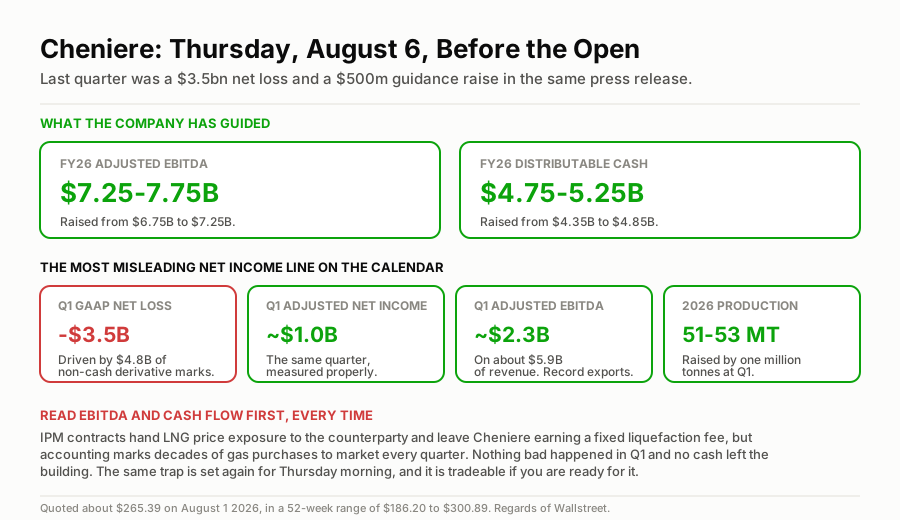
A $3.5 billion GAAP loss and a $500 million guidance raise in the same press release. Both are true.
The Most Misleading Net Income Line in the S&P 500
This deserves a proper explanation, because it will happen again on Thursday and most coverage will get it wrong twice a year forever.
Cheniere signs Integrated Production Marketing (IPM) agreements: long-term contracts under which it buys natural gas from producers at a price linked to international LNG benchmarks rather than to US gas. That is deliberate. It passes the LNG price exposure through to the counterparty and leaves Cheniere earning a fixed liquefaction fee, which is the stable, contracted, boring cash flow the whole company is built on.
Accounting requires those contracts to be marked to market every quarter. When international gas prices move, the estimated future value of decades of gas purchases moves with them, and the entire change lands in one quarter's income statement as a non-cash gain or loss.
In Q1 2026 that produced $4.8 billion of unrealised, non-cash derivative losses and a headline net loss of $3.5 billion, in a quarter with record export volumes, $2.3 billion of Consolidated Adjusted EBITDA, and roughly $1 billion of adjusted net income.
Nothing bad happened. No cash left the building. Cheniere expects these marks to unwind over time and reverse into gains as the corresponding fixed liquefaction fees are earned.
Two things follow from this, and both are practical:
- Read Consolidated Adjusted EBITDA and Distributable Cash Flow first, every time. They are the numbers Cheniere guides, the numbers management is paid on, and the numbers that fund the dividend and the buyback.
- Be very careful with any consensus EPS figure for this company. Analyst estimates for Cheniere are compiled on an adjusted basis that is not comparable to the GAAP net income the company also guides, which is why you can find a full-year net income range in the hundreds of millions sitting next to per-share estimates implying billions. Those two are not reconcilable, and we are not publishing a full-year EPS number as though they were.
This is the same discipline we applied to Merck, where a consensus loss of $0.26 is an acquisition charge rather than a business problem. Read what is inside the number, in both directions.
The Three Things to Watch
1. Whether the guidance is raised again. Cheniere raised both EBITDA and DCF by $500 million at Q1, driven by a one million tonne production increase, higher marketing margins and locked-in optimisation gains. A second raise would put the full year comfortably above the original plan and confirm that Corpus Christi Stage 3 is delivering ahead of schedule.
2. Production against the 51 to 53 million tonne target. LNG is a volume business first. A liquefaction train either runs or it does not, and the tonnage number is the least ambiguous statistic the company publishes.
3. Capital allocation between growth and returns. Midscale Trains 8 and 9 are advancing toward 2028 completion, which is real capital going into the ground. The tension in this equity is whether Cheniere is a cash-return story or a construction story, and the split between buybacks, dividends, debt paydown and capex is where management answers that.
Is Cheniere a Buy Around $265?
Yes, as an infrastructure holding, and specifically not as an energy trade.
At roughly $265, well inside a 52-week range of $186.20 to $300.89, you are buying $4.75bn to $5.25bn of guided distributable cash flow from long-term contracts with investment-grade counterparties. The distinguishing feature of Cheniere against a producer like ConocoPhillips is that Cheniere gets paid a fee for liquefaction whether the gas price is high or low. It is closer to a toll road than to an oil well, and it should be valued like one.
The bull case: contracted cash flow, a raised production target, Stage 3 fully online, and a structural global demand story for US gas exports that has years of contracted visibility. In a market repricing everything on a discount rate, a business with contracted revenue and a growing cash return is genuinely defensive.
The bear case: enormous capital intensity, construction risk on Trains 8 and 9 running to 2028, a balance sheet built on project debt, and a share price that has already run a long way from the $186 low. You are also buying a company whose reported earnings will keep swinging by billions on gas price marks, which means periodic headlines that make the stock look broken when it is not. That is a real cost if it panics you into selling.
The Options Angle
- The single most useful thing about Cheniere is that the earnings headline can be violently wrong. A $3.5 billion GAAP loss headline hitting the tape at 6:00am generates exactly the kind of algorithmic and retail selling that a prepared reader can trade against. That is the setup, and it repeats.
- This is not a reason to buy short-dated calls. It is a reason to have a bid ready and to read the adjusted EBITDA line before reacting to anything.
- At about $265, one contract is roughly $26,500 of notional, which puts covered calls out of reach for smaller accounts. Fractional options do not exist, so if you cannot hold 100 shares you cannot write the call, the same constraint that applies to Caterpillar and AppLovin this week.
- For holders, a covered call is more defensible here than in most names on this calendar, because the upside case is a slow compounding of contracted cash flow rather than a re-rating gap.
- Live option prices could not be sourced at the time of writing, so the plays below are quoted against the quote at the start of August.
Trade log
| # | Stance | Structure | Strikes and expiry | Cost or credit | Spot at writing | Implied move | Breakeven |
|---|---|---|---|---|---|---|---|
| 1 | Income, holders only | Covered call | ~$285 strike, first monthly after Aug 6 | premium not sourced | ~$265.39 (quoted Aug 1, 2026) | not sourced | caps upside above +7.4% |
| 2 | Opportunistic | Limit bid below the market on a GAAP-loss headline | ~$248, day of the print | n/a | ~$265.39 | not sourced | fills only on a −6.5% knee-jerk |
| 3 | Pass | Long straddle into the print | at-the-money | debit not sourced | ~$265.39 | not sourced | the cash numbers are already guided |
Row 3 is logged as a pass so it gets scored. We are saying a company that has already guided both of its key metrics is unlikely to move enough to pay for a straddle, and that call loses if the headline loss panics the tape harder than we expect.
The One-Line Read
Cheniere reports before the open on Thursday August 6 against raised full-year guidance of $7.25 to $7.75 billion of Consolidated Adjusted EBITDA and $4.75 to $5.25 billion of Distributable Cash Flow, and the only thing you have to get right is which number to read: last quarter's headline was a $3.5 billion net loss produced entirely by $4.8 billion of non-cash marks on contracts specifically designed to hand gas price risk to somebody else, while the business itself set an export record and earned about $1 billion of adjusted net income, and that same trap is set again for Thursday morning.
More on Earnings
$PPL · 2026-08-02
When Does PPL Report Earnings? August 7, and It Is the Boring Way to Own the Data Centre Power Trade
$TTWO · 2026-08-02
When Does Take-Two Report Earnings? August 7, and the Quarter Being Reported Barely Matters
$FISV · 2026-08-02
When Does Fiserv Report Earnings? August 6, and It Trades at Under Seven Times Its Own Guidance
The Sunday Setup
Enjoyed this breakdown? Don’t miss the next market setup.
Get deep-dive analyses delivered to your inbox every Sunday. Free, and built for retail investors.
Comments
0 totalNo comments yet. Be the first to drop a take.