When Does Pfizer Report Earnings? August 4, and the Dividend Has Not Moved for Four Quarters
Pfizer reports Q2 2026 on Tuesday morning August 4, analyst call at 10:00am ET. Consensus is $0.68 EPS on $14.45bn, down 1.4%. Why a frozen dividend and a 6.9% yield say the same thing.
TL;DR
- Pfizer issues its Q2 2026 performance report on Tuesday morning, August 4, with the analyst webcast at 10:00am ET.
- Consensus: adjusted EPS of about $0.68, down 12.8% from $0.78, on revenue of about $14.45 billion, down 1.4%.
- Full-year guidance of $59.5bn to $62.5bn of revenue and $2.80 to $3.00 of adjusted EPS was reaffirmed after Q1. The street sits at $2.96, at the top of the range.
- The quarterly dividend has been held at $0.43 for four consecutive quarters. On a $25.01 close that is a yield near 6.9%, and the freeze and the yield are saying the same thing.
- The bet that decides the next decade is Metsera, the $10 billion obesity acquisition completed in November 2025, whose monthly injectable produced up to 11% weight reduction over 28 weeks in mid-stage data.
When Does Pfizer Report Earnings?
The short answer: Tuesday, August 4, 2026. The performance report is issued that morning and the webcast with analysts starts at 10:00am ET.
That is half an hour after the US open, which is unusual and worth planning around: the numbers are public before the bell but the explanation arrives after it.
It is the second of two big pharmaceutical prints that morning. Merck reports before the open the same day, which makes Tuesday a genuine read on large-cap pharma rather than a single-company event.
What the Street Expects
| Line | Q2 2026 consensus | Comparison |
|---|---|---|
| Adjusted EPS | ~$0.68 | down 12.8% from $0.78 |
| Revenue | ~$14.45B | down about 1.4% |
| Full-year revenue guide | $59.5B to $62.5B | reaffirmed after Q1 |
| Full-year adjusted EPS guide | $2.80 to $3.00 | street at $2.96 |
| Quarterly dividend | $0.43 | unchanged for four quarters |
| July 31 close | $25.01 | yield about 6.9% |
| Options implied move | ~3% |
Pfizer has beaten the EPS consensus in each of the last four quarters, and Q1 2026 beat on the back of the non-COVID portfolio growing 7% year over year.
Do the arithmetic on the guide before Tuesday. Four quarters at the expected $0.68 would total $2.72, which is below the bottom of the company's own $2.80 to $3.00 range. This is a back-half-weighted year, as Pfizer's years usually are once respiratory vaccine season arrives. That means a soft Q2 is not by itself evidence the guide is at risk, and it also means the Q3 commentary carries more weight than usual.
The Board
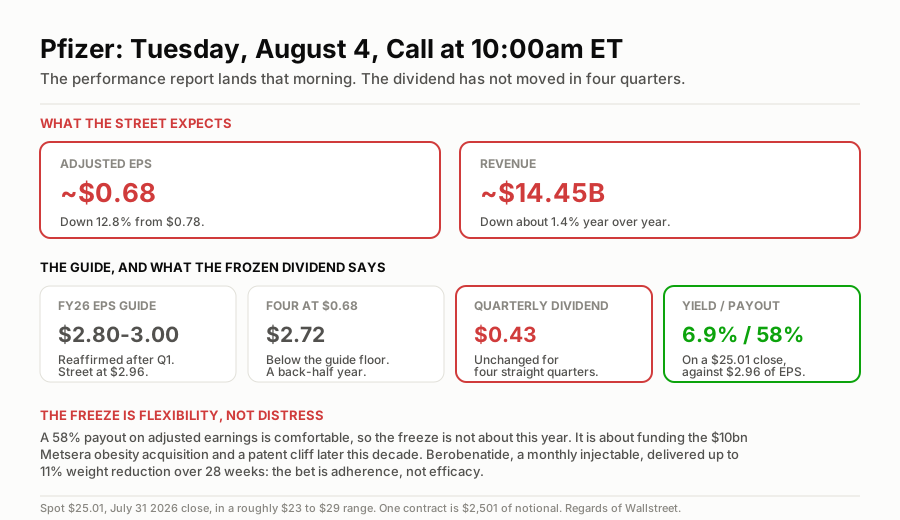
A dividend frozen for four quarters and a 6.9% yield. Those two facts are the same fact.
What a Frozen Dividend Actually Says
Pfizer's dividend is the reason a large share of its register owns the stock at all. It has been raised more or less annually for decades, and the raise is an event that income investors calendar.
It has now been held at $0.43 for four consecutive quarters.
Set out the coverage honestly, with the denominators attached, because "is the dividend safe" is the only question most Pfizer holders are actually asking:
- $0.43 a quarter is $1.72 a year.
- Against the street's full-year adjusted EPS of $2.96, that is a payout ratio of 58%.
- Against the bottom of the company's own guide, $2.80, it is 61%.
Those are not distress numbers. A 58% payout on adjusted earnings is comfortable for a large pharmaceutical company. So the freeze is not about affordability this year.
It is about the next three. Pfizer is holding cash flexibility because it spent $10 billion on Metsera and faces a patent cliff on major products later this decade. Freezing a dividend is what a board does when it wants to keep the payment intact while it finds out whether an expensive bet works. That is a defensible decision and a bearish signal at the same time, and any investor buying for the yield should understand that they are being paid 6.9% precisely because the market is not sure what the payout looks like in 2029.
The comparison worth making is with Clorox, which raised its dividend to $1.25 two days before reporting a year of falling profit. Two companies, two boards, two opposite decisions about what a dividend signals. Clorox chose to protect the streak. Pfizer chose to protect the optionality.
The Metsera Bet Is the Whole Investment Case
Everything else about Pfizer is a run-off calculation. The interesting part is a single acquisition.
Pfizer bought Metsera for roughly $10 billion, announced in September 2025 and completed in November 2025, after its own oral GLP-1 programme failed. The lead asset, berobenatide, is a monthly injectable, and that word is the entire strategic idea: the incumbents in obesity are weekly. In mid-stage data it delivered up to 11% weight reduction over 28 weeks on a regimen that switched from weekly to monthly dosing after 12 weeks.
Read that result carefully rather than as a headline. 11% over 28 weeks is a real effect and it is not, on its face, competitive with the best weekly incumbents on pure weight loss. The bet is not that Pfizer wins on efficacy. The bet is that a monthly injection at 11% beats a weekly injection at 15% for a large population of patients who stop taking weekly drugs. Adherence in obesity therapy is famously poor, and a drug people actually keep taking can outsell a better drug they abandon.
That is a genuine, testable thesis and it is unproven. The stock dipped when the detailed data landed, which tells you the market has not been convinced yet. Eli Lilly reports on Wednesday and Novo Nordisk reports the same day, so the obesity market gets three readings inside 36 hours and Pfizer's is the one with the least revenue and the most at stake.
The Three Things to Watch
1. The non-COVID portfolio growth rate. It grew 7% in Q1. This is the honest measure of the base business without the pandemic distortion in either direction. Anything that starts with a 5 or better keeps the full-year guide credible.
2. Whether the full-year guide is reaffirmed a second time. It survived Q1 intact. A company that reaffirms in May and trims in August is telling you the second half is worse than it thought, which is the pattern that has punished stocks all season.
3. Any Metsera development timeline. A phase 3 start date, an enrolment update, a regulatory pathway. This is where the value in the equity is, and it will get one paragraph in a release dominated by legacy product lines.
Is Pfizer a Buy at a 6.9% Yield?
Yes, for income, with your eyes open about what you are being paid for. No, as a growth or turnaround position, at least not until Metsera has phase 3 data.
At $25.01, near the low end of a roughly $23 to $29 range, you are buying a 58% payout ratio on adjusted earnings, a reaffirmed guide, four consecutive earnings beats, and a genuinely differentiated shot at the largest pharmaceutical market of the decade. That is a reasonable package for an income sleeve.
What you are not buying is a rerating catalyst in the next twelve months. The dividend freeze is management telling you the same thing the yield is: the money is going into the pipeline, and you should not expect the payment to grow while that is happening. Take the 6.9%, do not expect the multiple to move, and understand that if the market ever believes the obesity franchise works, you will not be buying this at $25.
The Options Angle
- Pfizer at $25.01 is one of the few large caps where the practical constraints run the other way. One contract is $2,501 of notional, which makes every strategy in our guides accessible to a small account rather than theoretical.
- That makes the wheel genuinely workable here. Selling a cash-secured put below the current price on a stock you would happily own at a 7% yield is one of the clearest legitimate uses of the structure, because the assignment outcome is the outcome you wanted.
- A covered call is the wrong trade for the same reason it is right at Merck. The whole upside case in Pfizer is a Metsera rerating that arrives as a gap, and selling calls means selling exactly that.
- The event risk on Tuesday is low. The event risk over the next eighteen months is not, and it will not arrive on an earnings date.
- Options price a move of only about 3%, which is the market saying the same thing this article does: the quarter is guided and the real event is eighteen months away.
Trade log
| # | Stance | Structure | Strikes and expiry | Cost or credit | Spot at writing | Implied move | Breakeven |
|---|---|---|---|---|---|---|---|
| 1 | Bullish, income | Cash-secured put | ~$24 strike, first monthly after Aug 4 | premium not sourced | $25.01 (Jul 31, 2026 close) | ±3% | assigned below $24, −4.0%, outside the implied move |
| 2 | Pass | Covered call on an existing holding | any strike | credit not sourced | $25.01 | ±3% | sells the only rerating case you own |
| 3 | Pass | Long calls or puts into the print | short-dated | debit not sourced | $25.01 | ±3% | needs a move beyond ±3%, about $0.75 |
Rows 2 and 3 are logged as passes so they get scored. If Pfizer gaps more than 5% on Tuesday, row 3 was wrong.
The One-Line Read
Pfizer reports Tuesday morning August 4 with the call at 10:00am ET, against consensus of $0.68 and $14.45 billion in a back-half-weighted year whose $2.80 to $3.00 guide was already reaffirmed, so the quarter itself will not settle anything: the two facts that matter are a dividend held at $0.43 for four straight quarters, which is a board protecting flexibility rather than a board in trouble, and a $10 billion monthly obesity injectable whose whole thesis is that patients keep taking it, which is the sort of claim no earnings release can prove.
More on Earnings
$PPL · 2026-08-02
When Does PPL Report Earnings? August 7, and It Is the Boring Way to Own the Data Centre Power Trade
$TTWO · 2026-08-02
When Does Take-Two Report Earnings? August 7, and the Quarter Being Reported Barely Matters
$LNG · 2026-08-02
When Does Cheniere Report Earnings? August 6, and Its Last Quarter Was a $3.5 Billion Loss and a Guidance Raise
The Sunday Setup
Enjoyed this breakdown? Don’t miss the next market setup.
Get deep-dive analyses delivered to your inbox every Sunday. Free, and built for retail investors.
Comments
0 totalNo comments yet. Be the first to drop a take.