When Does SpaceX Report Earnings? August 4, and the Report Itself Opens the Lock-Up
SpaceX reports its first quarter as a public company on Tuesday August 4. There is no history to model, and the release triggers a 911.5 million share unlock two days later.
TL;DR
- SpaceX reports Q2 2026 on Tuesday, August 4. It is the company's first earnings report as a public company, following the largest listing of the year.
- There is no history to model against: no prior public quarter, no established seasonality, no previous guide to beat.
- The report itself triggers the first lock-up tranche. Roughly 911.5 million shares become eligible to trade on Thursday August 6. The widely quoted $116 billion value was struck when SPCX traded near $127; at today's price the same tranche is worth closer to $100 billion.
- The IPO sold 638,888,888 shares including the greenshoe, and the public float is only 555.6 million, about 4.2% of shares outstanding. So Thursday is +164% of the float but only about 7% of the company.
- SPCX trades near $110, roughly 19% below its $135 IPO price and close to its all-time low.
When Does SpaceX Report Earnings?
The short answer: Tuesday, August 4, 2026, its maiden quarterly report since listing.
It shares the evening with AMD, which splits attention and tends to make after-hours pricing erratic in both.
Why There Are No Real Expectations
Most earnings previews open with consensus. This one cannot, honestly.
A company reporting its first public quarter has no track record for analysts to extrapolate from. Coverage has existed for weeks rather than years, models are built on prospectus figures rather than observed quarterly behaviour, and nobody knows yet how this business reports seasonality, how it books launch revenue, or how it will guide.
That is not a gap in the research. It is the single most important fact about the date. A first report is where a company reveals which numbers it intends to make investors care about, and the market has no basis for predicting what those will be.
The Board
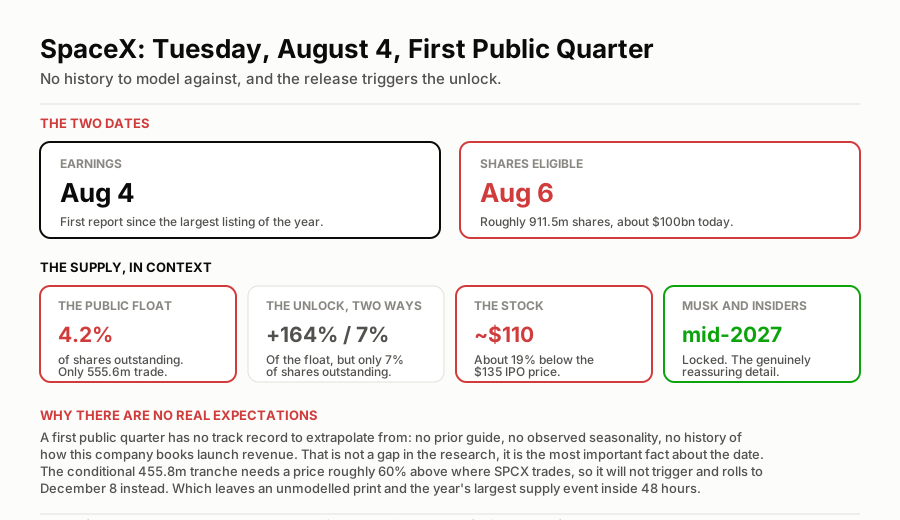
The report matters twice: as a print, and as the trigger for Thursday's supply.
The Report Matters Twice
This is the structural detail that makes August 4 different from any other earnings date this month.
The release itself triggers the first lock-up tranche. Two days later, on Thursday August 6, roughly 911.5 million shares become eligible to trade. For scale, the entire IPO sold 555,555,555 shares. More stock turns sellable on Thursday than the offering that created the public float.
A note on the dollar figure, because it is quoted everywhere and it has moved. The $116 billion headline implies about $127 a share, which is roughly where SPCX traded when the schedule was published in late July. Other outlets quote $123 billion, which works out at about the $135 IPO price. At today's price near $110 the same tranche is worth closer to $100 billion. The share count is the fixed fact; the dollar value falls as the stock does, which is worth remembering when the number is repeated unchanged next week.
So a disappointing first quarter does not merely reprice the stock. It releases supply into the reprice, 48 hours later. A strong quarter does the reverse, handing early holders a better level at which to sell. Either way, the sequencing is hostile: earnings Tuesday, supply Thursday, with no gap to absorb the first before the second arrives.
There is a second, conditional tranche of 455.8 million shares, and it is worth knowing why it will not arrive. Those release early only if SPCX closes at or above $175.50 on at least five of the 10 trading days in the window into earnings, a level 30% above the $135 IPO price. With the stock near $110, that trigger sits roughly 60% higher. It will not be met, and those shares roll to December 8 instead. The full staircase is in the SPCX lock-up calendar.
Musk and a select group of insiders stay locked until mid-2027, which is the genuinely reassuring part.
How Much of SpaceX Is Actually Unlocking?
This is the question the dollar headlines obscure, and the answer depends entirely on the denominator you choose.
| Measure | Shares | Unlock as a share of it |
|---|---|---|
| Public float | 555.6M | +164%, float goes to 2.6x |
| Float including the greenshoe | 638.9M | +143%, float goes to 2.4x |
| Total shares outstanding | ~13.1B | about 7% |
Both columns are true, and they tell opposite stories.
Against the float, this is enormous. SpaceX has roughly 13.1 billion shares outstanding, and only 555.6 million of them trade: a float of about 4.2%. The IPO sold that base offering plus an 83,333,333 share greenshoe, 638,888,888 in total, raising the record $86 billion. Adding 911.5 million tradeable shares to a float that size more than doubles it in a day.
Against the company, it is modest. Those same shares are only about 7% of the business. Nobody is selling SpaceX; a fraction of it is becoming sellable.
The float number is the one that sets the price. A 4.2% float means the market has been pricing SpaceX on a deliberately scarce supply of stock, and scarcity flatters a valuation. The August 6 event does not change what SpaceX is worth as a business. It changes how many shares have to find a buyer, and those are different questions with the same ticker.
If the conditional tranche ever releases, the float reaches roughly 3.5 times its present size. That is the December story rather than the August one.
What to Actually Watch
- Whatever metric management leads with. First reports establish the scoreboard. If SpaceX leads on launch cadence, that is the number the stock trades on for years. If it leads on Starlink subscribers or backlog, that is the number instead.
- Any forward guidance at all. A first-time reporter that declines to guide is telling you it lacks visibility, and this market has punished that severely. Roblox withdrew clarity and lost 29%.
- Commentary on the lock-up. Management knows what Thursday brings. Anything said about insider intentions moves the stock more than the revenue line.
The Options Angle
- Options on a newly listed company with no earnings history are wide, thin and badly priced in both directions. There is no realised volatility series to anchor them.
- Buying calls or puts into an unmodelled first print, two days before the largest supply event of the year, is paying peak premium for a genuinely unknowable distribution.
- Selling premium is worse. You would be shorting volatility into an event with no historical base rate, immediately ahead of roughly 911.5 million shares becoming sellable.
- Cash through Thursday is the coherent position. The supply date is the only event on this calendar with a known direction of pressure and an unknown size.
- The put is not the free money it looks like. Lock-up expiries average about -2% while SPCX weeklies price roughly 12.5%, so you can be right on direction and still lose. We backtested it against five real unlocks in is the lock-up a guaranteed put play?
- Markets front-run known supply, so the pattern to expect is weakness into August 6 and a relief bounce if the feared selling does not appear. The tradeable event is the anticipation, not the unlock.
The One-Line Read
SpaceX reports its first quarter as a public company on Tuesday August 4, with no history for anyone to model against, and that same release triggers roughly 911.5 million shares becoming eligible to trade on Thursday August 6, a tranche worth about $100bn at the current price and quoted almost everywhere at the $116bn it was worth when the stock was higher: the conditional 455.8 million tranche needs a share price 60% above where SPCX trades today and will roll to December instead, which leaves a stock 19% below its IPO price facing an unmodelled print and the largest supply event of the year inside 48 hours.
More on Earnings
$WMT · 2026-08-01
When Does Walmart Report Earnings? August 20 at 7:00am ET, and It Is the Consumer Verdict
$HD · 2026-08-01
When Does Home Depot Report Earnings? August 18, and Flat Earnings Are the Story
$UBER · 2026-08-01
When Does Uber Report Earnings? August 5 Before the Open, and Options Price an 8.3% Move
The Sunday Setup
Enjoyed this breakdown? Don’t miss the next market setup.
Get deep-dive analyses delivered to your inbox every Sunday. Free, and built for retail investors.
Comments
0 totalNo comments yet. Be the first to drop a take.