Is the SpaceX Lock-Up a Guaranteed Put Play? Facebook's Biggest Unlock Rose 12.6%
Lock-up expiries average about -2% while SPCX weeklies price a 12.5% move. Backtested against five real unlocks, the weekly put wins once. Why the contrarian call has a precedent.
TL;DR
- Everything about the August 6 unlock reads like a guaranteed short. It is not, and the reason is arithmetic rather than opinion.
- Academic studies put the average abnormal return around lock-up expiry at about -2%, with much of the damage arriving before the date rather than on it.
- SPCX options carry some of the richest implied volatility in the market, pricing roughly a 25% move over a month. That scales to about 12.5% for a weekly expiring Friday August 7.
- So a weekly put needs roughly -12.5% to break even against a base rate of -2%. You can be completely right about direction and still lose.
- Backtested against five real lock-up expiries, buying that weekly put would have paid once. The single biggest winner was a call.
More on $SPCX: SPCX Is Above Its IPO Price Again. 319 Million Shares Land Next Week, and I'm Still Not Buying →
The Case That This Is Free Money
State the bear argument at full strength first, because it is genuinely good.
Roughly 911.5 million shares become eligible on Thursday August 6, against a public float of 638.9 million. That is +143%: the tradeable supply more than doubles in a day. The stock is already 19% below its $135 IPO price and roughly 51% below its post-listing high. Insiders are sitting on gains, the first tranche is 20% of the restricted pool, and tranches keep coming every two to four weeks until December 8.
More sellers, no new buyers, a falling stock. Buy puts. It looks obvious.
Obvious is exactly the problem. Everyone can see this date. It has been in every calendar for a month. The question is never whether supply is coming, it is whether the supply is already in the price.
The Board
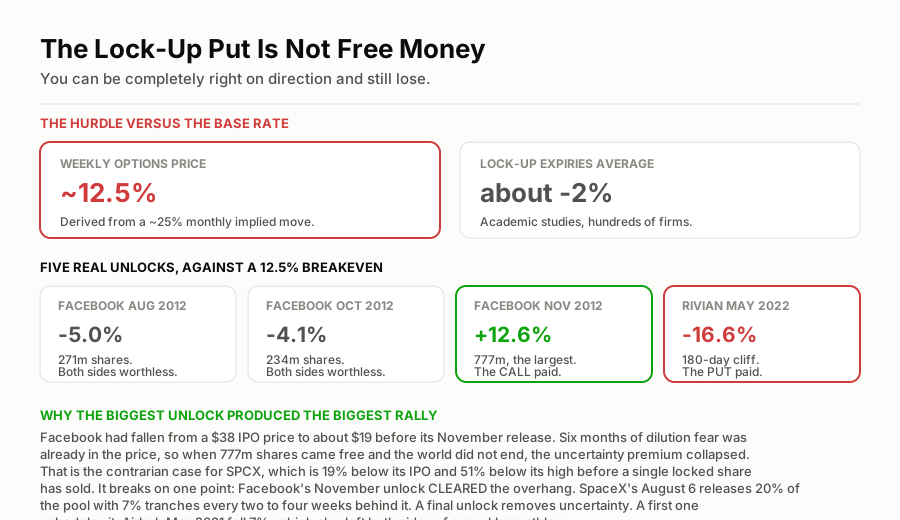
Three of five historical unlocks moved less than the weekly options are charging. Both sides expired worthless.
What Actually Happens on Lock-Up Day
The research is unusually consistent, and it is not what retail expects.
The average abnormal return around lock-up expiry is roughly -2%. Studies of firms with lock-ups of 180 days or less find cumulative abnormal returns of about -2.55% over a five-day window around the date. Venture-backed companies fare worse than average. Some studies find return reversals, meaning the drop into the date partially unwinds afterwards.
Two things follow.
The move is real but small. A 2% average is a genuine, statistically detectable effect. It is also nowhere near what an option buyer needs.
Much of it happens before the date. Markets front-run known supply. The decline is priced in the days and weeks into the expiry, which is precisely why a stock can fall for a month and then do nothing on the day itself.
The Five Cases That Matter
| Unlock | Shares released | Move | Weekly option outcome |
|---|---|---|---|
| Facebook, Aug 2012 | 271M | -5% | both expire worthless |
| Facebook, Oct 2012 | 234M | -4.1% | both expire worthless |
| Facebook, Nov 2012 | 777M, the largest | +12.6% | call pays |
| Airbnb, May 2021 | full expiry | -7% | both expire worthless |
| Rivian, May 2022 | 180-day expiry | -16.6% | put pays |
Against a 12.5% breakeven, buying the weekly put would have paid once in five. Three times both sides expired worthless. And the largest single winner in the table is a call.
Facebook Is the Precedent for the Contrarian Case
Look at the Facebook sequence again, because it is the most instructive thing in this article.
Facebook's smaller unlocks in August and October 2012 knocked 5% and 4.1% off the stock. Then its largest unlock, 777 million shares on November 14, sent it up 12.6%.
Why did the biggest supply event produce the biggest rally? Because by then Facebook had collapsed from a $38 IPO price to about $19. The market had spent six months pricing in dilution, disappointment and insider selling. When the shares actually came free and the world did not end, the uncertainty was removed and the stock re-rated.
That is exactly the mechanism you would invoke for SPCX: down 19% from IPO, down 51% from its high, having given back its entire post-listing gain before a single locked share has been sold.
Why We Would Still Not Buy the Call
The Facebook analogy is strong, and it breaks on one specific point.
Facebook's November unlock cleared the overhang. SpaceX's August 6 does not.
November 14 released 777 million of the roughly 800 million shares still restricted. It was the end. After it, there was no more scheduled supply to fear, which is why the uncertainty premium could collapse and the stock could re-rate.
August 6 is the first step of a staircase. Twenty percent of the restricted pool comes free, then 7% tranches every two to four weeks through October, then a large earnings-triggered slug at Q3, then the remainder on December 8. Nothing is resolved on Thursday. A holder who wants out has four months of exits and no reason to panic into the first one.
The distinction is the whole trade: a final unlock removes uncertainty, a first unlock schedules it. Rivian's -16.6% was a single 180-day cliff. Facebook's +12.6% was a final release. SpaceX is neither.
So What Is the Actual Play?
Not the weekly put. You would be paying roughly 12.5% for an event whose base rate is 2%, on a date every participant has had in their calendar for a month. That is the definition of buying a known catalyst at a premium price.
Not the contrarian call either, because the mechanism that made Facebook work is absent here.
The structurally correct read is that implied volatility is the expensive thing, not the direction. When an event is this well telegraphed and the historical move is this modest, the edge sits with the seller of premium, not the buyer.
- If you are bearish, a put spread beats an outright put. You sell some of the inflated volatility back to fund the leg you want, which lowers the breakeven from 12.5% to something a 2% base rate can plausibly reach.
- If you are bullish, sell cash-secured puts below the unlock rather than buying calls. You get paid the elevated premium, and if the feared selling arrives you own SPCX at a price the panic gave you.
- If you have no view, that is a position. Three of the five historical cases moved less than a weekly straddle costs. Selling that straddle is the trade the table actually supports, sized for the Rivian outcome, which is the one that kills you.
- The date to watch is not August 6. Markets front-run known supply, so the tradeable pattern is weakness into the date and a relief bounce if the selling does not materialise. That argues for looking at the week after, not the week of.
- Watch what management says on August 4. Any commentary on insider intentions moves this more than the unlock mechanics, and it arrives two days earlier, at SpaceX's first earnings report as a public company.
What We Don't Know
Two things we cannot tell you.
We could not source the live August 7 option chain. The 12.5% weekly figure is derived from the roughly 25% monthly move the options market is pricing, scaled by the square root of time. Check the actual chain before trading it; if the weekly is pricing 8%, the arithmetic changes and a put spread gets considerably more interesting.
Five cases is not a data set. It is an illustration of a distribution, and Rivian proves the tail is real. The academic average of -2% rests on hundreds of firms, and that is the number to anchor on. The five examples exist to show you how wide the spread around that average is.
The One-Line Read
The SpaceX unlock looks like a guaranteed put play and is not, because lock-up expiries average about -2% while SPCX weeklies are charging roughly 12.5%, so you can be completely right on direction and still lose: Facebook's largest unlock rose 12.6% precisely because it cleared the overhang, and the reason we would not make that contrarian bet here is that August 6 releases 20% of the restricted pool with tranches every two to four weeks behind it, which schedules the uncertainty rather than removing it.
Next up:Retail sales, today at 8:30am ET →
More on $SPCX
$SPCX · 2026-08-13
SPCX Is Above Its IPO Price Again. 319 Million Shares Land Next Week, and I'm Still Not Buying
$SPCX · 2026-08-10
Is SPCX About to Rocket, or Is the August 20 Unlock About to Land on It?
$SPCX · 2026-08-07
Why Is SpaceX Stock Up After the Lock-Up? 911.5 Million Shares Came Free and the Selling Never Came
Updated Every Saturday
The Week Ahead
Every earnings date, Fed event and setup for the current trading week, on one page.
Refreshed Weekly
Earnings Calendar
Who reports next, when, and what consensus and the whisper expect.
The Week-Ahead Brief
Don’t miss next week’s setups. Get the Sunday brief.
Latest issue, Sep 7“Week ahead in the stock market...”
Every Sunday: next week’s earnings dates, Fed days and the trades worth watching, from the same desk that writes the week-ahead hub. Free, built for retail investors.