When Does Vistra Report Earnings? August 7, With the Stock Near Its 52-Week Low and Profits Up 140%
Vistra reports Q2 2026 before the open on Friday August 7, the same morning as the July jobs report. Consensus is $2.43 EPS, up 140%. Why the AI power trade got sold and the numbers did not.
TL;DR
- Vistra reports Q2 2026 before the open on Friday, August 7, the same morning as the July jobs report at 8:30am ET.
- Consensus: diluted EPS of about $2.43, up 140.6% from $1.01, with Q2 adjusted EBITDA around $1.76bn to $1.79bn, up roughly 34%.
- Full-year 2026 guidance was reaffirmed: adjusted EBITDA of $6.8bn to $7.6bn and adjusted free cash flow before growth of $3.925bn to $4.725bn.
- The stock closed $148.19 on July 31, against a 52-week range of $132.66 to $219.82. It is nearer its low than its high, having fallen roughly a third from the top.
- The average analyst target is about $230. That is a gap of more than 50%, and it exists because the AI power trade was sold as a group while Vistra's own numbers went up.
When Does Vistra Report Earnings?
The short answer: before the market opens on Friday, August 7, 2026.
It is one of five pre-market reports that morning, alongside PPL, Take-Two, Oklo and ACM Research, and all of them land into the same 8:30am payrolls print.
That timing is the single most important practical fact about Friday. Nothing Vistra reports at 7:00am survives contact with a payrolls number at 8:30am if that number is a surprise in either direction.
What the Street Expects
| Line | Q2 2026 | Comparison |
|---|---|---|
| Diluted EPS | ~$2.43 | up 140.6% from $1.01 |
| Adjusted EBITDA | ~$1.76B to $1.79B | up roughly 34% |
| FY26 adjusted EBITDA guide | $6.8B to $7.6B | reaffirmed |
| FY26 adjusted FCF before growth | $3.925B to $4.725B | reaffirmed |
| July 31 close | $148.19 | 52-week range $132.66 to $219.82 |
| Average analyst target | ~$230 | |
| Options implied move | ~6.4% | exceeded in only 2 of the past 8 prints |
The Board
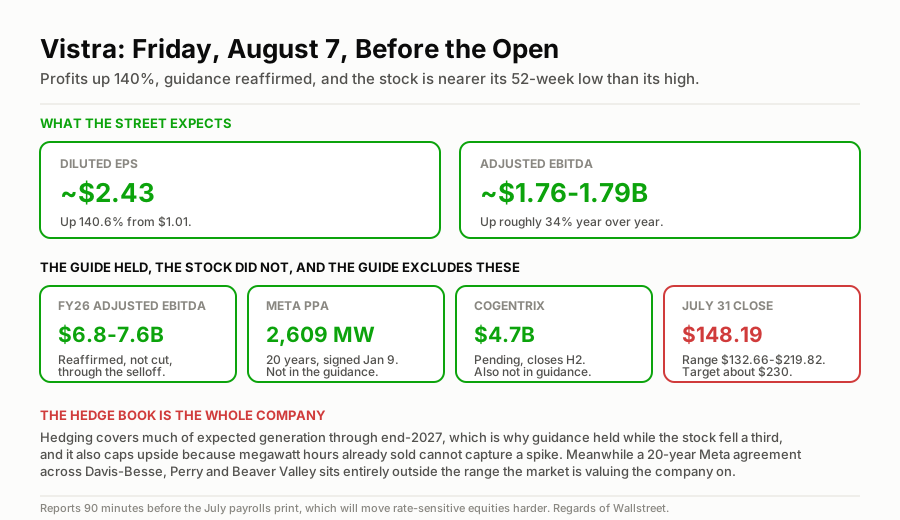
Profits up 140%, guidance reaffirmed, stock near the bottom of its range. Something has to give.
What Actually Happened to This Stock
Nothing happened to Vistra. Something happened to the theme.
Vistra is an independent power producer: it owns generation, sells electricity into competitive markets, and hedges forward. For two years it was one of the purest ways to own the argument that AI data centres would create the largest step-change in US electricity demand in a generation. Merchant generators capture that demand in the power price, without a regulator deciding how much of it they are allowed to keep.
Then the AI complex got repriced. Semiconductors lost a trillion dollars of market value, Vertiv fell hard on a good quarter, and Caterpillar fell 23% from a record close in five weeks with no company-specific news. Vistra fell with them, from a 52-week high of $219.82 to $148.19, roughly a third.
Over the same period its own numbers went the other way. Profits are expected up 140%, EBITDA up roughly a third, and the full-year guidance was reaffirmed rather than cut.
That is the setup, and it is honest to say it can resolve either way. Either the market is wrong about the theme and Vistra is a third cheaper than it was for no fundamental reason, or the market is early and the power demand assumption gets marked down before the earnings do. Guidance is a lagging indicator of a thesis. It reflects contracts already signed, not contracts that will not be.
The Hedge Book Is the Whole Company
This is the part of a merchant generator most investors skip and it is the part that decides everything.
Vistra sells its expected generation forward, locking in prices well before the electricity is produced. Management has described a conservative hedging posture that covers a significant portion of expected generation through the end of 2027.
Read that two ways, because both are true.
It is the reason the guidance is credible. A large hedged position means the 2026 numbers are close to contracted. This is not a company hoping power prices stay high; it has already sold much of the output. That is why guidance could be reaffirmed while the stock fell a third.
It is also the reason the upside is capped. If AI demand drives power prices sharply higher in 2027, Vistra does not capture all of it, because it sold the megawatt hours at yesterday's price. A heavily hedged generator is a bond-like instrument in a bull market for power and a fortress in a bear market for it. Investors buying Vistra as a leveraged AI-electricity bet have often not read this carefully.
The number to look for on Friday is the hedge percentage for 2027 and, if disclosed, 2028. That single figure tells you how much of the thesis you actually own.
The Three Things to Watch
1. New data centre contracts. A signed power purchase agreement with a named hyperscaler is worth more than any earnings line, because it converts a theme into contracted revenue at a known price. The absence of new agreements for another quarter would validate the selloff.
2. Whether guidance is raised rather than reaffirmed. Reaffirming a range twice is fine. In a year where the consensus already sits near the midpoint, a raise is the event, and the failure to raise when the theme is under attack reads worse than it would have six months ago.
3. Capital returns. Vistra has been a heavy buyer of its own shares. Buying back stock a third below the high, funded by nearly $4 billion of free cash flow before growth, is the most direct statement management can make about what it thinks the stock is worth.
Is Vistra a Buy Near Its 52-Week Low?
Yes, with the position sized for the fact that it is an AI trade wearing a utility's clothes.
At $148.19 against reaffirmed guidance of $6.8bn to $7.6bn of adjusted EBITDA and $3.925bn to $4.725bn of free cash flow before growth, the cash generation is real and the hedge book means most of it is close to contracted. A stock that has fallen a third while its own guidance held is a genuine opportunity or a genuine warning, and the hedge book is what tilts it toward the former.
The bull case: electricity demand growth from data centres, electrification and manufacturing reshoring is structural and slow to reverse, generation capacity takes years to build, and Vistra owns existing plants in the right markets. The sell side sits more than 50% above the price.
The bear case: every argument above depends on hyperscaler capex, and that is the assumption the whole market has spent five weeks repricing. You do not diversify away from AI by buying the electricity that powers it, which is precisely the mistake we flagged in Caterpillar. If the capex cycle slows, merchant power prices follow, and Vistra's hedges protect 2026 and 2027 but not the multiple.
The Options Angle
- The dominant risk on Friday is not the earnings. It is the 8:30am payrolls print landing 90 minutes after the release and roughly an hour before the open. A hot number pushes long yields higher and hits every capital-intensive, long-duration equity, which includes this one.
- Macro gaps through strikes and does not respect an expected move. That is why a defined-risk iron condor with real wings beats a naked strangle on any Friday like this one.
- The honest counter-argument to our pass on selling premium: options price about 6.4%, and Vistra has exceeded its implied move in only two of the past eight prints. On the earnings event alone, selling volatility in this name has usually worked. We are still passing, and the reason is payrolls rather than the print.
- At $148.19, one contract is $14,819 of notional, which keeps spreads and cash-secured puts accessible.
- If your thesis is the recovery rather than the print, a cash-secured put below the 52-week low is the cleanest expression: you either collect premium or you buy the stock cheaper than the market has been in a year.
- Live option prices could not be sourced at the time of writing, so the plays below are quoted against the July 31 close.
Trade log
| # | Stance | Structure | Strikes and expiry | Cost or credit | Spot at writing | Implied move | Breakeven |
|---|---|---|---|---|---|---|---|
| 1 | Bullish, income | Cash-secured put | ~$132.50 strike, first monthly after Aug 7 | premium not sourced | $148.19 (Jul 31, 2026 close) | ±6.4% | assigned below $132.50, −10.6%, outside the implied move |
| 2 | Bullish, defined risk | Call spread | ~$155 / ~$175, first monthly after Aug 7 | debit not sourced | $148.19 | ±6.4% | needs a close above ~$155, +4.6% |
| 3 | Pass | Short premium held through earnings and payrolls | any | credit not sourced | $148.19 | ±6.4% | two events, no gap to manage between them |
Row 3 is logged as a pass so it gets scored. Selling premium into an earnings print followed 90 minutes later by payrolls is the specific mistake we are telling readers not to make.
The One-Line Read
Vistra reports before the open on Friday August 7 against consensus of $2.43, up 140.6%, with adjusted EBITDA up roughly a third and full-year guidance of $6.8 to $7.6 billion reaffirmed rather than cut, and the stock sits at $148.19 nearer its 52-week low of $132.66 than its high of $219.82: nothing went wrong at the company, the AI power theme was sold as a block, and the number that tells you how much of the recovery you actually own is not the EPS line but the percentage of 2027 generation Vistra has already hedged away.
More on AI & Semiconductors
$ACMR · 2026-08-02
When Does ACM Research Report Earnings? August 7, and Revenue Is Up 25% While Earnings Are Guided Down
$OKLO · 2026-08-02
When Does Oklo Report Earnings? August 7, and a $6.76 Billion Company Is Expected to Book $3.8 Million of Revenue
$DDOG · 2026-08-02
When Does Datadog Report Earnings? August 6, and It Is Guiding Flat Profits on 30% Revenue Growth
The Sunday Setup
Enjoyed this breakdown? Don’t miss the next market setup.
Get deep-dive analyses delivered to your inbox every Sunday. Free, and built for retail investors.
Comments
0 totalNo comments yet. Be the first to drop a take.