What Is A Strangle? The Straddle's Cheaper, Greedier Cousin
Same Bet, Smaller Bill
The straddle buys a call and a put right at the money (where the stock is sitting) and pays full freight for the privilege. The strangle looks at that $800 bill and starts haggling.
Instead of buying both options at $100, you buy the put below the stock and the call above it. Stock at $100? Buy the $95 put for $150 and the $105 call for $150. Both are "out of the money" (worthless right now), which is exactly why they're cheap. Total bill: $300 instead of $800. Your worst case just shrank by more than half. Same core bet as the straddle: you win big on a move in either direction, and you don't care which. Slide it and find the catch:
At $100 you lose $300: about the worst this trade can do.
Cheap Has A Catch: The Flat Bottom
Drag the slider slowly from $95 to $105 and watch the loss number. It doesn't budge: it's pinned at −$300 the whole way across. That's the catch, and it's the entire difference between a strangle and a straddle.
A straddle's loss starts shrinking the moment the stock drifts off the strike. The strangle's loss is total across the whole $95–$105 range, because both options are out of the money and both expire worthless. A 4% move, which would hand a straddle holder back some of their premium, hands you nothing here. It's boom or bust by design. The break-evens land at $92 and $108, roughly the same doorway the straddle has to clear, but you're risking $300 instead of $800 to get there, in exchange for a loss profile that's strictly all-or-nothing.
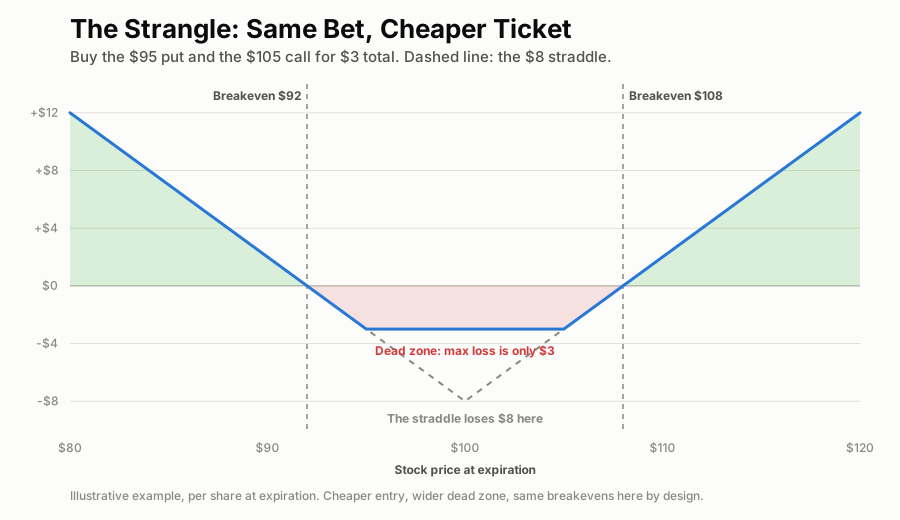
The flat bottom is the price of admission. Between $95 and $105, both legs die.
The Two-Line Version
- A strangle is an out-of-the-money call plus an out-of-the-money put, different strikes, same expiration.
- It costs a fraction of a straddle, so your max loss is smaller and your percentage payoff on a monster move is bigger.
- The price of cheap is a wider dead zone: the stock must clear one of two distant strikes before either leg is worth a cent.
- Small moves that would soften a straddle's loss do nothing for you. Boom or bust.
Strangle Or Straddle?
Run the two side by side and the trade-off is clean. Stock finishes at $110: the strangle turns $300 into $500, a 167% return that beats the straddle's percentage gain on the identical move. Stock finishes at $104: you take a 100% loss on a trade where the straddle only lost half. That's the deal in one line: bigger bang per dollar on a real move, total wipeout on a lukewarm one.
So buy the strangle when you expect a genuinely huge move and want maximum leverage per dollar: biotech binary events, short-squeeze candidates, anything where "up 40% or down 40%" is a serious scenario. Buy the straddle when you expect a solid move but want partial credit if it comes up short. The strangle is the lottery ticket; the straddle is the insurance policy; the market prices them accordingly.
One habit worth stealing: size the strangle like the lottery ticket it is. The low sticker price seduces people into buying ten contracts where they'd have bought two straddles, which rebuilds the exact risk they thought they were dodging. A 100% loss on a big position is a big loss, whatever the per-contract price was.
The Short Strangle Warning
Everything flips if you sell the strangle: collect that $300, root for a nap, and keep it if the stock stays boxed between the strikes. It's a real strategy that professionals run with hard risk limits, and it carries the same unlimited-loss tails as any naked short option. One overnight gap through a strike and the "easy income" trade eats a year of premium. If selling the range is your thesis, cap the tails first with an iron condor, a short strangle wearing a seatbelt. And if you want the long-chaos bet for even less than a strangle, the reverse iron condor trims the bill by selling off the far wings.
Sooo... When Do You Pull The Trigger?
When your thesis is "this thing is about to move violently and the options market is pricing a shrug." That mispricing is rare around famous events and common in forgotten corners: the small cap with a catalyst off every screener, the sector ETF before a policy decision nobody's gaming out. Buy the strangle where drama is cheap, skip it where drama is the consensus, and never confuse a low price with a high probability. The flat bottom of that chart is where most strangles go to die, and every buyer thinks they're the exception, right up until expiration Friday.
The Week-Ahead Brief
Don’t miss next week’s setups. Get the Sunday brief.
Latest issue, Oct 11“September CPI, the big banks and TSMC: earnings season starts”
Every Sunday: next week’s earnings dates, Fed days and the trades worth watching, from the same desk that writes the week-ahead hub. Free, built for retail investors.