When Does Caterpillar Report Earnings? August 4, and It Has Fallen 23% From a Record in Five Weeks
Caterpillar reports Q2 2026 at 6:30am ET on Tuesday August 4. Consensus is $6.25 EPS on $19.31bn, up 32%, after a 23% fall driven by a Michael Burry short and a Baird downgrade to $900.
TL;DR
- Caterpillar reports Q2 2026 at 6:30am ET on Tuesday, August 4, with the call at 8:30am ET.
- Consensus: adjusted EPS of about $6.25, up 32%, on revenue of about $19.31 billion, up 16.6%.
- The stock closed $814.81 on July 31, down about 23% from its record close of $1,062.93 on June 30. A five-week, quarter-of-the-company drawdown into a quarter expected to grow earnings by a third.
- That fall was not anonymous. Michael Burry shorted Caterpillar at $1,060.98, and days later the stock had fallen nearly 12% from its record high. Baird then downgraded it to Neutral on July 27 and cut its target from $1,200 to $900, a 25% reduction.
- Full-year tariff costs are guided at $2.2 to $2.4 billion, trimmed from $2.6 billion in January. On a roughly $77 billion revenue run rate that is about 3% of sales, and it is a known number.
- Options price a move of about 6.1%. Caterpillar has exceeded its implied move in five of the past eight prints, including 10.0% against 4.5% implied in April and 11.6% against 5.3% in October 2025.
When Does Caterpillar Report Earnings?
The short answer: Tuesday, August 4, 2026, with results at 5:30am CDT (6:30am ET) and the call at 7:30am CDT (8:30am ET).
It is the earliest report of the week by some distance, which matters practically: the numbers are out three hours before the US open and will be traded in Europe first.
Caterpillar leads a dense pre-market block alongside Merck, McDonald's and Pfizer, before AMD reports the same evening.
What the Street Expects
| Line | Q2 2026 | Comparison |
|---|---|---|
| Adjusted EPS | ~$6.25 | up 32% year over year |
| Revenue | ~$19.31B | up 16.6% |
| Full-year tariff costs | $2.2B to $2.4B | trimmed from $2.6B guided in January |
| July 31 close | $814.81 | |
| Record close | $1,062.93 on June 30, 2026 | −23% since |
| Options implied move | ~6.1% | exceeded in 5 of the past 8 prints |
| Baird target cut, July 27 | $1,200 to $900 | rating to Neutral from Outperform |
Caterpillar has beaten consensus in three of the last four quarters with an average surprise of 9.62%. Estimates have drifted up about 1% over the past two months. None of that is the interesting part.
The Board
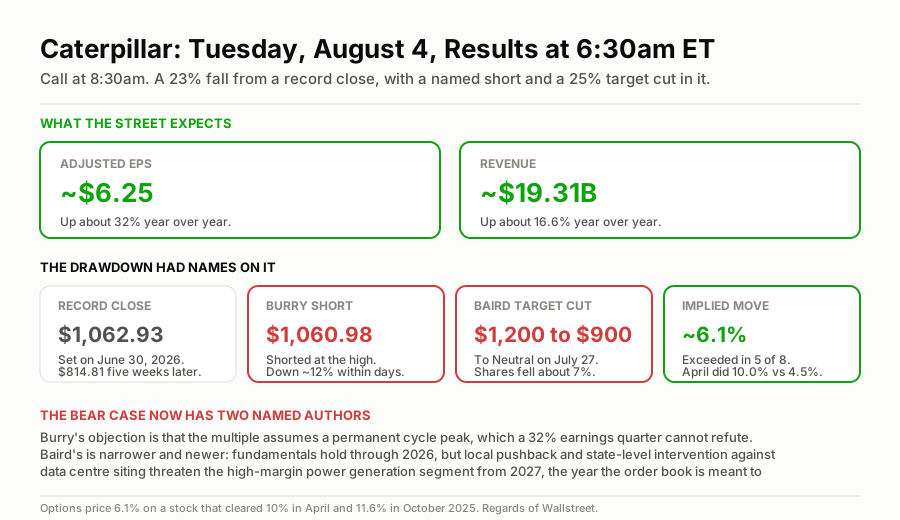
A 23% drawdown from a record close. A named short and a 25% target cut are most of the reason.
Who Actually Sold It
The AI complex was repriced in the same five weeks. Semiconductors lost a trillion dollars of market value and Vertiv fell hard on a good quarter, so some of Caterpillar's fall is sector beta.
But this drawdown had names attached to it, and both of them are worth understanding before Tuesday.
Michael Burry shorted Caterpillar at $1,060.98, essentially at the record close, and the stock fell nearly 12% from its high within days. His stated objection is not the order book: it is that the valuation has detached from a normalised earnings cycle. That is the classic cyclical-at-the-peak argument, and it is the one thing a 32% earnings growth quarter cannot refute, because a cyclical peak is exactly when earnings look best.
Baird downgraded the stock to Neutral from Outperform on July 27, cutting its price objective from $1,200 to $900, a 25% reduction, and shares fell about 7% on the day. Read the analyst's reasoning carefully, because it is more specific than a valuation call: Mircea Dobre said Caterpillar's fundamentals remain solid through the back half of 2026 but pointed at local pushback and state-level policy interventions against data centre buildouts, which would hit the high-margin power generation segment from 2027.
That is a genuinely new risk and almost nobody is modelling it. Every bull case for Caterpillar's power business assumes data centres get built where the developers want them. It assumes nothing about whether counties and state legislatures let them. Electricity bills are already rising in the service territories absorbing this load, which makes it a live political question rather than a theoretical one.
So the honest framing is this. The market has reclassified Caterpillar as a power infrastructure company, and it now trades on the same variable as the chip names. The July selling then added two specific arguments on top: that the multiple assumes a cycle peak persists, and that the 2027 power revenue faces a permitting problem rather than a demand problem.
The reclassification logic is sound. Data centre equipment demand is projected to grow roughly 25% a year for the next four to five years, and the binding constraint is not chips, it is electricity. Getting power to a site requires generation, and Caterpillar's large reciprocating engines and turbines are one of the few products that can be delivered in the timeframe a data centre developer needs. Every gigawatt of announced capacity is an order.
The logic also cuts the other way, which is the part the bulls skip. A company reclassified as an AI play gets an AI multiple, and it also gets an AI drawdown. Caterpillar just took one.
Tariffs: a Known Cost, Correctly Sized
Management guides $2.2 to $2.4 billion of tariff costs for 2026, trimmed from $2.6 billion in January. Percentages need a base, so here is one: against a revenue run rate near $77 billion implied by the quarterly consensus, that is roughly 3% of sales.
Three points make this less frightening than the headline number:
- It has already been guided, twice, and revised down. A cost management can forecast and then beat is a cost management understands.
- It is partly recoverable through price. Caterpillar has more pricing power than almost any manufacturer in the world, because dealers and customers have very few alternatives at the top end of the range.
- It is symmetric across the industry. Competitors import too.
The risk is not the $2.2 billion. It is a third revision. If the number moves back up on Tuesday, that says the input environment is deteriorating faster than a company with this much visibility can track, and that is a signal about the whole industrial complex.
The Three Things to Watch
1. Energy and Transportation, and specifically power generation. This is the segment that contains the data centre story. Revenue growth here is the number that justifies the valuation. A strong quarter for construction equipment and a soft one for power generation would be read as the thesis breaking, even if the total beats.
2. The backlog. Backlog is the honest version of an order book: it is signed work, not a pipeline. Caterpillar's premium exists because the market believes several years of power generation demand is already contracted. Show the backlog or the premium goes.
3. Any answer to the Baird objection. The downgrade did not dispute 2026. It disputed 2027 power generation revenue on permitting and policy grounds. If management is asked about local opposition and state-level intervention against data centre siting and gives a real answer with contracted projects behind it, the most specific bear argument in the market goes away. If they wave it off, it stays.
Margin is the fourth line worth checking, because operating margin is where the tariff cost, the offsetting price increases and the mix shift toward higher-margin power products all collide.
Is Caterpillar a Buy After a 23% Drawdown?
Yes, but sized as an AI position rather than as an industrial one, and that distinction is the whole answer.
At $814.81 you are buying a company expected to grow earnings 32% this quarter, with a guided and shrinking tariff bill, a dominant position in a genuine physical bottleneck, and a share price a quarter below where it stood five weeks ago. That is a decent entry by any conventional measure.
But be honest about what you own. If you buy Caterpillar here you are making the same bet as somebody buying AMD on Tuesday evening or Nvidia on August 26: that announced data centre capex converts into delivered orders. Investors who think they are diversifying out of AI by buying an industrial are buying the same risk with a duller ticker and a dividend.
The bear case now has two named authors. A short seller at the high arguing the multiple assumes a permanent cycle peak, and a downgrade arguing the 2027 power revenue has a permitting problem. Multiple compressions rarely stop the day the earnings look good: Apple set a record gross margin and still fell about 8%.
The Options Angle
- This is the cleanest setup on the week's calendar and the numbers say so. Options price a move of about 6.1%. Caterpillar has exceeded its implied move in five of the past eight prints, and not narrowly: 10.0% against 4.5% implied in April, and 11.6% against 5.3% in October 2025.
- A 6.1% implied move on a stock that has twice done double digits, into a quarter with a live short thesis and a fresh downgrade attached, is the market underpricing the event. This is the season's most repeated mistake in reverse, and we are taking the other side: buy volatility here rather than sell it.
- The clean structures are a call spread for the recovery case or a straddle if you think the backlog disclosure is genuinely binary. On this implied move the straddle is the better expression of the two.
- A 6:30am release is a real constraint. European hours will set the price before any US retail account can act.
- Live prices for individual strikes could not be sourced, so the plays below are quoted against the July 31 close and the implied move.
Trade log
| # | Stance | Structure | Strikes and expiry | Cost or credit | Spot at writing | Implied move | Breakeven |
|---|---|---|---|---|---|---|---|
| 1 | Long volatility | Long straddle | at-the-money, first expiry after Aug 4 | ~6.1% of spot, strike price not sourced | $814.81 (Jul 31, 2026 close) | ±6.1% | needs a move beyond ±6.1%, about $50 |
| 2 | Bullish, defined risk | Call spread | ~$850 / ~$925, first monthly after Aug 4 | debit not sourced | $814.81 | ±6.1% | needs a close above ~$850, +4.3% |
| 3 | Pass | Selling premium into the print | any | credit not sourced | $814.81 | ±6.1% | loses beyond ±6.1% |
Row 3 is the logged pass, and it is the one we most want scored. We are telling readers not to sell a 6.1% implied move in a name that has cleared 10% twice in the past year.
One practical constraint worth naming. At $814.81, a single options contract controls $81,481 of stock. That removes cash-secured puts and covered calls from most retail accounts entirely, in the same way a $1,270 share price does. Fractional options do not exist. If the notional is more than you would put into the shares, the trade is not smaller because the premium is.
The One-Line Read
Caterpillar reports at 6:30am ET on Tuesday August 4 against consensus of $6.25 and $19.31 billion, numbers that imply 32% earnings growth and 16.6% revenue growth, after a 23% fall from a record close that had two names on it: Michael Burry shorting at $1,060.98 on the argument that the multiple assumes a permanent cycle peak, and Baird cutting its target from $1,200 to $900 because state-level pushback against data centre siting threatens the high-margin power business from 2027: the tariff bill is a known and shrinking cost, so what matters is the power generation backlog and whether management can answer the permitting objection, and with options pricing only 6.1% against a stock that has cleared 10% twice in a year, the event looks underpriced.
More on Earnings
$PPL · 2026-08-02
When Does PPL Report Earnings? August 7, and It Is the Boring Way to Own the Data Centre Power Trade
$TTWO · 2026-08-02
When Does Take-Two Report Earnings? August 7, and the Quarter Being Reported Barely Matters
$LNG · 2026-08-02
When Does Cheniere Report Earnings? August 6, and Its Last Quarter Was a $3.5 Billion Loss and a Guidance Raise
The Sunday Setup
Enjoyed this breakdown? Don’t miss the next market setup.
Get deep-dive analyses delivered to your inbox every Sunday. Free, and built for retail investors.
Comments
0 totalNo comments yet. Be the first to drop a take.