S&P 500 Forecast This Week: 7,489 Into the Busiest Earnings Week of the Quarter
S&P 500 forecast for the week of August 3: the index closed 7,489.72, just 1.7% below its 52-week high, after a July that looked flat and was not. Key levels and three scenarios.
TL;DR
- The S&P 500 closed 7,489.72 on Friday, up 0.7% on the day and about 1% on the week, leaving it 1.7% below its 52-week high of 7,620.90.
- July finished down 0.1%. That flatness is the most misleading number on the page.
- Underneath it, the Dow rose and the Nasdaq 100 fell about 7%, its worst month since March 2025. The index did not go nowhere. It contained a fight.
- This week is the busiest earnings week of the quarter, and it stacks both sides of that fight into four sessions, ending with payrolls on Friday.
- Levels below, plus the three scenarios and why the second one is the least discussed.
Where Is the S&P 500 Headed This Week?
The short answer: the index is close to its high, its internals are not, and this week decides which of those two facts is the real one.
An index that finishes a month at -0.1% looks like a market that took July off. It did the opposite. The Dow Jones was the only major index to gain in July, the Nasdaq 100 lost roughly 7%, and the S&P 500 sits in the middle because it contains both. A flat print is what a violent rotation looks like from a distance.
That matters this week because the calendar is not neutral between the two sides. Twenty-seven companies report, and they run the whole argument from the chip that sells AI compute to the burger chain that finds out whether the consumer is still spending. The full week-ahead calendar is here.
The Board
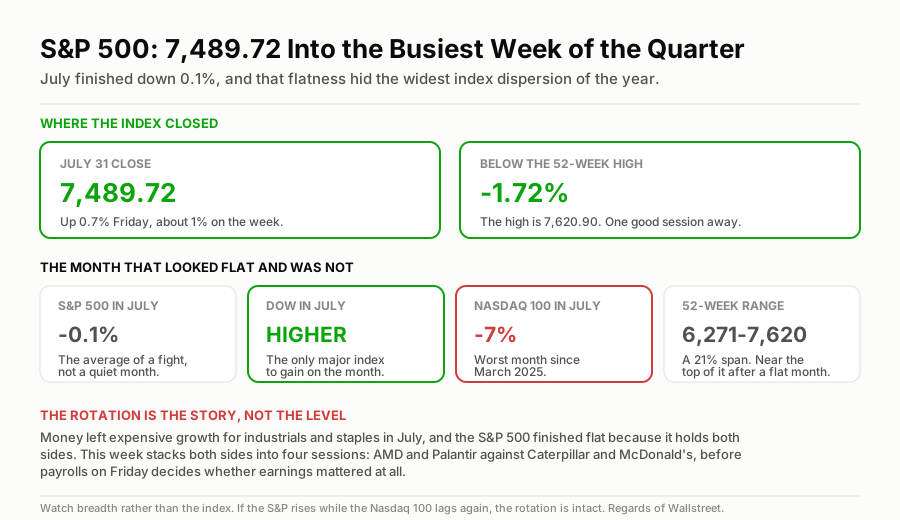
Down 0.1% for July, with a 7-point gap between the best and worst major index. The average hid a fight.
The Levels That Matter
Resistance: 7,620.90, the 52-week high. The index needs 1.7% to touch it. That is one good session in this tape, which is precisely why the level is dangerous rather than distant: it can be reached on Monday and rejected by Wednesday.
Support: the late-July selloff shelf. The chip-led drawdown that erased a trillion dollars from the semiconductor complex built the level buyers defended on the way down. It has not been retested since. A first retest is more informative than the first break of resistance, because it tells you whether the rotation has buyers underneath it or only sellers above.
The wider frame: a 52-week range of 6,271.71 to 7,620.90. That is a 21% span. Sitting near the top of it after a flat month is not the same as sitting near the top after a strong one.
The rule for the week: near the top of a range, levels do not predict, they size. Use them to decide how much, not which way.
Scenario 1: The Rotation Continues (Most Likely)
The Dow keeps working, the Nasdaq 100 keeps struggling, and the S&P 500 grinds sideways within a percent or two while the dispersion underneath stays enormous. This has been the signature of the entire season and nothing on this calendar obviously breaks it.
What makes it likely is the shape of the week: the AI names and the defensive names report on the same days. Caterpillar and McDonald's report Tuesday morning, AMD Tuesday evening. One will disappoint and one will not, and the index nets them out.
Scenario 2: The Rotation Reverses
The least discussed outcome, and the one that would hurt the most people. A cluster of clean AI results would put a violently oversold Nasdaq 100 back on the bid, and the money funding that bid comes out of exactly the defensive and industrial positions everybody rotated into during July.
If AMD's data centre line confirms that hyperscaler spending converted into orders, and Datadog and Palantir support it, the index goes to new highs led by the very names that just lost 7% of index value. Being defensively positioned into that is how a flat month becomes an underperforming one.
Scenario 3: The Discount Rate Wins
Both sides lose. The Fed held on July 29 with three members voting to hike and the 30-year pushed above 5.19% afterward. A hot payrolls print on Friday validates the hawks and lifts long yields, which is a valuation problem for the whole index regardless of what any company reported on Tuesday.
That is the scenario where earnings stop mattering. It does not need a recession or a bad quarter. It only needs the long bond to keep repricing.
What Would Change the Picture
Watch breadth, not the index. If the S&P 500 rises while the Nasdaq 100 lags again, the rotation is intact and the index level is telling you very little. If they move together, whichever direction, the rotation is over and the index level starts meaning something again.
And watch Friday over Tuesday. June payrolls came in at 57,000 against 115,000 expected with 74,000 of downward revisions. We argued then that the jobs report matters more than CPI now, and a week that ends with payrolls can spend four days pricing earnings and one morning undoing it.
The Options Angle
- Index implied volatility is not the trade this week. Dispersion is. The setup that has paid all season is enormous single-stock movement inside a nearly motionless index, and that is precisely what kills a naked index straddle.
- Selling index premium into a payrolls Friday is a different trade from selling it into an earnings print. Macro gaps through strikes and does not respect an expected move. A defined-risk iron condor with genuine wings beats a naked strangle.
- Hedges are cheaper Monday than Thursday. If you are long the index and want protection through payrolls, buying it at the start of the week costs less than buying it once everyone else wants it.
- For long-term investors this is noise. A week with 27 earnings reports and a payrolls print is exactly the situation where time in the market beats timing it.
The One-Line Read
The S&P 500 closed 7,489.72, just 1.7% below its 52-week high, after a July that finished down 0.1% while the Dow rose and the Nasdaq 100 fell about 7%: the index is not near its high because the market is strong, it is near its high because the two halves of it are pulling in opposite directions, and this week hands both halves a microphone before Friday's payrolls print decides whether any of it mattered.
More on Markets Today
$DIA · 2026-08-02
Dow Jones Forecast This Week: The Only Index That Won July Now Has Four of Its Own Reporting
$QQQ · 2026-08-02
Nasdaq 100 Forecast This Week: Down 7% in July, and This Week Is the Rematch
$SKHY · 2026-07-31
Why Is the KOSPI Up 17.91%? The Biggest Day in Its History, at the End of Its Worst Month Since 1997
The Sunday Setup
Enjoyed this breakdown? Don’t miss the next market setup.
Get deep-dive analyses delivered to your inbox every Sunday. Free, and built for retail investors.
Comments
0 totalNo comments yet. Be the first to drop a take.