Why Is the KOSPI Up 17.91%? The Biggest Day in Its History, at the End of Its Worst Month Since 1997
South Korea's KOSPI closed up 17.91% at 6,595.45, its largest one-day gain ever, with SK Hynix locked limit-up. Why it happened, and why July was still the worst month since 1997.
What happened next: on August 13 the index closed at 6,813.34, clearing 20% off the July 30 low and entering a technical bull market. SK Hynix is still below the limit-up close described here. The July 31 session below is left exactly as it was written.
TL;DR
- The KOSPI closed at 6,595.45, up 17.91%, the largest single-day gain in the index's history. It had fallen about 17% in the previous three sessions.
- SK Hynix closed limit-up, at ₩1,718,000, a gain of 29.95%. That is not a number the market chose. It is the maximum move Korean rules allow, which means buyers were still bidding when the exchange stopped them.
- Samsung Electronics rose about 27% and went back above a $1 trillion market capitalisation. Total KOSPI market cap crossed ₩5,000 trillion. Foreign investors net bought more than ₩5 trillion before 10:06am.
- And yet: July finished down 22.19%, Korea's worst month since the 1997 Asian financial crisis, and that is including the best day the index has ever had.
- The KOSPI is still 29.7% below its June 19 record of 9,385.59. Getting back there from here needs another 42.3%.
More on $SKHY: Kospi Enters a Bull Market, and Is Still 27% Below Its Record →
Why Is the KOSPI Up Today?
Wall Street's AI trade came back to life overnight, and Korea is the most leveraged expression of that trade on earth. Microsoft and Amazon both delivered results that answered the AI capex question, the US memory complex rallied double digits, and Seoul opened to the first genuinely good news in a fortnight.
There is a second reason, and it is domestic. SK Group chairman Chey Tae-won disclosed his first ever open-market purchase of SK Hynix shares, roughly ₩4.8 billion of stock, on Thursday. Both Samsung and SK Hynix also moved to defend share prices that had roughly halved, with Samsung formalising the possibility of a special dividend plus buybacks and cancellations, and SK Hynix expected to announce its own shareholder return plan in early August once the legal restrictions tied to its ADR offering lift. Those restrictions are SEC Rule 174, they expire on August 4, and what they actually unlock is narrower than the market thinks.
Overnight optimism plus a chairman buying his own stock plus buyback signalling is a potent combination in a market that had just been sold indiscriminately for three days.
How Big Was This Move?
Big enough that the comparisons are all historical rather than recent.
17.91% is the largest one-day gain the KOSPI has ever posted. Not the largest this year, or since 2008. Ever.
Here is the more useful way to see it. Line up the crash sessions:
| Session | Close | Move |
|---|---|---|
| Monday July 27 | 6,806.93 | down 8.95%, circuit breaker |
| Tuesday July 28 | 6,023.66 | down 10.84% |
| Wednesday July 29 | 5,663.24 | down 5.98%, circuit breaker |
| Thursday July 30 | 5,593.71 | down 1.23% |
| Friday July 31 | 6,595.45 | up 17.91% |
One session undid three. Friday's close sits above Tuesday, Wednesday and Thursday, and still 3.1% below where Monday's circuit-breaker session left it. The whole record-breaking day bought back three days of a four-day collapse.
That arithmetic is worth holding onto. We covered the collapse itself in why the Korean stock market is crashing.
The Board
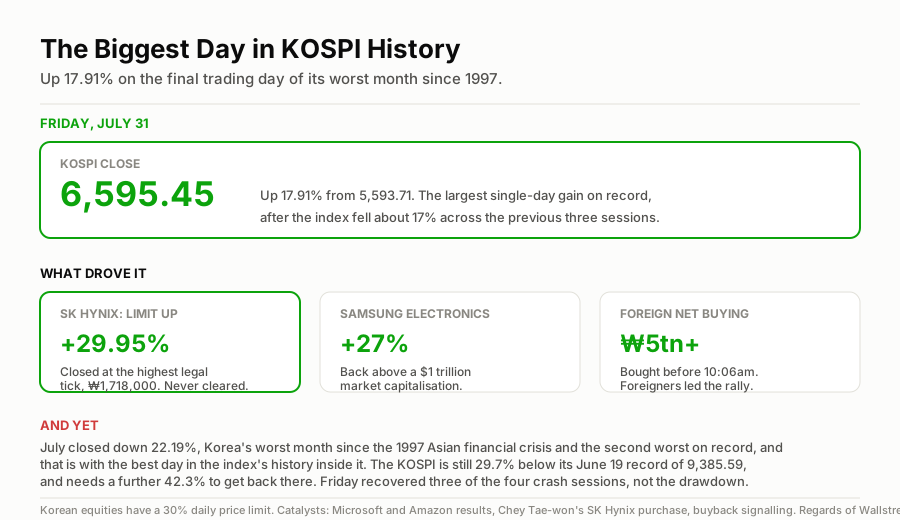
The best day in the index's history, inside its worst month since 1997.
What Limit-Up Actually Means
This is the detail most coverage will round off to "SK Hynix rose 30%", and it is the single most informative thing about the session.
Korean equities have a daily price limit of plus or minus 30%. Above ₩500,000 a share, prices move in ₩1,000 ticks. SK Hynix closed Thursday at ₩1,322,000. Add 30% and you get ₩1,718,600, which rounds down to the highest legal tick at ₩1,718,000. That is a gain of 29.95%.
That is exactly where SK Hynix closed.
So the stock did not rise 29.95% because that is where buyers ran out. It rose 29.95% because that is where the rules ran out. A limit-up close means the order book never cleared: there was still unfilled demand sitting at the bid when the bell went, and the market never discovered what the shares were actually worth on the day.
Two things follow from that, and they point in opposite directions.
The constructive reading. Unfilled demand has to go somewhere. Limit-up closes frequently see follow-through the next session, because the buyers who did not get filled are still buyers on Monday. The price discovery was postponed, not cancelled.
The cautionary reading. A limit move is also the signature of a market that has stopped pricing and started panicking in the other direction. The same mechanism that produced three circuit breakers in a week produced this. Violent moves in both directions are the same illness, not evidence of a cure. Nothing about a stock hitting a hard-coded ceiling tells you the ceiling is fair value.
The Three Catalysts, and Only One Is About Korea
Separating these matters, because they have very different shelf lives.
1. The US AI trade repriced, and it is not Korea's to keep. Microsoft rose about 9.5% on $678 billion of contracted backlog, and Amazon's AWS accelerated to 36.7%. Two of the three hyperscalers demonstrated that the capex is converting into revenue. That is real, and it directly supports memory demand. It is also entirely exogenous: Korea imported this rally, and it can import the next selloff just as fast.
2. The memory complex itself moved. SanDisk closed up 26.29% and the whole group rallied double digits, on Samsung's record quarter, a shortage Samsung expects to run into 2028, and DRAM contract prices projected up 13% to 18% next quarter. This is the most fundamental of the three.
3. Insider buying and buyback signalling, which is genuinely Korean. Chey Tae-won buying SK Hynix stock personally, for the first time, after the shares halved, is the highest-conviction signal available to a chairman. Combined with Samsung opening the door to a special dividend and cancellations, it tells you management thinks the price is wrong.
What is missing from that list is the thing that caused the crash. Nobody resolved the Chinese supply question. The rout began with reports of Chinese-developed DUV lithography reaching mass production, landing on top of CXMT's 466% Shanghai debut. Not one of Friday's three catalysts speaks to it. Bloomberg's framing of the session, that the leveraged unwind may be nearing its end, is a statement about positioning, not about the competitive threat.
The Number That Should Stop You Celebrating
July closed down 22.19%.
That is the worst month for Korean equities since the 1997 Asian financial crisis, and the second worst on record, behind only October 1997's 27.2%. And it includes a 17.91% day.
Sit with the arithmetic. The index needed the largest single-session gain in its entire history, on the final trading day of the month, to limit July to a 22% loss.
The drawdown math is worse than the bounce feels. The KOSPI peaked at 9,385.59 on June 19. It closed Friday at 6,595.45, which is 29.7% below that. To return to the record from here it needs another 42.3%, or roughly two and a half more days like Friday.
This is the asymmetry that catches people after violent rallies. A 17.91% gain off a 39.7% drawdown feels like the recovery. It recovers about a quarter of it.
Is This the Bottom, or a Dead Cat Bounce?
Our read: a real bottom is more plausible today than it was a week ago, and Friday is not the evidence for it.
The case that this is a bottom does not rest on the size of the move. It rests on three things that happened around it. Valuations halved. Insiders started buying with their own money. And companies began deploying balance sheets to defend the price. Those are the things that mark lows. A chairman making his first ever open-market purchase after a 50% decline is worth more as a signal than any single session's percentage.
The case against is that the move itself proves nothing. A 17.91% day is not what healthy markets do. Indices that gain a sixth of their value in a session are indices where forced sellers have finished and dip buyers have arrived at the same moment, and that mechanical flush is compatible with both a genuine low and a violent bear-market rally. The KOSPI has now printed three circuit breakers and a record up-day inside five sessions. That is a market with broken price discovery, not a market that has bottomed.
And the original bear thesis is untouched. Chinese memory capacity is still scaling. Contract prices being projected higher for Q3 does not tell you what 2027 supply looks like, which is exactly the argument that started the selling.
We got the mid-July version of this call wrong, and said so: the buy-the-dip piece named SK Hynix's earnings as the thing to wait for, and the print missed. The lesson we took from it applies again now. Wait for the catalyst that resolves the actual argument, not the one that changes the mood.
The Playbook
- Do not buy Friday. You are five sessions from three circuit breakers, on a day when the largest stock in the index could not legally trade higher. Implied volatility across Korean memory names is at the most expensive it has been all year, and buying calls into that is paying peak premium for a move that already happened. This is the same conclusion we reached on the US memory complex on Thursday, for the same reason.
- The unfilled-demand argument gives you Monday, not a position. If limit-up follow-through appears at the Monday open and then holds through the afternoon, that is information. Buying ahead of it is a guess.
- Watch the ADRs, not the Seoul close. SKHY trades in the US and prices continuously, with no 30% band. It will tell you what SK Hynix is actually worth long before Seoul reopens, and the gap between the ADR and the limit-up Seoul close is the cleanest read on how much of the 29.95% was real.
- The early-August SK Hynix shareholder return announcement is the next dated catalyst, with one large caveat. The ADR-related restriction genuinely lifts on August 4, but management guided to communicating plans "within the year", not this week. What is scheduled is a permission, not an announcement, and the difference matters for how you trade it.
- If you want exposure and can accept assignment, sell premium rather than buy it. Elevated volatility pays sellers. After a 30% limit move, that is the side of the trade with the wind behind it.
What Happened Next
Update, August 3: the KOSPI closed the following session down 5.12% at 6,257.45, handing back 338 of Friday's 1,001.74 points. SK Hynix fell 7.92% to ₩1,582,000 and Samsung 8.19% to ₩241,000, and US memory gapped with them. The read-through for Micron and the complex is in why Micron is down today.
The One-Line Read
The KOSPI rose 17.91% to 6,595.45 in the biggest single day of its history, with SK Hynix locked limit-up at ₩1,718,000 because Korean rules would not let it trade higher, on a US AI rally it imported, a chairman buying his own shares, and buyback signalling from two companies whose stock had halved: all of which still left July down 22.19%, the worst month since 1997, and the index 29.7% below its June record needing another 42.3% to get back, which is why this is a bounce worth respecting and not yet a bottom worth buying.
Next up:Fed decision, tomorrow →
More on $SKHY
Updated Every Saturday
The Week Ahead
Every earnings date, Fed event and setup for the current trading week, on one page.
Refreshed Weekly
Earnings Calendar
Who reports next, when, and what consensus and the whisper expect.
The Week-Ahead Brief
Don’t miss next week’s setups. Get the Sunday brief.
Latest issue, Sep 7“Week ahead in the stock market...”
Every Sunday: next week’s earnings dates, Fed days and the trades worth watching, from the same desk that writes the week-ahead hub. Free, built for retail investors.