The Fed Held, Three Members Voted to Hike, and the Bond Market Called It a Mistake. What Now?
The Fed held at 3.50-3.75% on a 9-3 vote with three dissents for a hike. The Dow fell 2.19% to 51,594.14, the 30-year hit 5.193%, and the Nasdaq is now 10% off its high. What happens next.
TL;DR
- The Fed held at 3.50% to 3.75% for a fifth consecutive meeting, but the vote was 9-3, and all three dissenters wanted a 25 basis point hike: Hammack, Kashkari and Logan.
- Stocks did not read that as a hold. The Dow fell 2.19% to 51,594.14, its worst session since April 2025. The S&P 500 fell 1.52% to 7,316.15. The Nasdaq Composite fell 1.74% to 24,442.94 and is now more than 10% below its all-time high.
- The real message was in bonds, and it was not about the level of rates. The 2-year fell 4bp to 4.236% while the 10-year rose above 4.67% and the 30-year jumped more than 9bp to 5.193%. Short end relaxed, long end panicked.
- That shape has one translation: the market thinks the Fed is behind on inflation. Chair Warsh said the Fed would not hesitate to stop it. The long bond did not believe him.
- Sectors told the same story. Industrials fell 3.42% and technology 2.36%, while energy and consumer defensives were among the only groups green.
More on $SPY: Stock Market Week Ahead (Sep 7-11): Labor Day, Apple's iPhone Event, Oracle, Adobe, and August CPI →
What Did the Fed Actually Decide?
Nothing, on rates. Everything, on communication.
The target range stayed at 3.50% to 3.75%, a fifth straight hold and exactly what consensus expected. We previewed the three branches on Saturday and said the smart pre-Fed move was a volatility decision rather than a rate forecast. That framing held up, because the surprise was never going to be the number.
Two things were surprising.
Three dissents, all hawkish. Beth Hammack of Cleveland, Neel Kashkari of Minneapolis and Lorie Logan of Dallas all voted to raise by 25 basis points. A 9-3 split is a serious crack. It says a meaningful minority of the committee thinks the current stance is too loose, and it puts a live hike on the table for September in a way that no amount of statement language can walk back.
The statement was much shorter than the norm. This was the second meeting under Chair Kevin Warsh, who has now stripped forward guidance out of the post-meeting statement entirely. We flagged that this would be Warsh's first real test, and the answer is that he is running the Fed with deliberately less signalling.
That has a consequence nobody priced. When the Fed stops telling the market where rates are going, the market has to guess, and it does its guessing in the long end of the curve.
The Board
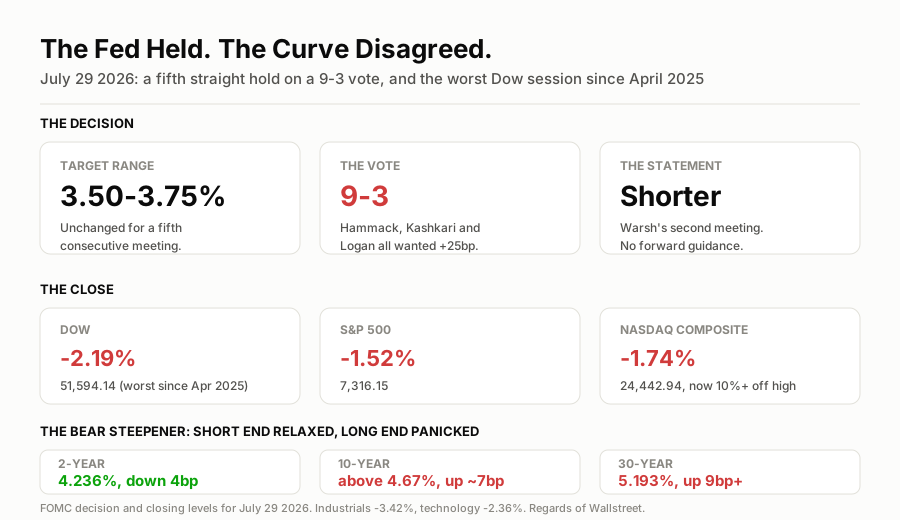
The decision was a hold. The curve was a verdict.
Read the Curve, Not the Statement
This is the part that actually explains a 1,000-plus point down day, and it is the part most coverage will skip.
- 2-year: down 4bp to 4.236%. The 2-year tracks where the market thinks policy rates go over the next couple of years. It fell. That is a dovish move.
- 10-year: up roughly 7bp, above 4.67%.
- 30-year: up more than 9bp to 5.193%.
Short end down, long end up. That is a bear steepener, and it is the single most uncomfortable shape a central bank can produce.
Here is what it means in plain English. The short end is saying the Fed will not hike much, maybe not at all. The long end is saying that is precisely the problem, because inflation over the next decade now looks less anchored than it did yesterday morning. The market is not pricing tighter policy. It is pricing a Fed that will let inflation run, and demanding to be paid more to hold thirty-year paper as compensation.
Warsh said the Fed would not hesitate to stop inflation. A 30-year yield above 5.19% is the bond market's way of saying it would like that in writing.
Why does that crush stocks? Because long yields are the discount rate on every future dollar of earnings, and because a 5%-plus 30-year makes equities compete for capital against a risk-free asset that just got more attractive. Long-duration growth stocks lose the most, which is why tech fell 2.36%, and cyclicals lose next, which is why industrials fell 3.42%. It is also why energy and defensives held: near-term cash flows, pricing power, no duration.
Where This Leaves the Indices
The Nasdaq Composite closed 1.74% lower at 24,442.94 and is now more than 10% below its record. That matters because of what we published this morning: the Nasdaq 100 had entered a correction at the open, and the Composite had not. Twelve hours later the Composite joined it. Our morning piece on the Nasdaq 100 correction has the full drawdown map, and the distinction it drew is now closed.
So the tally at the close: two Nasdaq indices in correction, semiconductors in a bear market more than 20% off their highs, and the Dow taking its worst single day since April 2025 on a day when the Fed did nothing at all.
Add one non-Fed variable, because it was real and it compounded everything: Middle East tensions escalated, which is both an oil bid and a reason to hold defensives. Energy being green on a 2% down day is not a coincidence.
What Now?
Three things decide the next week, in order of how much they matter.
1. Tomorrow's cash session, not tonight's after-hours tape. Microsoft, Meta, Qualcomm, Arm and Robinhood all reported into a closed market. Microsoft rose about 8% on Azure at 43% and $678 billion of contracted backlog, up 84%. Meta missed on EPS and traded down about 5%. Those moves were set on thin volume by a small number of participants, and Nasdaq 100 futures are up only about 0.7%, recovering less than half of today's loss. Thursday's open is where the real repricing happens. We have the breakdowns for each: Microsoft, Meta, Qualcomm, Arm and Robinhood, plus the question the 8% raises: can Microsoft save tech stocks?
2. The 30-year above 5%. This is the number to watch every morning now, ahead of the S&P. If the 30-year keeps climbing while the 2-year sits still, the equity market has a mechanical problem that no earnings beat can fix. If the long end settles back under 5.10%, today looks like a tantrum. Our framework for the long end is in the 10-year yield forecast.
3. September, and whether three dissents become five. A 9-3 vote is not stable. Either the data cools and the dissenters fold, or inflation firms and the hawks recruit. We argued weeks ago that the rate-cut trade was dead and the hike risk was live. Today's vote is the strongest evidence yet for that view, and it is now the base case rather than the contrarian one.
The Playbook
- Do not buy this dip on the theory that the Fed will rescue it. That was the trade for a decade and it is not the trade now. A committee with three hawkish dissents is not about to cut.
- Duration is the risk factor to manage, in both books. Long-dated growth equity and long-dated bonds are now the same trade wearing different clothes. If you are overweight both, you are twice as exposed to one variable.
- Defensives and energy earned their keep today, and that is a clue rather than a recommendation. Rotation this clean tends to persist for weeks, not days. It has already rewarded Coca-Cola, Ford and Boeing this week.
- If you want to express the bond view directly, understand what you are buying. A 5.19% 30-year is attractive yield and brutal price risk. Every further 10bp costs you capital. That is not a safe asset at this point in the cycle, it is a leveraged bet on inflation cooling.
- For options, the event is behind you and the vol is not. Selling premium into a market where the macro driver is unresolved and the long end is moving is picking up nickels in front of a steamroller. If you want defined exposure, buy it rather than sell it, and read calls and puts explained before you size anything into Thursday.
- Where this playbook is wrong: if tomorrow's data cools and the 30-year retraces, everything above is wrong and the correction ends as a three-week scare inside an up year. The S&P is still positive on 2026. Sizing for both outcomes beats being certain about either.
The One-Line Read
The Fed did nothing and the market fell 2% anyway, because three hawkish dissents plus a stripped-down statement plus a 30-year yield through 5.19% add up to a bond market that thinks policy is behind inflation: watch the long end every morning, treat duration as the single risk factor that matters, and stop waiting for a committee with three hike votes in it to come to the rescue.
Next up:Fed decision, Tuesday →
More on $SPY
$SPY · 2026-09-05
Stock Market Week Ahead (Sep 7-11): Labor Day, Apple's iPhone Event, Oracle, Adobe, and August CPI
$SPY · 2026-09-04
Options Scorecard: The Week of August 24, Graded (4 Calls, 75% Right)
$SPY · 2026-08-29
Stock Market Week Ahead (Aug 31-Sep 4): Broadcom, Dell, and a Jobs Report Into 57% Hike Odds
Updated Every Saturday
The Week Ahead
Every earnings date, Fed event and setup for the current trading week, on one page.
Refreshed Weekly
Earnings Calendar
Who reports next, when, and what consensus and the whisper expect.
The Week-Ahead Brief
Don’t miss next week’s setups. Get the Sunday brief.
Latest issue, Sep 7“Week ahead in the stock market...”
Every Sunday: next week’s earnings dates, Fed days and the trades worth watching, from the same desk that writes the week-ahead hub. Free, built for retail investors.