When Does AppLovin Report Earnings? August 5, and It Is Guiding 52% Growth While the Stock Is Down a Third
AppLovin reports Q2 2026 after the close on Wednesday August 5, call at 5:00pm ET. Guidance is $1.915bn to $1.945bn on an 84% EBITDA margin. Why the e-commerce pixel count matters more.
TL;DR
- AppLovin reports Q2 2026 after the close on Wednesday, August 5, with the webinar at 2:00pm PT / 5:00pm ET.
- Company guidance: revenue of $1.915bn to $1.945bn, roughly 52% to 54% growth against the $1.26 billion of advertising revenue in Q2 2025, with adjusted EBITDA of $1.62bn to $1.65bn on an 84% to 85% margin.
- Consensus diluted EPS of about $3.72, up 64.6% from $2.26. AppLovin has beaten in each of the last four quarters.
- And the stock is down about a third in 2026, closing $418.22 on July 28 before falling a further 3.28% on July 31.
- The reason for the disconnect is not in the guidance. It is in a third-party leading indicator: net new e-commerce pixels slowed to about 750 in June from about 950 in May.
When Does AppLovin Report Earnings?
The short answer: after the close on Wednesday, August 5, 2026, with the webinar at 2:00pm PT, which is 5:00pm ET.
It closes the busiest day of the week. Novo Nordisk, Eli Lilly, Shopify and Uber all report in the morning, Disney lands the same day, and AppLovin is the last word.
What the Company Guided
| Line | Q2 2026 | Comparison |
|---|---|---|
| Revenue guidance | $1.915B to $1.945B | up roughly 52% to 54% from $1.26B |
| Adjusted EBITDA guidance | $1.62B to $1.65B | |
| Adjusted EBITDA margin | 84% to 85% | |
| Consensus diluted EPS | ~$3.72 | up 64.6% from $2.26 |
| Q1 2026 actual revenue | $1.84B | beat the $1.77B consensus by 3.9% |
| Q1 2026 operating income | $1.44B | more than doubled |
| Analyst price targets | average $654.04, high $860, low $406 | |
| Options implied move | ~12% | May realised 11.1% against 11.7% implied |
Stop on the margin line for a second. An 84% to 85% adjusted EBITDA margin at a two billion dollar quarterly revenue run rate is among the highest of any company at scale anywhere. That is what happens when you sell software that allocates advertising, own no inventory, and have divested the games business that used to consume the cash.
The Board
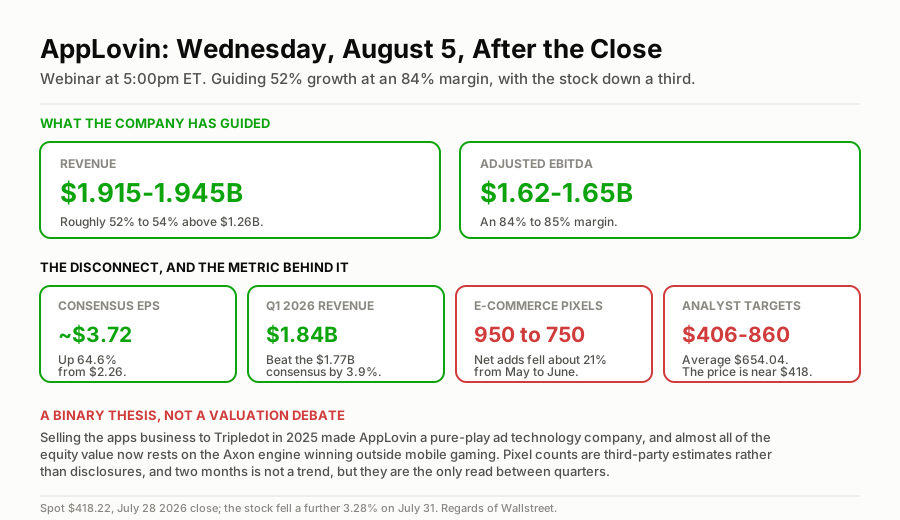
52% guided growth, an 84% EBITDA margin, and a stock down a third. One of those is not like the others.
Why a Company Guiding 52% Growth Fell a Third
This is the question, and the answer is that nobody is arguing about this year. The argument is entirely about what AppLovin becomes next.
The bull case for the last three years was that Axon, the AI engine that decides which advertisement to show which user, works better than anyone else's, and that AppLovin could take it out of mobile gaming and point it at everything else. Selling the apps business to Tripledot for $400 million on June 30, 2025 was the commitment: no more games, pure-play advertising technology, one engine, one addressable market that is the entire internet.
E-commerce is the proof of that thesis, and e-commerce is measured in "pixels": the tracking snippets merchants install to let AppLovin's engine attribute and optimise their advertising. Every pixel is a customer who has agreed to try it.
Third-party data suggests net pixel additions slowed to roughly 750 in June from roughly 950 in May. That is a decline of about 21% in the rate of new customer additions, in the single metric the entire expansion thesis rests on, in the quarter that reports on Wednesday.
Percentages need denominators, so be careful with this one. A fall in net adds is not a fall in customers; the installed base still grew in June, just more slowly. Two months is not a trend, and third-party pixel counts are estimates rather than disclosures. But it is the only public read on the thesis between quarters, and the market has traded it hard.
The Price Target Spread Tells You Everything
Look again at the analyst range: average $654.04, high $860, low $406, against a share price near $418 at the end of July.
The most bullish analyst thinks this stock doubles. The most bearish one thinks it is roughly correctly priced today. A spread that wide, on a company with clear guidance, published margins and four consecutive beats, is not a disagreement about the numbers. It is a disagreement about whether the e-commerce expansion is a new business or a good quarter.
That is the honest way to frame this stock: AppLovin is not a valuation debate, it is a binary one, and Wednesday delivers one more data point in a series that needs about six more before anyone can be confident.
The Three Things to Watch
1. Any e-commerce disclosure at all. Management has been sparing with segment detail. Advertisers onboarded, revenue from non-gaming verticals, self-serve adoption: any of these turns the pixel guesswork into a fact. The absence of disclosure is itself information, and after a soft third-party read it would be read badly.
2. The Q3 guide against a 52% comparison. Growth of 52% is exceptional and it is also lapping increasingly hard numbers. The rate at which the guided growth rate steps down is the single cleanest signal about whether the expansion is compounding or maturing.
3. Whether the 84% margin holds as the customer mix changes. Mobile gaming advertisers are a concentrated, sophisticated, high-value customer base. E-commerce merchants are numerous, small and expensive to serve. A self-serve platform is the answer to that, and self-serve platforms have lower margins than concentrated enterprise ones. If the margin guide steps down while revenue accelerates, that is the mix telling you what kind of company this is becoming, exactly as the gross profit gap does at Shopify.
Is AppLovin a Buy Down a Third?
Only at a position size you would be comfortable losing half of, and that is not a throwaway line, it is the actual recommendation.
The financial profile is extraordinary: 52% guided growth, an 84% EBITDA margin, four straight beats, and a business model with almost no capital intensity. Those numbers on a stock down a third look like an obvious opportunity.
The reason it is not obvious is concentration of thesis. Almost all of the value in the equity depends on one engine continuing to outperform in one new market, verified by a metric the company does not disclose and outsiders have to estimate. There is no dividend, no asset backing and no second business to fall back on since the games were sold. When a single variable carries the whole valuation, the distribution of outcomes is wide in both directions, and the analyst targets are simply saying that out loud.
The bull case: Axon genuinely is better, e-commerce is a market ten times the size of mobile gaming advertising, and the June pixel slowdown is seasonal noise that the July and August numbers reverse.
The bear case: the easy e-commerce customers have been acquired, incremental ones cost more and convert worse, and a 52% grower decelerating toward 30% does not hold this multiple. A stock that ran more than 1,400% in three years does not need bad news to fall, only a slower good one.
The Options Angle
- This is the highest-variance print of the week and the options should be treated accordingly. A binary thesis, a leading indicator that just wobbled, an after-close report and a price target range from $406 to $860 is a recipe for a large move.
- Options price a move of about 12%, and AppLovin has beaten its implied move in four of the past eight prints. In May it realised 11.1% against 11.7% implied, which is close enough to a coin toss that the edge has to come from the view rather than the volatility.
- The house reflex of selling expensive premium is exactly wrong here, and it is the mistake that cost readers repeatedly through July when realised moves beat implied across the board. We are not making it in the single most binary name on the calendar.
- At roughly $418, one contract controls about $41,800 of stock. That is a serious notional and it removes covered calls and cash-secured puts from most retail accounts, in the same way it does for Caterpillar the day before. Fractional options do not exist. If you cannot own 100 shares, you cannot write the call.
- The defined-risk expression is a strangle or a wide call spread. Both cost less than an at-the-money straddle and both survive being directionally wrong for one session.
- Live option prices could not be sourced at the time of writing, and the exact July 31 close could not be sourced either, so the log below is anchored to the last confirmed close.
Trade log
| # | Stance | Structure | Strikes and expiry | Cost or credit | Spot at writing | Implied move | Breakeven |
|---|---|---|---|---|---|---|---|
| 1 | Long volatility | Long strangle | ~$470 call / ~$370 put, first expiry after Aug 5 | debit not sourced | $418.22 (Jul 28, 2026 close; fell a further 3.28% on Jul 31) | ±12% | needs a move beyond roughly ±12%, about $50 |
| 2 | Pass | Short premium into the print | any | credit not sourced | $418.22 | ±12% | binary thesis, wide analyst range |
| 3 | Pass | Covered call on an existing holding | any strike | credit not sourced | $418.22 | ±12% | caps the only case for owning it |
Rows 2 and 3 are logged as passes so they get scored. We are explicitly telling readers not to sell volatility in AppLovin, which is a call that loses if the stock moves less than the options cost.
The One-Line Read
AppLovin reports after the close on Wednesday August 5, guiding revenue of $1.915 to $1.945 billion at an 84% to 85% adjusted EBITDA margin, which is roughly 52% growth at a margin almost no company at this scale achieves, and the stock is still down about a third this year: the disconnect is not about the quarter but about one number the company does not publish, the rate at which e-commerce merchants install its pixel, which third-party data says slowed from about 950 net adds in May to about 750 in June, and the analyst targets running from $406 to $860 are just that single uncertainty written down twice.
More on Earnings
$PPL · 2026-08-02
When Does PPL Report Earnings? August 7, and It Is the Boring Way to Own the Data Centre Power Trade
$TTWO · 2026-08-02
When Does Take-Two Report Earnings? August 7, and the Quarter Being Reported Barely Matters
$LNG · 2026-08-02
When Does Cheniere Report Earnings? August 6, and Its Last Quarter Was a $3.5 Billion Loss and a Guidance Raise
The Sunday Setup
Enjoyed this breakdown? Don’t miss the next market setup.
Get deep-dive analyses delivered to your inbox every Sunday. Free, and built for retail investors.
Comments
0 totalNo comments yet. Be the first to drop a take.