When Does Merck Report Earnings? August 4, and Consensus Is a Loss That Has Nothing to Do With the Business
Merck reports Q2 2026 before the open on Tuesday August 4. Consensus is a loss of $0.26 on $16.33bn of revenue, up 3.3%. Why the loss is an accounting artefact and Keytruda is the real story.
TL;DR
- Merck reports Q2 2026 before the open on Tuesday, August 4.
- Consensus is a loss of $0.26 a share on revenue of about $16.33 billion, up 3.3%. The loss is not a warning about the business.
- It is an accounting artefact. The Terns acquisition carries a one-time R&D charge of roughly $5.8 billion, about $2.35 a share. Add that back and the underlying quarter is roughly $2.10 and close to flat year over year.
- This is the second quarter in a row with a charge like this. Q1 2026 carried $3.62 a share from the Cidara acquisition.
- Keytruda is expected at about $8.06 billion, roughly half of all Merck revenue, and its US exclusivity ends in 2028. Everything Merck is buying is an answer to that one date.
When Does Merck Report Earnings?
The short answer: before the open on Tuesday, August 4, 2026.
It is a busy morning. Caterpillar reports at 6:30am ET, McDonald's reports before the open, and Pfizer's performance report lands the same morning with its call at 10:00am ET. Two of the three largest US pharmaceutical companies report within hours of each other, which makes Tuesday a genuine sector read rather than a single-stock event.
What the Street Expects
| Line | Q2 2026 consensus | Comparison |
|---|---|---|
| Headline EPS | −$0.26 | includes a one-time acquisition charge |
| Underlying EPS, charge added back | ~$2.10 | roughly flat year over year |
| Revenue | ~$16.33B | up 3.3% |
| Keytruda | ~$8.06B | up 1.3% |
| Terns one-time R&D charge | ~$5.8B, about $2.35 a share | |
| Options implied move | ~3.9% |
The Board
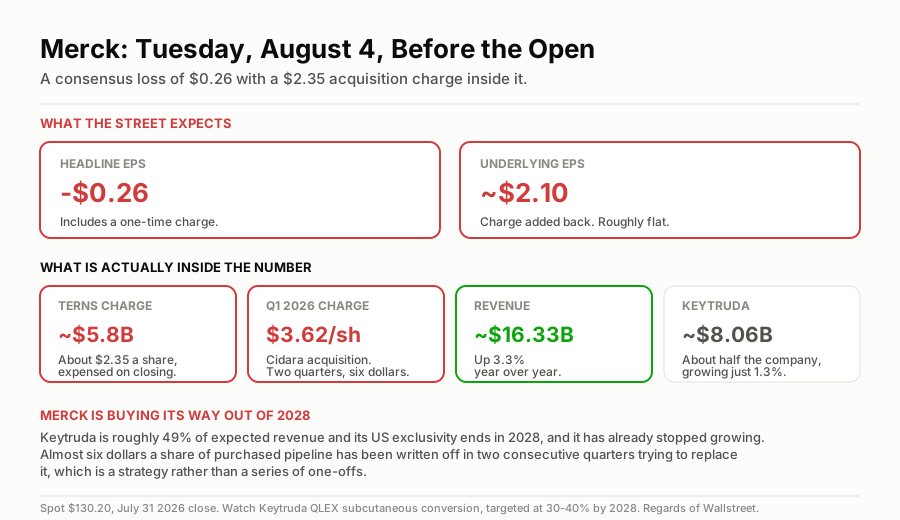
A consensus loss with a $2.35 charge inside it. Read the composition, not the headline.
Read the Composition, Not the Headline
The house rule on every earnings print is to ask what is inside the number before deciding whether it is good or bad. That rule runs in both directions, and Merck is the clearest example this season of a headline that looks alarming and is not.
The Zacks consensus carries a loss of 26 cents. The cause is that when Merck buys a clinical-stage company, accounting requires the acquired in-process R&D to be expensed immediately rather than capitalised. The Terns deal produces a charge of roughly $5.8 billion, about $2.35 a share, plus a further $0.12 of ongoing drag across 2026. Strip the one-off out and the quarter is around $2.10, roughly level with last year.
Do not let that make you relaxed either. Look at the pattern:
- Q1 2026: a $3.62 per share charge from the Cidara acquisition.
- Q2 2026: a roughly $2.35 per share charge from the Terns acquisition.
That is almost six dollars a share of acquired R&D expensed in six months. Individually each is a one-off. Together they are a strategy, and the strategy has a name: Merck is buying its way out of 2028.
Whether that money is well spent is the only question about this company that matters, and one quarter will not answer it. What Tuesday can tell you is whether the operating business is funding it comfortably.
The 2028 Problem, Sized Properly
Keytruda is expected at about $8.06 billion for the quarter against total revenue of about $16.33 billion. That is roughly 49% of the company, from one drug, and its US exclusivity ends in 2028.
Percentages of what, exactly: half of revenue, not half of profit. Because Keytruda is a high-margin oncology biologic, its share of Merck's operating profit is higher than its share of revenue. The revenue number understates the exposure rather than overstating it.
Notice also the growth rate. Keytruda is guided to grow 1.3% while the whole company grows 3.3%. Merck's biggest drug has already stopped growing, two years before it loses exclusivity, and the rest of the portfolio is now carrying the increase. That is either reassuring or terrifying depending on which you were expecting.
The Three Things to Watch
1. Keytruda QLEX conversion. The subcutaneous formulation is the single most important defensive asset Merck owns. Biosimilar competitors will copy the intravenous product; a patient successfully moved onto a subcutaneous version with its own patent life and a different administration setting is a patient who is much harder to switch. Merck is targeting roughly 30% to 40% adoption by 2028. Any conversion figure disclosed on Tuesday is more valuable than the EPS line.
2. The full-year sales guide. Merck tightened its 2026 sales view at Q1. Tightening again is fine; narrowing downward is not. This is the recurring lesson of the season, and Apple's record margin losing to a soft guide is the version everyone remembers.
3. Whether the acquisitions have stopped. Two large charges in two quarters. A third would tell you management does not think the pipeline is fixed yet, and each one is real cash leaving the business even though it is presented as non-recurring.
Is Merck a Buy at $130?
It is a hold with a specific catalyst, and the catalyst is not this quarter.
The stock closed $130.20 on July 31. Merck has traded at a persistent discount to the pharmaceutical group for two years and the discount has one cause: the market has decided it knows how 2028 ends. A cheap multiple attached to a known cliff is not a bargain, it is a correctly priced cliff. The re-rating comes when a specific acquired asset produces a specific number, not when the P/E looks low.
The bull case is that the market is double-counting the risk. Merck has beaten estimates in each of the last four quarters with an average surprise of 7.75%, the non-Keytruda business is growing faster than the company average, and roughly six dollars a share of R&D has just been bought and immediately written off, which means any success from it arrives with essentially no carrying cost on the balance sheet.
The bear case is that a large pharmaceutical company facing a cliff this size has exactly one playbook, which is to buy pipeline at whatever price is asked, and the historical hit rate on that playbook across the industry is poor. You are being asked to trust capital allocation, not chemistry.
The Options Angle
- Merck is a low-volatility mega-cap that prints before the open. The realistic reaction is low single digits unless the guide moves, which makes it a poor candidate for buying premium.
- The specific trap here is a reader seeing "consensus loss of $0.26", seeing Merck report a loss, and selling. If the reported loss lands near the consensus loss, that is an in-line quarter, not a disaster. Know which number you are reading before the market opens.
- Covered calls are the reasonable structure for holders: a dividend-paying pharma with a capped medium-term upside and a well-telegraphed risk is close to the textbook case for the strategy.
- Options price a move of about 3.9%, which is the market agreeing that a guided quarter with an accounting charge in it is not an event.
Trade log
| # | Stance | Structure | Strikes and expiry | Cost or credit | Spot at writing | Implied move | Breakeven |
|---|---|---|---|---|---|---|---|
| 1 | Income, holders only | Covered call | ~$137.50 strike, first monthly after Aug 4 | premium not sourced | $130.20 (Jul 31, 2026 close) | ±3.9% | caps upside above +5.6%, outside the implied move |
| 2 | Pass | Long puts on the "consensus loss" headline | any short-dated | debit not sourced | $130.20 | ±3.9% | needs a real decline, not an accounting one |
| 3 | Pass | Long straddle into the print | at-the-money weekly | ~3.9% of spot | $130.20 | ±3.9% | needs a move beyond ±3.9%, about $5.08 |
Rows 2 and 3 are logged as passes so they get scored. If Merck moves more than 5% on Tuesday morning, both were wrong.
The One-Line Read
Merck reports before the open on Tuesday August 4 with a consensus loss of $0.26 that exists only because roughly $5.8 billion of Terns acquisition R&D gets expensed on the day it closes, so the underlying quarter is about $2.10 and roughly flat: the real content is that Keytruda is expected at $8.06 billion, close to half the company, growing 1.3% two years before it loses US exclusivity, and that Merck has now written off almost six dollars a share of purchased pipeline in two consecutive quarters trying to replace it.
More on Earnings
$PPL · 2026-08-02
When Does PPL Report Earnings? August 7, and It Is the Boring Way to Own the Data Centre Power Trade
$TTWO · 2026-08-02
When Does Take-Two Report Earnings? August 7, and the Quarter Being Reported Barely Matters
$LNG · 2026-08-02
When Does Cheniere Report Earnings? August 6, and Its Last Quarter Was a $3.5 Billion Loss and a Guidance Raise
The Sunday Setup
Enjoyed this breakdown? Don’t miss the next market setup.
Get deep-dive analyses delivered to your inbox every Sunday. Free, and built for retail investors.
Comments
0 totalNo comments yet. Be the first to drop a take.