What Is A Straddle? The Bet That Doesn't Care Which Way The Stock Goes
The Bet You Make When You Don't Know The Direction
A company reports earnings tomorrow. You're certain the stock is about to move hard (the whole market is holding its breath) but you have genuinely no idea which way. Up on a blowout, down on a miss. Betting on a call feels like a coin flip. Betting on a put feels like the same coin flip.
So you buy both.
You buy the $100 call for $400 and the $100 put for $400, same strike, same expiration. Total bill: $800. Now you don't care about direction at all. If the stock rockets, the call prints and the put dies. If it collapses, the put prints and the call dies. You're not betting which way; you're betting that something big happens. The only outcome that kills you is the stock sitting still.
That combo is a straddle. If "call" and "put" aren't yet second nature, take five minutes with the options primer first, because the premium you just paid is about to become your entire problem. Drag the slider:
At $100 you lose $800: about the worst this trade can do.
The Dead Zone Is Bigger Than You Think
Park the slider at $100 and look at the number: −$800. That's the trap. Both options are worth nothing when the stock finishes exactly at the strike, and you've torched the whole premium. Now here's the mistake every first-timer makes: slide over to $103. Your call is worth $300, your put is worth zero, and you're still down $500. The stock moved 3% in the right direction and you lost money.
Read that twice. You are not betting the stock moves. You're betting it moves more than $8, because that's what you paid, split across two options. The break-evens sit at $92 and $108, and everything between them is a loss. The stock has to clear that whole moat before you see a cent.
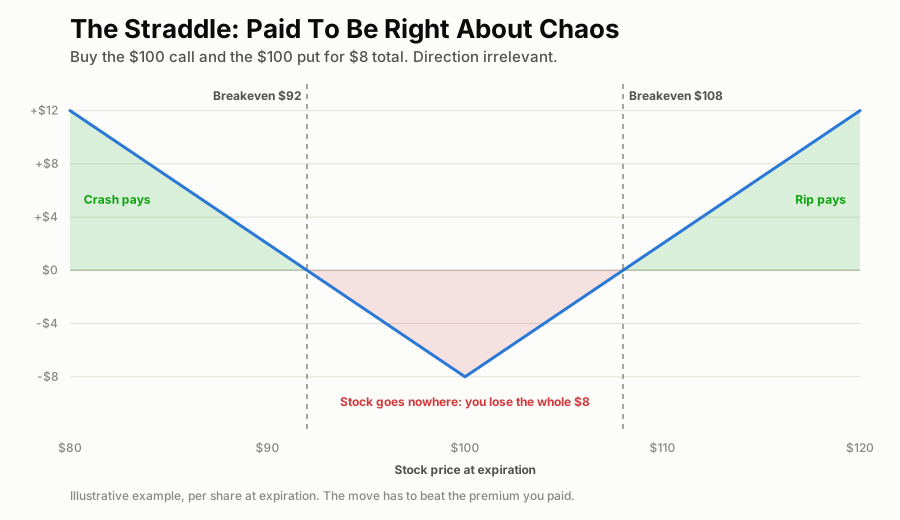
The V of the straddle: profitable on both wings, dead in the middle.
The Two-Line Version
- A straddle is a call plus a put at the same strike and expiration. You win on a big move in either direction.
- Your max loss is the total premium, hit when the stock pins the strike and both legs die.
- The stock has to move more than the combined premium to pay you. On earnings plays, that hurdle is fat on purpose.
- The silent killer is IV crush: the drama premium collapses after the event and deflates both your options at once.
Earnings: Where Straddles Feast And Die
That earnings setup is the classic straddle use case: a binary event where you know violence is coming but not the direction. Earnings, an FDA ruling, a court decision, a Fed meeting. The straddle turns "something's about to blow" into an actual position.
But the option sellers own the same calendar you do. In the week before earnings, everyone piles in, and that $800 straddle inflates to $1,100. The market has priced in the expected move, and you only profit if reality beats the price. This is implied volatility doing its job: charging you upfront for the fireworks everyone's expecting.
Then comes the crush. The instant the report drops, the uncertainty evaporates and the premium deflates out of both legs at once. That's IV crush, and it's how a trader buys a straddle, watches the stock gap 6%, and still loses money, because the market had priced in 8%. The event happened. The drama was insufficient. You paid for a hurricane and got a thunderstorm.
The Cheaper Cousin, And The Dangerous Mirror
The straddle has a budget version. Slide the two strikes apart (put below the stock, call above) and you've built a strangle: smaller premium, smaller max loss, but the stock has to travel further before either leg is worth anything. Straddles cost more and start paying sooner; strangles are the lottery-ticket version. Pick based on how big you honestly think the move is, not on which sticker price is smaller, because cheaper always has a reason.
And everything above has a mirror image: sell the call and the put, collect the $800, and profit if the stock stays still. Sellers win exactly where buyers lose. The catch is the tails: the buyer's worst case is the premium, but the seller's worst case is unbounded in both directions, which is why the short straddle has vaporized more accounts than any other named strategy. If "get paid for boredom" appeals to you, do it with the loss capped: that's the iron condor, which exists precisely because naked straddle selling ends careers.
So When Does It Print?
Buy straddles when you expect violence the market hasn't priced in: the sleepy stock with a catalyst nobody's watching, the macro print after three quiet months, the name where implied volatility is asleep and the chart is coiling. Skip them when the event is circled on everyone's calendar and the premium already assumes fireworks. The straddle is a bet against consensus calm, and it pays worst exactly when the crowd already agrees with you.
The Week-Ahead Brief
Don’t miss next week’s setups. Get the Sunday brief.
Latest issue, Oct 11“September CPI, the big banks and TSMC: earnings season starts”
Every Sunday: next week’s earnings dates, Fed days and the trades worth watching, from the same desk that writes the week-ahead hub. Free, built for retail investors.