Jensen Huang's $100 Billion Gigawatt Just Became Nvidia's Biggest Problem
Huang says AI computing costs are heading from $50 billion toward $100 billion per gigawatt. Seaport says that math forces Nvidia to finance its own customers. Why one supply-chain comment knocked the whole AI trade.
TL;DR
- Huang's own numbers: AI computing costs are climbing from roughly $50 billion toward $100 billion per gigawatt of data center.
- Seaport drew the conclusion the bulls won't: at those costs, customers can't carry the bill alone, so Nvidia increasingly has to help finance its own buyers.
- The market has seen that movie. It's called vendor financing, it starred Lucent and Nortel, and it's one of the most reliable late-cycle signatures in the history of tech.
- Nvidia's demand is real and its moat is real. But the cost curve pointing the wrong way is the first crack in the one thing the whole trade depends on: customers who can afford to keep buying.
More on $NVDA: DeepSeek Raised AI Prices 4.5x the Week OpenAI Hit Pause. What It Says Before Nvidia's Print →
The Math
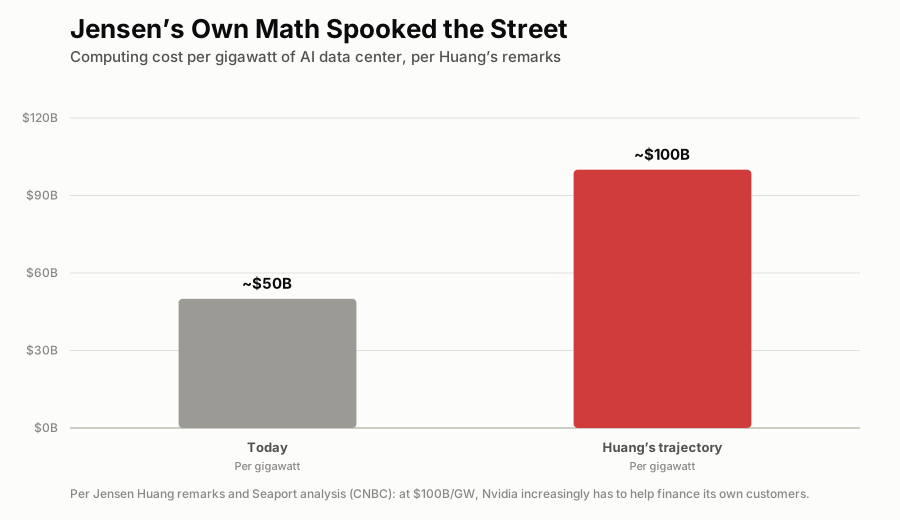
The most bullish man in the industry describing his customers' bill doubling. The street did the rest of the math itself.
Nobody shorted Nvidia today because a bear said something. The AI complex sold off because its biggest bull described a cost curve going vertical. When a gigawatt of AI compute runs $50 billion and the trajectory points to $100 billion, the total addressable market stops being bounded by demand (infinite, apparently) and starts being bounded by financing capacity. Who has a spare $100 billion per gigawatt? A handful of hyperscalers, a couple of sovereigns, and after that the customer list gets thin, fast.
Why "Vendor Financing" Is the Scariest Phrase in Tech
Seaport's point lands because history loaded it. In the late-90s telecom buildout, equipment makers kept their growth alive by lending customers the money to buy their gear. Revenue looked spectacular right up until the customers, who could never really afford the equipment, stopped paying, and the vendors ate both the lost sales and the dead loans. Lucent and Nortel were the two most valuable companies in their sector when it started.
Nvidia helping finance its customers' buildouts is not automatically that. Its customers today are the most creditworthy entities on Earth, not dot-com CLECs. But the direction rhymes: when the seller starts subsidizing the buyer, it means organic demand at current prices has a ceiling, and the revenue booked beyond that ceiling carries the seller's own balance sheet risk. The market marked the whole complex down today because it knows exactly which movie this is the trailer for, even if the feature never plays.
Where That Leaves NVDA Itself
Hold two things at once. First: NVDA at a ~21x forward multiple (the flat-year piece still stands) is priced like a mature industrial, so the cost-curve fear is landing on a stock that's already cheap by its own history; this is nothing like marking down a 72x NVDA. Second: the gigawatt math is a genuine ceiling question, and ceiling questions compress multiples for as long as they stay open. Both are true. The result is a stock that's hard to hurt badly from here and hard to re-rate upward until someone answers the "who pays" question with something other than "Nvidia, eventually."
The answer, when it comes, arrives through one of three doors: compute costs per unit of output falling faster than the gigawatt bill rises (Huang's actual argument), AI revenue at the customer level showing up big enough to service the capex, or the buildout slowing. Two of those three are fine for NVDA. The market spent today pricing the third.
The Options Angle
- NVDA is the wrong instrument for this fear; the financed customers are the right one. If vendor-financing risk materializes, it shows up first in the weakest AI-capex borrowers, not in Nvidia's own print. The sharper bear expression is puts on leveraged data-center and AI-infrastructure names, not on the company with $40 billion of cash.
- For NVDA itself, the LEAPS thesis survives today and gets a better entry. January 2027 calls at the money were the trade at $197; they're better a few percent lower with IV bid. The cost-curve question takes quarters to resolve, and a 21.7x multiple pays you to wait for it.
- Watch one number in NVDA's next print: receivables and financing commitments. Revenue growth with receivables growing faster is the vendor-financing tell in accounting form. That line item, not the EPS beat, is where this thesis gets confirmed or killed.
The One-Line Read
Huang described his customers' bill doubling, Seaport translated it into the scariest phrase in tech, and the market repriced the entire complex in an afternoon. The demand is real, the moat is real, and the question that matters has changed: no longer "how fast can Nvidia grow" but "how long can its customers afford it." Every AI valuation from here hangs on that answer.
Next up:PPI, tomorrow at 8:30am ET →
More on $NVDA
$NVDA · 2026-08-20
DeepSeek Raised AI Prices 4.5x the Week OpenAI Hit Pause. What It Says Before Nvidia's Print
$NVDA · 2026-08-10
Is Nvidia a Buy Before August 26 Earnings? Yes, With One Caveat That Decides the Sizing
$NVDA · 2026-08-10
Nvidia Earnings Preview (August 26): The $91 Billion Bar, Zero China in the Guide, and What Beats Are Worth
Updated Every Saturday
The Week Ahead
Every earnings date, Fed event and setup for the current trading week, on one page.
Refreshed Weekly
Earnings Calendar
Who reports next, when, and what consensus and the whisper expect.
The Week-Ahead Brief
Don’t miss next week’s setups. Get the Sunday brief.
Latest issue, Sep 7“Week ahead in the stock market...”
Every Sunday: next week’s earnings dates, Fed days and the trades worth watching, from the same desk that writes the week-ahead hub. Free, built for retail investors.