Stock Market Week Ahead (Sep 14-18): Fed Hike, Dot Plot, Retail Sales, Lennar and Quad Witching
TL;DR
- Wednesday carries the week. A quarter-point rise to 3.75%-4.00% is almost fully priced: CME FedWatch odds ended last week around 85-90% after August CPI's hot core, up from roughly 70% the day before. The dot plotThe dot plot is a chart the Fed publishes four times a year showing where each of its 19 policymakers expects interest rates to be at the end of this year and the next few. Each dot is one anonymous official. Markets watch the median dot, because it shows whether the committee as a whole still expects to raise or cut. publishes in the same release, and it is the part that is not priced.
- Monday and Tuesday are quiet. Hain Celestial and Dave & Buster's both reported Monday and both missed; Hain also agreed to sell its international business for about $323 million to pay down debt, and Dave & Buster's fell roughly 12% after hours on the miss. Tuesday brings the Empire State survey at 8:30am ET, a 20-year Treasury auction at 1:00pm and Trip.com after the close.
- Wednesday delivered on the whole lineup. August retail sales rose 1.2%, beating the roughly 0.8% consensus; the Fed raised its target range a quarter point to 3.75%-4.00% on a 12-0 vote and lifted the dot plot's 2026 median to 4.1% (full breakdown); and Lennar missed on revenue and earnings after the close, cutting its full-year delivery guidance, with shares down about 2% after hours.
- Thursday is two central banks: the Bank of England at 7:00am ET, then housing starts, building permits, jobless claims and the Philadelphia Fed survey all at 8:30am, with the Bank of Japan overnight into Friday.
- Friday is quadruple witching, and index funds trade the S&P 500 rebalance into that close: Bloom Energy, Illumina and Everpure join the index, Molson Coors, The Trade Desk and Builders FirstSource leave.
What to Expect From the Stock Market This Week
One hike decision, one dot plot projection, and no exciting earnings. With a hike already priced in, oil might be the most interesting thing to watch, after Brent jumped nearly 9% last week on Middle East supply risk, per CNBC.
Stocks went into the weekend higher. The S&P 500 closed Friday's regular session at 7,656.98, up 0.86%. The Dow at 52,573.29 and the Nasdaq Composite at 26,333, up 0.96%, per the Associated Press tally. That broke a four-session losing streak, and on a day when inflation reading came in hot (bad news was already priced in...). Brent oil fell close to 3%, and that likely did more to sooth markets than the inflation figures did. Oil still closed over $100 a barrel. The sector heatmap has the day-by-day read.
So stocks rallied and traders raised the odds of a rate hike from 70% to nearly 90%. The market can price in a rise in rates and still go up when the biggest input to next month's inflation reading gets (slightly) cheaper.
The Board
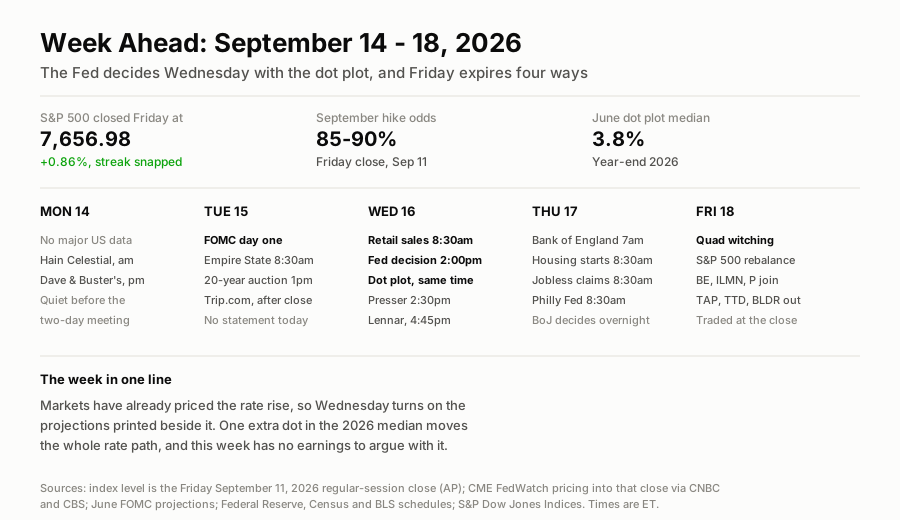
Wednesday carries the week. Friday just moves a lot of stock.
What Time Is the Fed Decision This Week?
2:00pm ET on Wednesday, September 16, with the chair's press conference half an hour later. The FOMC meets across Tuesday and Wednesday, and this is one of the four meetings a year that publishes projections alongside the statement. Live coverage will be front page on this site.
Pricing on a quarter-point rise to 3.75%-4.00% sat near 85-90% at Friday's close. CNBC put CME FedWatch at 85-86% and CBS News at 90%. Both had it around 70% the day before. The Fed hub tracks every move in that number. It moved after August's core inflation reading came in a tenth hotter than forecasted.
The Dot Plot Is the Part That Isn't Priced in
A hike everyone expects will not move much. The dot plot projections might.
In June, nine officials pencilled in at least one increase for 2026, eight wanted none and one wanted a cut. The year-end median came out at 3.8%, which is one quarter-point rise from where rates sit now. Wednesday's hike satisfies that median.
The new median is what matters. If it lands higher, the committee is signalling a second increase before Christmas. Higher rates for longer discount future profits more, so the stocks that get hurt most are the ones priced on earnings years away (basically everything AI related...). If the median stays at one, the 2027 projections become more important.
Chair Warsh filed no projection in June and has argued against forward guidance since taking the job. A dot under his name would be news on its own. The full dot plot preview is here.
Monday and Tuesday: A Quiet Open
Updated September 14, 6:40pm ET: Monday's two reports are in, and both missed. Hain Celestial's adjusted loss widened to $0.05 a share on $263 million of revenue, short of the $0.03 loss and $269 million Wall Street modeled, while announcing a $323 million sale of its international business to cut debt. Dave & Buster's missed by more: an adjusted $0.27 loss against a $0.19 profit expected, and the stock fell roughly 12% after hours. Details below.
Monday was empty on the US data calendar, with only Hain Celestial and Dave & Buster's reporting. Hain Celestial's fiscal Q4 adjusted loss came in at $0.05 a share on $263 million of revenue, both short of the $0.03 loss and $269 million analysts had modeled, per the company's release. Total net sales fell 28% year over year, but that is almost entirely the North American snacks business Hain has been selling off: strip that out and North America's remaining portfolio grew 2% organically, with adjusted EBITDA there up 55%. The same morning, Hain agreed to sell its international business (Ella's Kitchen, Linda McCartney and half a dozen smaller brands) to private equity firm AURELIUS for about $323 million, with the roughly $305-310 million of net proceeds earmarked to cut debt by more than half, from about $500 million to $250 million pro forma. The stock closed the regular session down 3.1% at $0.60, per stockanalysis.com.
Dave & Buster's reported after the close and did worse. Revenue of $544.1 million missed the $556.8 million consensus and fell 2.9% on a comparable-store basis; the adjusted result flipped from the $0.19-a-share profit analysts expected to a $0.27 loss, as operating costs climbed to 96.4% of revenue from 90.5% a year earlier, per the company's release. Adjusted EBITDA fell 24% to $98.9 million. Shares, which had closed the regular session up 4% at $8.47 ahead of the report, fell about 12-13% in after-hours trading on 5x average volume, per stockanalysis.com and StockTitan.
Tuesday brings the Empire State manufacturing survey at 8:30am ET, a 20-year Treasury auction at 1:00pm and Trip.com after the close. The FOMC meeting opens the same day and produces nothing public. Every confirmed date sits on the earnings calendar.
Wednesday, September 16: Retail Sales at 8:30, the Fed at 2:00, Lennar at 4:45
Updated September 16, 6:45pm ET: retail sales beat, the Fed hiked, and Lennar missed. August retail sales rose 1.2% against a roughly 0.8% consensus, keeping the resilient-economy case intact going into the decision. The Fed then raised its target range a quarter point to 3.75%-4.00% on a 12-0 vote and lifted the dot plot's 2026 median to 4.1%; stocks closed lower after Chair Warsh's press conference, and the Fed hub carries the full timeline, the dot plot table and the close. Lennar reported after the close and missed on both lines:
Reported Expected A year ago Revenue: $8.05bn $8.37bn $8.81bn Adjusted EPS: $1.23 (GAAP $1.19) $1.30 $2.00 (GAAP $2.29) Deliveries: 20,840 homes, down 3% Gross margin: 15.8% 17.5% FY2026 delivery guide: 80,000-81,000 homes cut from 82,000-83,000 Shares fell about 2% in after-hours trading, to roughly $76.65 from a $78.36 close, a milder move than the roughly 5-6% straddle the options market had priced. The two soft-consumer and rate-shock scenarios below did not both land: the consumer held up, but the homebuilder read confirms the demand problem anyway.
August retail sales publish at 8:30am ET, five and a half hours before the rate decision, per the Census Bureau's schedule. July's report fell 0.6% to $763.6 billion against forecasts for a small rise, and the control group that feeds GDP fell 0.5%. Strip out online sales and the rest of that group actually rose, which is why July's report wasn't too alarming.
Two soft months in a row would not be ignored so easily. It would leave the Fed tightening into a household sector already cutting back. One number won't make the committee blink, but it would change the tone of the press conference.
Lennar reports at 4:45pm ET, with its call on Thursday morning. Analysts want $1.30 a share on $8.37 billion of revenue, against $2.00 a year ago, per Yahoo Finance's compilation. Options price a move of about 6%, taking the September 18 straddle against Monday's close; Bloomberg's implied-move convention discounts the same contracts to 5.2%. Homebuilders are a good read on what mortgage rates have done to demand, and Lennar reporting just hours after a rate rise makes the timing especially relevant.
Thursday, September 17: Two Central Banks and the 8:30 Stack
The Bank of England decides first, at 7:00am ET. Bank Rate has sat at 3.75% since late 2025 and a hold is widely expected.
Then the 8:30am slot stacks up: housing starts, building permits, weekly jobless claims and the Philadelphia Fed survey all land together.
The Bank of Japan follows overnight into Friday. It raised rates to 1.00% in June and held there in July, and markets lean heavily towards another quarter point rise now.
Friday, September 18: Quad Witching and the Rebalance
Stock index futures, index options, single-stock options and single-stock futures all expire together on the third Friday of September. Volume runs well above normal and so does intraday noise. Much of a witching day's midday movement is expiry mechanics rather than news, and a good deal of it unwinds before the close.
The rebalance: Bloom Energy, Illumina and Everpure join the S&P 500 before Monday's open. Molson Coors, The Trade Desk and Builders FirstSource drop to the SmallCap 600, per S&P Dow Jones Indices. Funds tracking the index have to buy the new names and sell the old ones, and most of that trades in Friday's closing auction. Demotion from the S&P 500 wraps up a bad year for The Trade Desk; the August preview laid out how its advertising business got here.
The One-Line Read
The rate rise is priced. The risk sits in the dot plot projection table beside it, because one more dot in the 2026 median forces another repricing, and this week has no earnings of note. Live times are on /today.