What Are Prediction Markets? Kalshi, Polymarket and the $30 Billion Month Nobody Told You About
Kalshi traded more than $30 billion in a month and Robinhood earned $156 million from prediction markets last quarter. How event contracts work, the tax problem, and the legal fight.
TL;DR
- A prediction market trades event contracts: binary instruments priced between $0.01 and $0.99 that settle at $1 if the event happens and $0 if it does not. The price is the market's implied probability.
- This stopped being a curiosity. Kalshi traded more than $30 billion of notional volume in June, driven by the FIFA World Cup, against Polymarket's record $10.8 billion. Kalshi's open interest is now above $1 billion, up roughly twentyfold from mid-2025.
- You are probably already one tap away from it. Robinhood runs a prediction markets hub through a Kalshi partnership, exposing 27 million funded accounts, and it booked $156 million of prediction markets revenue last quarter, up more than 10x.
- Kalshi is a CFTC-regulated exchange, a designated contract market clearing through its own approved clearinghouse. That is a genuinely different legal animal from an offshore betting site, and it is the reason your broker can offer it.
- Two things are unresolved and both can cost you money: the tax treatment (the favourable 60/40 rule may not apply, and the IRS has issued no guidance), and the legal status (the CFTC proposed new rules in June, and at least three states are suing).
More on $HOOD: Is Robinhood a Buy 39% Off Its High? The Answer Lives in One Revenue Line →
What Are Prediction Markets?
A prediction market lets you buy and sell a contract on whether something will happen, and the price you pay is the probability the market assigns to it.
Here is the whole mechanic in one example. A contract on "will the Fed hold rates in September" trades at $0.62. That means the market thinks there is a 62% chance. If you buy it and the Fed holds, the contract settles at $1.00 and you make $0.38 on a $0.62 stake. If the Fed hikes, it settles at $0.00 and you lose the $0.62.
That is it. Binary outcome, binary settlement, price equals probability. No leverage, no expiry decay, no strike price to choose. It is the simplest instrument in finance and that simplicity is exactly why it has scaled so fast.
Contracts trade between $0.01 and $0.99 because a 0% or 100% probability has nothing left to trade. Kalshi charges about $0.02 per contract, scaling down with volume, which is a meaningful cost when the contract itself costs 62 cents. Fees matter enormously here in a way they do not on a $400 stock.
The Board
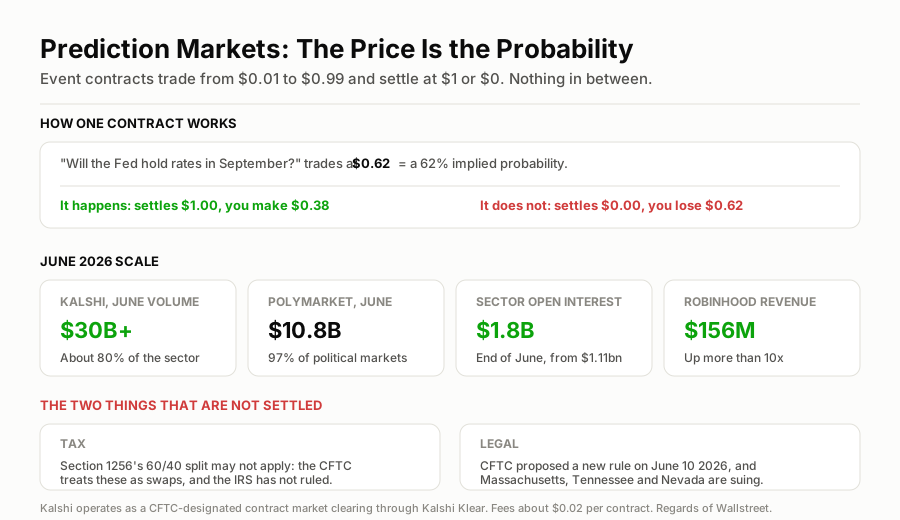
The price is the probability. Everything else about this market is unresolved.
How Big Has This Actually Got?
Bigger than most investors realise, and the growth curve is steep.
| Metric | Kalshi | Polymarket |
|---|---|---|
| April 2026 volume | $5.42B taker volume | $1.99B |
| May 2026 notional | $17.91B (ninth straight record) | $7.08B |
| June 2026 notional | more than $30B | $10.8B (record) |
| Open interest | above $1B | just under $400M |
| Share of June volume | about 80% | the remainder |
| Share of political markets | the remainder | 97% |
Two things jump out of that table.
Kalshi overtook Polymarket and then ran away. In April, Kalshi passed Polymarket on volume for the first time. By June it was doing roughly three times Polymarket's record month. Sector-wide open interest reached about $1.8 billion by the end of June, from $1.11 billion on May 1, and the two platforms hold 98% of it.
They are specialising, not competing head-on. Kalshi has taken the volume, largely through sports and a broadening product set. Polymarket retains 97% of political markets. If you want election odds you are going to Polymarket. If you want World Cup or macro contracts, Kalshi.
And the growth driver in June was not politics or finance. It was the FIFA World Cup. To most users right now, this is a sports product first, whatever the regulatory filings call it.
Can I Trade Prediction Markets on Robinhood?
Yes, through Robinhood's prediction markets hub, which runs on Kalshi's infrastructure via a partnership dating to March 2025.
That distribution deal is the single most important fact in this whole story. It put event contracts in front of 27 million funded brokerage accounts with no new app, no new account, no crypto wallet. Robinhood's exchange has since passed Crypto.com for third place in notional volume.
How well is it working? Robinhood's prediction markets revenue hit $156 million last quarter, up more than 10x, making it a top-two transaction revenue line and larger than its crypto business, which fell 38% to $100 million in the same quarter. We covered that mix shift in the Robinhood Q2 breakdown, and flagged the segment as the swing factor in the earnings preview.
One more number worth holding: roughly 40% of Kalshi's volume comes from institutions. This is not purely a retail toy. Desks use these contracts to hedge event risk that no other instrument prices cleanly.
Are Prediction Markets Legal? And Is It Gambling?
This is where it gets genuinely unsettled, and where most coverage is vague. Be precise instead.
Kalshi is federally regulated. It operates as a designated contract market under the CFTC, the same regulator that oversees futures exchanges, and clears trades through Kalshi Klear, its CFTC-approved clearinghouse. A clearinghouse matters: it stands between buyer and seller, so if your counterparty defaults you still get paid. That is a structural protection an offshore sportsbook does not offer.
But the boundary with gambling is being litigated right now. At least three states, Massachusetts, Tennessee and Nevada, have sued Kalshi, Polymarket and Robinhood, arguing that offering sports event contracts to their residents is sports betting, which requires a state gambling licence and state tax. The platforms argue these are federally regulated derivatives and states have no jurisdiction. Both arguments are serious.
And the rules are actively being rewritten. On June 10, 2026 the CFTC published a proposed rule on prediction markets, opened for a 45-day comment period, to define what is legal under federal law. Whatever emerges from that process determines which contracts exist and who can offer them.
So the state of play: legal today, federally regulated, and operating inside an unresolved fight over whether large parts of the product are gambling by another name.
The Tax Problem Nobody Mentions
This is the part that catches people, and it is worth a paragraph of real attention.
Section 1256 of the tax code gives certain regulated contracts favourable treatment: gains and losses split 60% long-term and 40% short-term regardless of holding period. Because long-term rates are materially lower, that is a genuinely valuable benefit, even on a position held fifteen minutes.
Traders assume event contracts qualify because Kalshi is CFTC-regulated. They may not. The CFTC classifies retail event contracts as swaps under the Commodity Exchange Act, and Section 1256 explicitly excludes swaps. As of late May 2026 the IRS had issued no guidance either way.
Translation: you might owe ordinary short-term rates on every gain, and you should not build a strategy around the 60/40 assumption. Nor should you assume a clean 1099 arrives. If you are trading size here, this is a question for an accountant before it is a question for a broker.
Where This Is Going
Both platforms are expanding well past their origins, into perpetual futures, margin trading, metals, FX and energy. That trajectory turns them from novelty venues into general-purpose retail derivatives exchanges, competing with brokers rather than bookmakers. One analyst projection has the sector reaching $1 trillion by 2030, which should be read as a projection rather than a forecast, because the entire regulatory framework is still being drafted.
The investable angle today is not the platforms, since neither Kalshi nor Polymarket is publicly traded. It is Robinhood, where this line grew 10x in a year and now sits second in transaction revenue. Our view on that stock is in the Robinhood breakdown.
The Playbook
- Treat the price as a probability, always. A contract at $0.90 is not "nearly certain money," it is a bet that pays 11 cents to risk 90. Beginners systematically overpay for high-probability contracts because the win rate feels comfortable.
- Fees are the biggest hidden cost in the product. At roughly $0.02 per contract, a trade at $0.50 gives up about 4% of stake in friction. That is enormous relative to equity commissions and it compounds with activity.
- Do not confuse a hedge with a hobby. Using an event contract to hedge a real exposure (a rate decision against a bond position) is legitimate and it is what the institutional 40% is doing. Trading football is entertainment, and should be sized as entertainment.
- Sort the tax question before you scale. The 60/40 assumption may be wrong and the IRS has not said.
- The bear case on the whole category: the CFTC rule could narrow what is tradeable, and the state suits could fragment access by geography. Growth this fast in a product whose legal foundation is under active construction is the definition of regulatory risk. Enjoy it, but do not build a plan on it. If you are weighing whether this is investing at all, we wrote trading or gambling, how to tell.
The One-Line Read
Prediction markets are binary contracts where the price is the probability, they have scaled from curiosity to more than $30 billion a month on Kalshi alone, and Robinhood has already put them in front of 27 million accounts: the mechanics are the simplest in finance, and the tax treatment and legal status are the two things you actually need to resolve before you trade them.
Next up:Fed decision, Tuesday →
More on $HOOD
$HOOD · 2026-08-10
Is Robinhood a Buy 39% Off Its High? The Answer Lives in One Revenue Line
$HOOD · 2026-07-29
Robinhood Q2 2026 Earnings Breakdown: Prediction Markets Grew 10x, Crypto Halved, and the Stock Still Fell
$HOOD · 2026-07-25
Robinhood Earnings Preview (July 29): After a 7% Drop, the Print That Decides the Whole Trade
Updated Every Saturday
The Week Ahead
Every earnings date, Fed event and setup for the current trading week, on one page.
Refreshed Weekly
Earnings Calendar
Who reports next, when, and what consensus and the whisper expect.
The Week-Ahead Brief
Don’t miss next week’s setups. Get the Sunday brief.
Latest issue, Sep 7“Week ahead in the stock market...”
Every Sunday: next week’s earnings dates, Fed days and the trades worth watching, from the same desk that writes the week-ahead hub. Free, built for retail investors.