When Does Booking Holdings Report Earnings? August 4, and Management Guided EBITDA Growth Down From 19% to 5%
Booking Holdings reports Q2 2026 at about 4:00pm ET on Tuesday August 4, call at 4:30pm. Consensus is $2.46 EPS on $7.19bn. Why the guided deceleration is the most severe of the season.
TL;DR
- Booking Holdings posts results at approximately 4:00pm ET on Tuesday, August 4, with the call at 4:30pm ET. It shares that evening with AMD and SpaceX.
- Consensus: EPS of about $2.46, up 10.8%, on revenue of about $7.19 billion, up 5.8%.
- The guide is the story, and it is brutal. Management guided Q2 room nights to 2% to 4%, gross bookings to 4% to 6%, revenue to 4% to 6% and adjusted EBITDA to 4% to 6%. In Q1 those four lines grew 6%, 15%, 16% and 19%.
- Adjusted EBITDA growth guided from 19% to roughly 5% in a single quarter is the sharpest deceleration any large company has guided this season.
- All the figures above are post-split. Booking completed a 25-for-1 split on April 2, taking the share price from $4,117.51 to about $165. It closed $192.90 on July 31.
When Does Booking Holdings Report Earnings?
The short answer: the release posts at approximately 4:00pm ET on Tuesday, August 4, 2026, with the conference call at 4:30pm ET.
That puts it in the most crowded evening of the month. AMD reports the same evening and so does SpaceX, in its first quarter as a public company. Booking will be competing for attention with two AI-adjacent prints, which is worth knowing if you were planning to trade the reaction rather than read it.
What the Street Expects
| Line | Q2 2026 consensus | Comparison |
|---|---|---|
| EPS | ~$2.46 | up 10.8% from $2.22 |
| Revenue | ~$7.19B | up 5.8% |
| Q2 guidance: room nights | +2% to +4% | Q1 actual: +6% |
| Q2 guidance: gross bookings | +4% to +6% | Q1 actual: +15% |
| Q2 guidance: revenue | +4% to +6% | Q1 actual: +16% |
| Q2 guidance: adjusted EBITDA | +4% to +6% | Q1 actual: +19% |
| Constant-currency revenue | +2% to +4% |
Booking has beaten estimates in each of the last four quarters, with an average beat of 4.31%. That is not the variable.
The Board
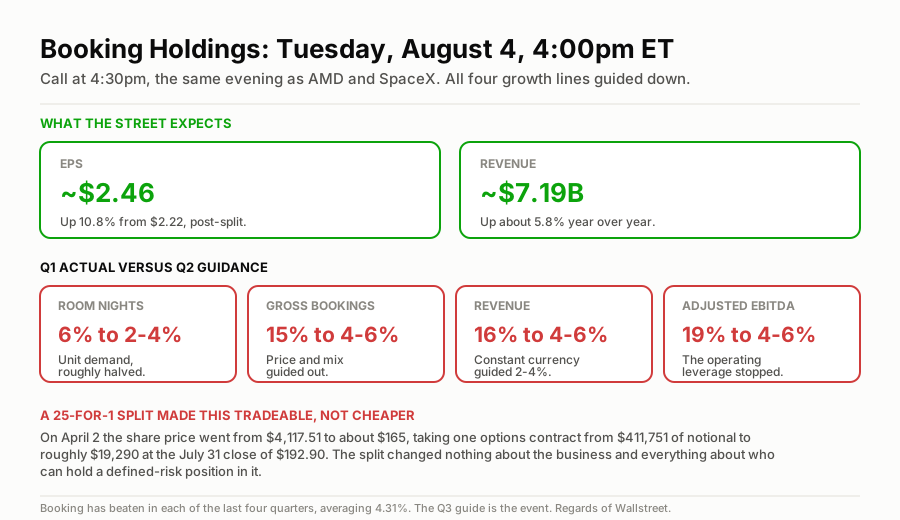
Four growth lines, all guided down hard. EBITDA from 19% to about 5% in one quarter.
A Deceleration This Severe Is Either Sandbagging or a Warning
Take the four lines seriously, because companies do not guide like this casually.
Room nights: 6% to 2-4%. This is unit demand, the cleanest read on whether people are travelling. Halving it is a statement about the consumer, not about Booking.
Gross bookings: 15% to 4-6%. Gross bookings grew more than twice as fast as room nights in Q1, which is price and mix and currency doing the work. Guiding both down together means Booking expects fewer trips and less inflation in what each trip costs.
Adjusted EBITDA: 19% to 4-6%. This is the one to stare at. EBITDA growing four times faster than room nights in Q1 was operating leverage: fixed costs spread across more transactions, plus a marketing efficiency story Booking has run for two years. Guiding EBITDA growth down to the same rate as revenue growth says that leverage has stopped, at least for a quarter.
Management attributed the moderation to ongoing geopolitical challenges, which in travel means specific regions going quiet rather than global demand collapsing. We have written about why the Iran war has produced less market disruption than expected, and this is where the effect actually shows up: not in the oil price, in the booking curve for a set of destinations.
Two readings, and the print resolves which one.
The generous reading is that this is classic Booking. The company has a long record of guiding conservatively and beating, and setting the bar at 4-6% after a 19% quarter is exactly what a management team does when it wants a clean beat in an uncertain summer.
The harsh reading is that Q1's 15% gross bookings growth was the anomaly, powered by pricing that has now normalised, and 2026 is the year online travel stops compounding at mid-teens.
The Thing Everyone Compares Wrong
Booking's Q2 revenue consensus is about $7.19 billion. Marriott's Q2 revenue consensus is about $7.19 billion. Two companies, the same quarter, the same revenue line, and almost nothing else in common.
Marriott's revenue is mostly reimbursed costs and franchise fees on rooms it does not own. Booking's is commission on transactions it did not fulfil. Neither company puts a sheet on a bed, and their revenue happens to be identical this quarter while their margins, growth rates and multiples are not remotely comparable. If you are trying to work out how travel demand is doing this week, you get two independent readings 33 hours apart, and they are worth reading together.
The 25-for-1 Split, and Why It Actually Matters
On April 2, 2026 Booking completed a 25-for-1 forward split, with split-adjusted trading from April 6. Holders of record on March 6 received 25 shares for each one held. The share price went from $4,117.51 to about $165, and authorised shares went from 1 billion to 25 billion.
A split changes nothing about the business and one thing about the reader's access.
At $4,117.51, a single options contract controlled $411,751 of stock. There is no such thing as a fractional options contract. That single fact removed every options strategy in our guides from essentially every retail account: no cash-secured puts, no covered calls, no defined-risk spreads without a six-figure position.
At $192.90, one contract is $19,290 of notional. That is still a serious position and it is a completely different question. The split did not make Booking cheaper. It made Booking tradeable.
It is worth saying plainly because the reverse case exists too: a "rally" produced by a corporate action is not a rally, which is why we wrote about the reverse-split artefact that produced a headline 21,251% move in DFNS. Check for corporate actions before you compare any two prices a year apart.
Is Booking a Buy Into a Guided Slowdown?
Wait for the guide, not the quarter.
The stock closed $192.90 on July 31, up roughly 17% from where it started trading post-split in April. The Q2 numbers are already guided and the beat is nearly a formality on this company's record. The variable is the Q3 guide, and specifically whether room night growth is set back above 4% or below it.
The bull case: Booking earns a genuinely exceptional return on capital, buys back stock aggressively enough that EPS grows roughly twice as fast as EBITDA even in a soft quarter, and has been the most disciplined capital allocator in travel for a decade. A quarter of geopolitical softness in a business with no inventory risk is not a thesis break.
The bear case: every number the company controls is decelerating at once, the operating leverage that made this a compounder has paused, and you are paying a premium multiple for it. A high-multiple business guiding four growth lines down in the same sentence is how de-ratings start.
The Options Angle
- Do not hold short-dated premium through Tuesday evening. Booking, AMD and SpaceX all print within 30 minutes of each other and there is no managing between them. That is the same warning we gave for AMD, and it applies with more force to the smaller position.
- The guide has already been published, so the asymmetry is skewed to the upside: a beat against a bar management deliberately lowered is the base case, and the surprise scenario is a Q3 guide that confirms the slowdown is structural.
- That argues for a call spread rather than an outright long, because you are buying a probable but small move rather than an improbable large one.
- We could not source a usable implied move for Booking and it is worth saying why. The one figure in circulation, a move of about 4.5%, is quoted alongside a dollar value of $230.96, which only reconciles against a share price above $5,000. That is a pre-split quote from an earlier quarter, so it says nothing about Tuesday. The plays below are quoted against the July 31 close with no implied move.
Trade log
| # | Stance | Structure | Strikes and expiry | Cost or credit | Spot at writing | Implied move | Breakeven |
|---|---|---|---|---|---|---|---|
| 1 | Bullish, defined risk | Call spread | ~$200 / ~$215, first monthly after Aug 4 | debit not sourced | $192.90 (Jul 31, 2026 close) | not sourced | needs a close above ~$200, +3.7% |
| 2 | Pass | Long straddle into the print | at-the-money weekly | debit not sourced | $192.90 | not sourced | competing with AMD and SpaceX for attention |
| 3 | Pass | Short premium held overnight through Aug 4 | any | credit not sourced | $192.90 | not sourced | three correlated prints, no ability to manage |
Rows 2 and 3 are both logged as passes so both get scored. We are saying Booking moves, but less than the evening's other two names, and that a straddle is the wrong way to own the guide.
The One-Line Read
Booking Holdings reports at about 4:00pm ET on Tuesday August 4 against consensus of $2.46 and $7.19 billion, and the quarter is close to a formality because management already guided it: what matters is that the same guidance took room nights from 6% to 2-4% and adjusted EBITDA from 19% to 4-6% in a single step, which is either the most conservative bar this company has set in years or the moment online travel stopped compounding, and the Q3 outlook on Tuesday evening is what tells you which.
More on Earnings
$PPL · 2026-08-02
When Does PPL Report Earnings? August 7, and It Is the Boring Way to Own the Data Centre Power Trade
$TTWO · 2026-08-02
When Does Take-Two Report Earnings? August 7, and the Quarter Being Reported Barely Matters
$LNG · 2026-08-02
When Does Cheniere Report Earnings? August 6, and Its Last Quarter Was a $3.5 Billion Loss and a Guidance Raise
The Sunday Setup
Enjoyed this breakdown? Don’t miss the next market setup.
Get deep-dive analyses delivered to your inbox every Sunday. Free, and built for retail investors.
Comments
0 totalNo comments yet. Be the first to drop a take.