Why Is T3 Defense (DFNS) Stock Up? A 1-for-125 Reverse Split, 1.12 Million Shares, and $1.4 Million of Revenue
DFNS rose about 85% to roughly $33.95 on July 29 after a reverse split cut its share count to 1.12 million. The mechanics, the counter-drone deal, and why the 21,000% figure is wrong.
TL;DR
- DFNS rose about 85% on Wednesday July 29, trading between $29.29 and $37.31 and priced near $33.95. Two days earlier it had already jumped about 201% to $13.10.
- The cause is mechanical, not fundamental. A 1-for-125 reverse stock split took effect at 12:01am on July 20, cutting the share count from roughly 139.8 million to about 1.12 million.
- The split's purpose was Nasdaq compliance. Listing Rule 5550(a)(2) requires a $1.00 minimum bid price for 10 consecutive trading days, and T3 Defense was not meeting it.
- There is a real business story underneath: a 60% stake in Project35, an Israeli developer of drones, VTOL aircraft, tactical FPV platforms and an autonomous aerial interceptor that has passed initial live-fire trials.
- And there is the number that should end most people's interest. Project35 did about $1.4 million of unaudited 2025 revenue and expects about $2.4 million in fiscal 2026. That is the asset the market is currently valuing at a multiple no spreadsheet supports.
More on Single Stocks: Why Is Nayax Stock Up? A $350 Million Bet on Parking Meters →
Why Is T3 Defense Stock Up Today?
Because a reverse split reduced the number of shares available to trade by about 99%, and a small amount of buying now moves the price enormously.
That is the whole mechanism and it is worth stating plainly, because the ticker looks like it is telling you something about drones and it is not.
Before July 20: roughly 139.8 million shares outstanding, trading well under $1.00. After July 20: roughly 1.12 million shares, at 125 times the price.
A reverse split changes nothing real. Authorised shares stay the same, par value stays the same, and no shareholder's percentage ownership changes. If you held 1% before, you hold 1% after. The company is worth exactly what it was worth on July 19.
What it does change is liquidity. When only about a million shares exist and some fraction of those are held by insiders and long-term holders, the tradeable float is tiny. In that situation, ordinary daily volume can exceed the entire float, and price becomes a function of who wants in rather than what the business is worth. Hence a session range of $29.29 to $37.31: an 27% swing between low and high in one day.
The Board
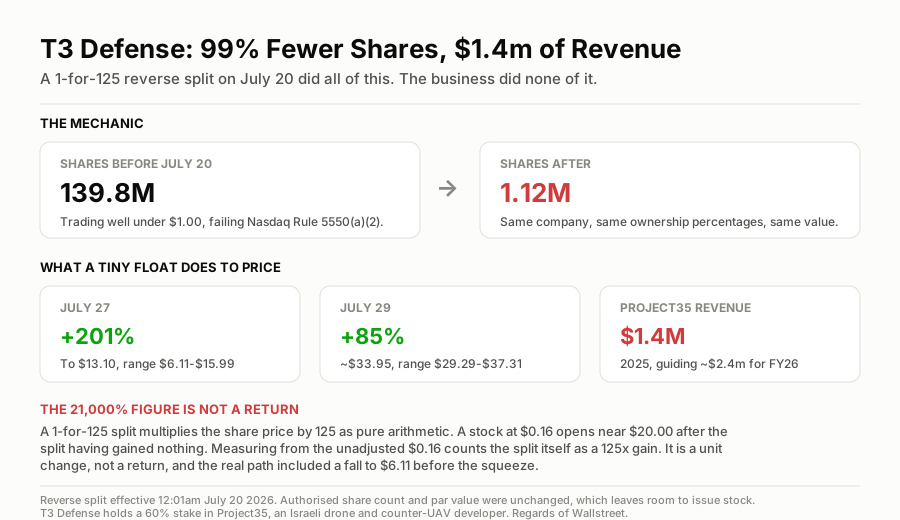
A 99% reduction in share count on one side. $1.4 million of revenue on the other.
The 21,000% Number Is Wrong
You will see a figure circulating that DFNS has gained roughly 21,000% in the nine sessions since the split, from about $0.16 to nearly $34.
That calculation is invalid, and understanding why will protect you from a whole category of bad data.
It compares a post-split price to an unadjusted pre-split price. A 1-for-125 reverse split multiplies the share price by 125 on day one purely as arithmetic. A stock at $0.16 before the split opens at roughly $20 after it, having gained nothing at all. Anyone holding through it has exactly the same money.
So measuring from $0.16 to $34 counts the split itself as a 214x return. It is not a return. It is a unit change, like reporting a temperature rise because you switched from Celsius to Fahrenheit.
The real move, measured properly from the split-adjusted reference, is far smaller, and it includes a decline first: DFNS traded as low as $6.11 on July 27 before the squeeze took it to $37.31 on the 29th. That is a violent round trip, not a straight-line 21,000% ascent.
Whenever you see an enormous percentage attached to a stock that recently split, check the adjustment before you check the story. We wrote up the general mechanics in reverse split squeezes explained.
The Actual Business
Worth taking seriously on its own terms, separately from the tape.
In July, T3 Defense acquired a 60% majority stake in Project35, an Israeli developer of unmanned systems. The portfolio is genuinely relevant to how modern conflicts are being fought:
- Heavy-lift cargo drones
- Fixed-wing VTOL aircraft
- Tactical FPV platforms
- An autonomous aerial interceptor designed to neutralise hostile drones using proprietary AI tracking and guidance, which has completed successful initial live-fire field trials
Counter-UAV is a real and growing defence category. Cheap drones have become a primary battlefield threat, and shooting them down with million-dollar missiles is economically unsustainable, so interceptors built at drone-like cost have obvious demand.
Now the scale. Project35 reported approximately $1.4 million of unaudited 2025 revenue and guides to about $2.4 million for fiscal 2026. T3 Defense owns 60% of that.
Hold those two facts together. The technology may matter. The revenue is roughly what a single mid-sized dental practice turns over, and the company is being valued in a squeeze that has nothing to do with either number.
Is DFNS a Buy?
No. Not at this price, not on this setup, and we will be direct about why rather than hedging.
The float squeeze is not a thesis. Every reason the stock is up today is a reason it can be down 50% next week. Low float cuts both ways with perfect symmetry: the same absence of liquidity that produced +85% produces the gap down when the momentum crowd rotates to the next ticker. There is no valuation support underneath, because there is barely any revenue.
The reverse split is a distress signal, not a catalyst. Companies do 1-for-125 reverse splits because they are about to be delisted. That is the context: T3 Defense needed to satisfy Nasdaq Rule 5550(a)(2) and a $1.00 minimum bid. A company whose shares were worth fractions of a cent is a company the market had already voted on.
Dilution risk is the specific danger. Authorised share count did not change in the split. So a company with 1.12 million shares outstanding, a suddenly high share price, and a history of needing capital has both the room and the incentive to issue stock. That is the standard sequel to exactly this pattern, and it lands on whoever bought the squeeze.
What would change our view: an actual contract award at meaningful scale, audited revenue growing toward tens of millions, and a financing already completed so the dilution is behind you rather than ahead. None of those exist today.
If you want defence and drone exposure, buy it where the revenue is real. If you want to trade the squeeze, understand you are trading float mechanics on a sub-$3 million revenue asset, and size it as money you are prepared to lose entirely. Our framework for that distinction is in trading or gambling, how to tell.
The Options Angle
- On a name like this, options are frequently the worse instrument even when you are right. Bid-ask spreads on a 1.12 million share float are punishing, implied volatility is extreme, and you can lose money on a correct directional call purely to the spread.
- Never sell naked premium here. A stock that moves 85% in a session and 27% intraday can gap through any strike you thought was safe. This is precisely how small accounts get destroyed.
- If you must express a view, do it with a small cash position, not leverage. There is no structure that makes a float squeeze safe.
- Borrow costs to short are likely prohibitive and the shares may be hard to locate. That is part of why the squeeze works, and it means the obvious bearish trade is not actually available to most people.
The One-Line Read
T3 Defense is up about 85% because a 1-for-125 reverse split cut its tradeable share count from 139.8 million to 1.12 million, which turns ordinary buying into a violent price move, and the widely-quoted 21,000% gain is an arithmetic error that counts the split as a return: the counter-drone technology may genuinely matter, but $1.4 million of revenue does not support this price, and the reverse split was a delisting fix rather than a catalyst.
Next up:Fed decision, Tuesday →
More on Single Stocks
Updated Every Saturday
The Week Ahead
Every earnings date, Fed event and setup for the current trading week, on one page.
Refreshed Weekly
Earnings Calendar
Who reports next, when, and what consensus and the whisper expect.
The Week-Ahead Brief
Don’t miss next week’s setups. Get the Sunday brief.
Latest issue, Sep 7“Week ahead in the stock market...”
Every Sunday: next week’s earnings dates, Fed days and the trades worth watching, from the same desk that writes the week-ahead hub. Free, built for retail investors.