The Wheel Strategy Explained: Get Paid to Buy Stocks You Already Wanted
Rosa Wanted the Shares Anyway
Rosa likes a stock trading at $100. She'd happily buy 100 shares, but she thinks $95 is a nicer price. Instead of setting a limit order and waiting for free, she gets paid to wait.
She sells a put option: she promises to buy 100 shares at $95 any time in the next month, and a buyer hands her $200 today for that promise. She sets aside the $9,500 she'd need to actually buy. That's a cash-secured put, and it's the first half of the wheel.
Two things can happen, and Rosa is fine with both. Drag the price and watch:
At $100 you're up $200.
Read the Two Endings
The stock stays above $95. The put expires worthless, the buyer walks, and Rosa keeps the $200 for doing nothing but promising. Monday she sells another put and collects again. She never bought the shares, she just rented out a promise, over and over.
The stock drops below $95. Rosa gets assigned: she buys her 100 shares at $95, exactly the price she wanted. And because she pocketed $200 up front, her real cost is $93 a share. She didn't lose, she got the stock she wanted at a discount to the discount.
That's the whole trick of phase one: on a stock you actually want to own, both outcomes are wins. You either get paid to wait, or you buy it cheaper than the market price the day you started.
Phase Two: Now You Flip to Covered Calls
Once Rosa owns the shares, the wheel turns. Now she sells a covered call against those 100 shares: she rents out the upside, collecting premium every month the same way she collected it selling puts.
If the stock rises past her call strike, her shares get called away at a profit, and she pockets all the premium she collected along the way. Now she's back to cash, holding no shares, and she starts over by selling a put again. Put, assignment, call, called away, repeat. That circular motion, selling puts until you own it, selling calls until you don't, is why it's called the wheel.
The Jargon the Story Just Taught You
- Cash-secured put: selling a put while holding enough cash to buy the shares if assigned. No leverage, no naked risk.
- Assignment: when the option buyer exercises and you're obligated to buy (put) or sell (call) the shares.
- Premium: the cash you collect for selling the option. On the wheel, it arrives whether or not you ever trade a share.
- The wheel: the loop of cash-secured puts before you own the stock, covered calls after, capturing premium at every step.
The Two-Line Version
You sell puts to get paid while you wait to buy a stock you want, and if you're assigned, you sell calls to get paid while you wait to sell it. Done on a stock you'd be happy to own anyway, it turns patience into a paycheck.
Where the Wheel Actually Loses
Slide that widget hard to the left, past $95, past $90, down to $75. Rosa still has to buy at $95 while the stock craters. This is the risk the "free income" crowd skates past: the wheel has the full downside of owning the stock, minus a little premium. Your $200 cushions a $2 fall. It does nothing for a $20 one.
The wheel's failure mode is a stock that keeps dropping after you're assigned. You buy at $95, it goes to $70, and now you're selling covered calls on a loser, capping your rebound while you nurse a big unrealized loss. The premium was a rebate, not a parachute, the same hard truth that governs the covered call.
Which gives you the one rule that makes the wheel safe: only wheel stocks you'd genuinely want to own at the strike, with no premium at all. The dark pattern is chasing fat premiums on volatile junk, because rich option prices are the market pricing danger. A wheel on a quality name you wanted anyway is patient income. A wheel on a meme stock is just warehousing crash risk for tip money, the gambling side of the line wearing an income costume.
When It Wins, When It Waits
- It wins in flat, choppy, or slowly rising markets on a stock you like: you collect premium round after round and never sweat.
- It waits in a screaming bull market: you'll get your shares called away and watch the stock run without you, capped, the same upside cost as a plain covered call.
- It hurts in a sharp, sustained drop: you're assigned near the top of the fall and ride the rest down with only a thin premium cushion.
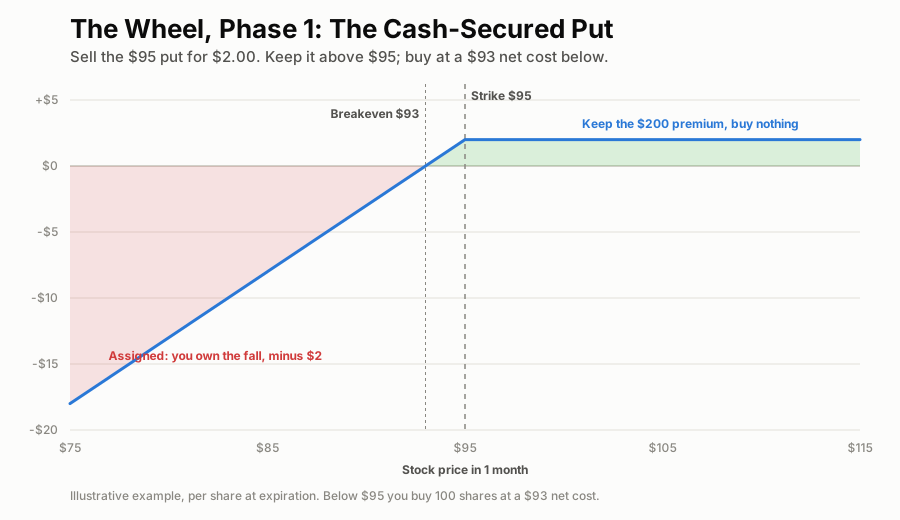
The flat top is the premium you keep. The downward slope below $95 is why you only wheel stocks you actually want.
The One-Line Read
The wheel turns patience into income, sell puts to get paid while you wait to buy, sell calls to get paid while you wait to sell, but it carries the full downside of the stock underneath it, so run it only on names you'd be happy to own at the strike, and never let fat premium talk you into wheeling something you'd never buy outright.
The Week-Ahead Brief
Don’t miss next week’s setups. Get the Sunday brief.
Latest issue, Oct 11“September CPI, the big banks and TSMC: earnings season starts”
Every Sunday: next week’s earnings dates, Fed days and the trades worth watching, from the same desk that writes the week-ahead hub. Free, built for retail investors.