The FTSE 100 Front-Ran Its Whole Year by February. Then the S&P Ate Its Lunch
The FTSE 100 was up 7.6% by mid-February and looked set to beat the S&P 500 two years running. Five months later it's still up 7.6% while the S&P rocketed to record highs. Here's exactly why the UK stalled.
TL;DR
- By February 18 the FTSE 100 was up 7.6% YTD and the S&P 500 was flat (-0.03%). The UK looked set to dunk on Wall Street two years running, and we said so at the time.
- It's now mid-July. The FTSE is up... 7.7% YTD. Basically the exact same number. It made its entire year by February and has done nothing since.
- The S&P went from flat to +10.7% and record highs over the same stretch, straight through a war it should have hated more than the UK did.
- This isn't bad luck. The FTSE is built for the regime that ran January to February, and 2026 switched regimes the moment the Iran war started. Here's the mechanism.
More on $UKX: FTSE 100 vs S&P 500: Why The UK Is Beating The US (YTD + Last Year) →
Two Lines, One Crossover
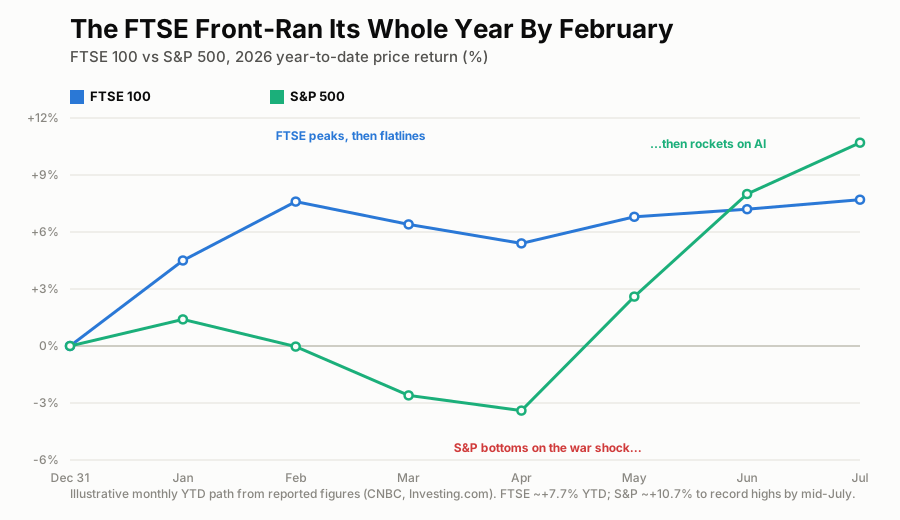
The FTSE made its year by February. The S&P made its year after it.
Look at the two lines and the story writes itself. The FTSE's line is a staircase up to February and a flat line ever after. The S&P's line dumps into the March-April war shock, bottoms around -3.5%, then goes near-vertical. They cross in June, and the gap has been widening since. Same seven months, two completely different markets, and the crossover point lines up almost exactly with when the Iran war began.
Why The FTSE's Early Lead Was Real
Nothing about January and February was a fluke. The FTSE is a value-and-cash-flow index: energy majors, banks, miners, staples, drugmakers. Early 2026 was a "cash flows matter again" tape, rates were sticky, US tech valuations looked stretched, and defensive money did exactly what defensive money does. It hid in dividends and hard assets, which is the FTSE starter pack. The UK earned that 7.6%.
The problem is that the FTSE cashed the entire regime in one go. When your index is the safety trade, you win big in the two months everyone's scared and then you have nothing left to give when they stop being scared.
Why It Stalled: The Regime Flipped Under It
Three things happened at once after February, and all three cut against the UK.
The war ballast round-tripped. You'd think an energy-heavy index would love a Middle East war. It did, for about six weeks. Oil ran to $126 by late April and the FTSE's Shell-and-BP weighting rode it up. Then oil collapsed back to $71 by early July as the market decided the war was contained, and every one of those energy gains reversed. The FTSE's biggest sector spent five months making a giant round trip to nowhere, which is a decent one-line summary of the index itself. Our oil piece has the full decay story.
The AI melt-up locked the UK out. The dominant trade of 2026 has been AI infrastructure: the memory supercycle, Nvidia, the biggest foreign IPO in US history when SK Hynix listed. The FTSE 100 has effectively zero of this. No hyperscalers, no AI chip designers, no memory. When the market's entire engine is a theme your index doesn't contain, you don't participate in the melt-up, full stop. The S&P is roughly a third big tech; the FTSE is roughly a third things you dig up or drill for. In an AI year, that's the whole ballgame.
Risk-on came back, and risk-on means US tech. Early 2026's defensiveness was the FTSE's tailwind. Once the market ruled the Iran war "contained" (the war-fatigue theme visible everywhere from defense stocks to gold), risk appetite came roaring back. And risk appetite in this cycle doesn't flow to UK banks and miners. It flows to the Nasdaq. The safety trade that carried the FTSE in February became the exact thing nobody wanted by May.
The Part The UK Bulls Don't Want To Hear
Here's the uncomfortable structural truth. The FTSE didn't "lose" to the S&P because of a bad quarter of earnings or a policy mistake. It lost because it's a value index in a growth supercycle, and its one growth-adjacent lever (energy, via the war) was a head-fake that fully reversed. The UK's defensiveness is a feature when the world is scared and a cage when it isn't. It went up like a tank in January and then drove like a tank for five months while the S&P flew a fighter jet.
None of that makes the FTSE bad. It makes it what it always was: lower beta, higher yield, built for a different weather system than the one that's actually been blowing since March.
Does The FTSE Catch Back Up?
It has one clear path, and it's the mirror image of what just happened. The FTSE reclaims leadership if, and only if, the AI trade cracks. The whole US melt-up sits on a handful of AI-adjacent names at rich multiples; the memory complex already flashed a warning with its July flush. If that unwinds into a genuine growth-to-value rotation, the FTSE's dividends and hard assets become the port in the storm again, exactly as they were in February, and the UK's flat line starts climbing while the S&P's gives back its melt-up.
The other path, a fresh oil spike that actually sticks (a real Strait of Hormuz closure rather than a declared one), also favors the FTSE's energy weight. But we've watched that head-fake three times now, and it keeps reversing.
The Positioning Angle
- This is a pairs trade, not a directional one. Long FTSE / short S&P is the cleanest expression of "the AI trade is overcooked and value rotates back." You're not betting on the UK economy; you're betting on a regime change in what the market rewards. The FTSE's flat five months means the entry is cheap relative to a stretched S&P.
- Own the FTSE for the yield and the hedge, not the fireworks. As a standalone hold it's a ballast position: ~3.5%+ dividend yield, low correlation to the Nasdaq's drama, and a genuine cushion if the AI names roll over. That's a real role in a book that's otherwise long US tech, which most books are.
- The cheap optionality is defensive. If you're heavy US growth, a slug of FTSE (or a covered-call overlay on a FTSE ETF for extra carry) is a lower-cost hedge than index puts, because it pays you to wait. It only underperforms if the melt-up keeps going, in which case your core book is winning anyway.
The One-Line Read
The FTSE 100 didn't stagnate because the UK broke. It made its entire year in the two months the world was scared, and then spent five months as a value index watching a growth supercycle it isn't invited to. It catches back up the day the AI trade stops working, and not one day before.
Next up:PPI, tomorrow at 8:30am ET →
More on $UKX
Updated Every Saturday
The Week Ahead
Every earnings date, Fed event and setup for the current trading week, on one page.
Refreshed Weekly
Earnings Calendar
Who reports next, when, and what consensus and the whisper expect.
The Week-Ahead Brief
Don’t miss next week’s setups. Get the Sunday brief.
Latest issue, Sep 7“Week ahead in the stock market...”
Every Sunday: next week’s earnings dates, Fed days and the trades worth watching, from the same desk that writes the week-ahead hub. Free, built for retail investors.