Advasa Holdings (ADBT): Nasdaq Debut Pushed to Aug. 25
Advasa Holdings pushed its ADBT direct listing from Aug. 18 to Aug. 25. Two customers make up 99.8% of its $10 million, Japan-only revenue, per its own S-1/A.
UPDATE (August 25): No Anchor Meant No Floor, Either
ADBT started trading Monday, and the no-reference-price scenario this piece described played out about as violently as a direct listing can. Shares opened at $12.00, then swung as low as $3.89 and as high as $13.20 intraday, before closing the session at $6.26, down roughly 48% from the open, per Google Finance and stockanalysis.com. Advasa confirmed the listing completed as planned in a same-day release; the company itself has not commented on the price action, which is the point of a direct listing with no underwriter obligated to say anything.
The rich-against-revenue math from the preview still holds, just at a different number. At the $6.26 close, 485,469,380 shares works out to roughly $3.04 billion of market value against a business running $10-15 million of annual revenue, a price-to-sales ratio above 200x. At the $12.00 open it was closer to $5.8 billion and 400x-plus. Whichever print a reader anchors to, this is still a thinly-covered Japanese fintech trading at a multiple few professional investors would defend, exactly the setup flagged before the open: no book-building, no price discovery ahead of time, and a share count large enough that any print carries an extreme multiple unless the stock opens far lower than $12.00 did.
No options play is logged here; ADBT had no listed chain before today and this site is not pricing one off a single, extremely volatile debut session.
More on Markets Today: SB Energy Files for an IPO, Revealing a $439 Billion AI Backlog →
TL;DR
- Advasa Holdings pushed its Nasdaq debut from August 18 to August 25, the company said in a filing dated August 20, citing "standard administrative clearing procedures" with its transfer agent, DTC and brokerage clearing participants.
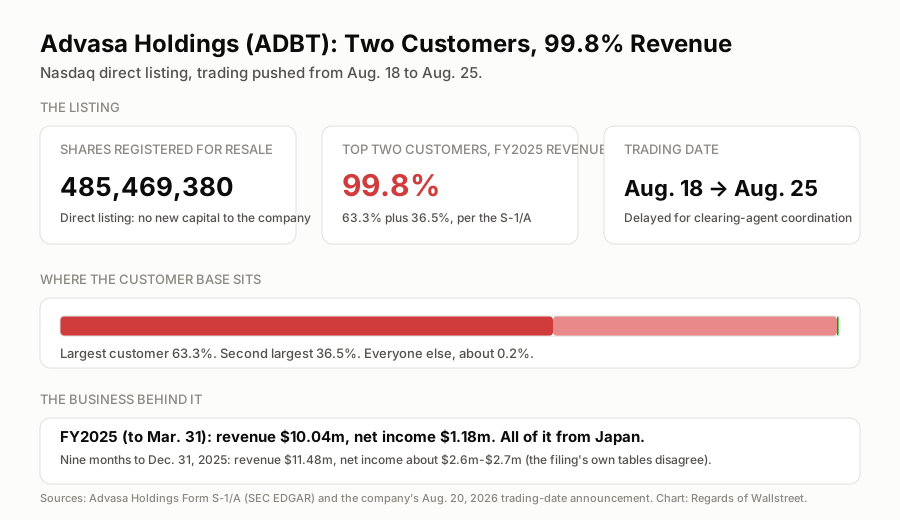
- This is a direct listing, not an IPO. No underwriters, no new shares sold, no capital raised by the company. 485,469,380 shares are simply registered for resale, per the Form S-1/A on file with the SEC.
- Two customers made up 99.8% of fiscal 2025 revenue: the largest at 63.3%, the second at 36.5%. Everyone else combined is a rounding error.
- The whole business is one Japan-only fintech. Fiscal 2025 (ended March 31, 2025) revenue was $10.04 million against $1.18 million of net income. Nine months to December 31, 2025 (part of fiscal 2026) brought $11.48 million of revenue; the filing's own summary and detailed tables disagree on net income for that period, $2.62 million versus $2.71 million.
- There is no reference price. A direct listing has no book-building and no offer price, so the opening trade on August 25 gets set entirely by Nasdaq's opening auction, with no underwriter backstop if nobody shows up to buy.
The Board
Trading now expected Monday, August 25, on the Nasdaq Global Market.
What Is Advasa Holdings, and Why Did ADBT's Debut Get Pushed?
Advasa Holdings runs FUKUPE, an earned wage access platform in Japan that lets employees pull down wages they have already earned instead of waiting for payday. The Delaware holding company owns 96.6% of its operating subsidiary, Advasa Co., Ltd., a Tokyo business founded in 2017. Every dollar of revenue currently comes from Japan.
The SEC declared the company's registration statement effective on August 11, and Nasdaq approved the listing the same week. Trading was first expected to start August 18. On August 20, the company announced a new target: August 25. The reason given is administrative: coordinating share intake and crediting between the transfer agent, the Depository Trust Company and the brokerage participants who will actually hold the stock, including four Japanese brokers (Monex, Rakuten Securities, SBI Securities and Webull Securities Japan) named as expected access points for domestic buyers. Nothing in the announcement points to a problem with the company or the offering itself, just plumbing that has not finished clearing.
A slipped debut date is a minor story on its own. What makes it worth writing down is the shape of the listing underneath it: a Japan-only fintech nobody outside a small circle of EWA-industry trackers has covered, going public in a structure most US retail investors have never had to think through.
A Listing With No Price, No Underwriter and No New Capital
Most of the IPOs this site has covered this month, Lyntris among them, sold new shares through an underwriter that built a book of orders and set a price before the stock ever traded. Advasa Holdings did none of that. Its registration statement covers 485,469,380 shares of common stock registered for resale by existing holders. That is a direct listing: existing stock simply becomes tradable, with no firm-commitment underwriting and no proceeds landing on the company's balance sheet.
The practical difference for anyone watching Monday's open: there is no offer price to compare the first trade against, and no underwriter obligated to stabilize the stock if the opening auction finds a level nobody wants to hold. Every dollar figure attached to "ADBT's IPO price" that shows up anywhere before the open is not sourced to anything the company has said, because the company has not set one. The only honest way to frame the first print is as price discovery with no anchor, decided by whatever order flow Nasdaq's auction process happens to match that morning.
Do the arithmetic without inventing a number: at a hypothetical $1 per share, 485.5 million shares works out to roughly $485 million of market value against a business running $10-15 million of annual revenue, a price-to-sales ratio above 30x. At $0.50, it is still north of 15x. Whatever the market decides Monday, the share count alone means the stock opens rich against its own revenue line unless it opens very low. This is arithmetic on the filing's own numbers, a starting point for judging Monday's print rather than a guess at it.
Two Customers Are Almost the Entire Business
The single most striking number in the S-1/A is customer concentration. For fiscal 2025, Advasa's largest customer accounted for 63.3% of total revenue. Its second-largest customer accounted for 36.5%. Add those together and 99.8% of a year's revenue sits with two counterparties, leaving roughly 0.2% spread across everyone else the company serves.
That is about as concentrated as a revenue base gets without being a single-customer company outright. The filing itself flags the obvious risk: client agreements carry no fixed term and are terminable on three months' notice. Lose either relationship and the company does not have a diversified base to fall back on, it has a gap. I would treat any forward growth story here as riding on those two relationships holding up, well before I gave much weight to the wider Japanese EWA market the S-1 gestures at.
The company frames its total addressable market in terms of the roughly 1.7 billion people globally without full access to banking, and names Indonesia and the United Arab Emirates as the next markets it wants to enter, with later references to the US, Vietnam, Pakistan, South Korea and India. None of that expansion has revenue behind it yet. Every dollar reported so far is Japanese, and mostly from two names the filing does not disclose.
The Numbers Don't Quite Agree With Themselves
Running the four-check discipline this site applies to every headline figure turned up one internal inconsistency worth stating plainly rather than picking a side. For the nine months ended December 31, 2025, the S-1/A's summary section states net income of $2.618 million; its detailed financial statements elsewhere in the same document show $2.710 million for the identical period. That is a roughly $92,000 gap, about 3.5% of the smaller figure, inside one filing.
It does not change the shape of the story. Either number describes a small, profitable niche fintech generating low-eight-figure revenue with a real (if thin) margin. But a filing whose own tables do not reconcile is a filing worth reading twice before trusting any single line out of it, and I am not going to quote one of the two figures as gospel when the company's own document does not. Call nine-month net income $2.6-2.7 million and move on.
Set against fiscal year 2025 as a whole: $10.04 million of revenue and $1.18 million of net income for the twelve months to March 31, 2025. Working capital stood at $17.24 million as of December 31, 2025, against an accumulated deficit of $10.66 million, so the balance sheet carries more cash than the historical losses that built it, a reasonable position for a company that only recently turned durably profitable.
The One-Line Read
A profitable niche fintech from Tokyo is coming to Nasdaq through a structure that raises it no money, at a share count that makes the math rich unless the open is cheap, sitting on a customer base concentrated in exactly two names.
No options play is logged here. ADBT has no listed options chain before its first trade, so there is nothing to price and nothing to score yet; that changes once the stock has an actual opening print to work from.
Related: SK Hynix's Nasdaq listing is the template for a foreign name with thin English-language coverage trading well, Lyntris's downsized IPO is the same week's underwritten-offering comparison, SunScout's first week shows how a new listing can break instead, and the rest of that week is in our August 17-21 hub.
Next up:Fed minutes, today at 2:00pm ET →
More on Markets Today
Updated Every Saturday
The Week Ahead
Every earnings date, Fed event and setup for the current trading week, on one page.
Refreshed Weekly
Earnings Calendar
Who reports next, when, and what consensus and the whisper expect.
The Week-Ahead Brief
Don’t miss next week’s setups. Get the Sunday brief.
Latest issue, Sep 27“Micron, PCE and the jobs report that decides October”
Every Sunday: next week’s earnings dates, Fed days and the trades worth watching, from the same desk that writes the week-ahead hub. Free, built for retail investors.