Netflix Earnings Breakdown: The Beat That Dropped the Stock to a 52-Week Low
Netflix reported Q2 2026 earnings on July 16: revenue up 13.4%, EPS beat, and the stock still fell 8.5% to its lowest level in over a year. The full breakdown of the numbers, why the guide did the damage, and where NFLX goes short and long term.
TL;DR
- Netflix reported Q2 2026 results after the close on July 16: revenue $12.56 billion (+13.4% year over year), EPS $0.80 vs $0.79 expected, net profit $3.4 billion (+8.8%). A beat on the bottom line, a rounding-error miss on the top ($12.59B expected).
- The stock fell 8.5% after hours to roughly $68, below the $70.86 52-week low, its worst level in more than a year. It has now lost around half its value since the $133.91 peak on June 30, 2025.
- The print didn't do that. The guide did: Q3 revenue of $12.86 billion, +11.7% growth, against a street looking for ~$13 billion. First guide below 12% growth in years.
- Short term: the 52-week low breaks and the flush runs into the low $60s before real buyers show. Longer term: this is a multiple reset on a still-excellent business, and the reset is most of the way done. Levels and options below.
More on $NFLX: Why Is Netflix (NFLX) Stock Up? Ackman's Stake Doesn't Multiply Out →
The Actual Numbers, Line by Line
Start with what the report said, because the headline ("Netflix beats, stock craters") makes no sense without it:
- Revenue: $12.56 billion, up 13.4% year over year, versus $12.59 billion expected. A miss of 0.2%, which is noise.
- EPS: $0.80 versus $0.79 expected. A beat.
- Net profit: $3.4 billion, up 8.8%. Notice profit growing slower than revenue; that's the margin line talking.
- Operating margin: 33.4%, down from 34.1% in Q2 2025. Still elite, no longer expanding.
- Q3 guide: $12.86 billion in revenue, 11.7% growth. The street wanted roughly $13 billion. This is the line that vaporized the stock.
- Full-year 2026: narrowed to $51 to $51.4 billion from the prior $50.7 to $51.7 billion. The floor came up, and the ceiling came down by $300 million. Markets only heard the ceiling.
- Buyback: $4.7 billion of stock repurchased in the quarter. Remember this number; it matters for the floor later.
None of the reported numbers are bad. Several are genuinely strong. The stock dropped anyway, and the chart below is the reason.
The Growth Staircase Going Down
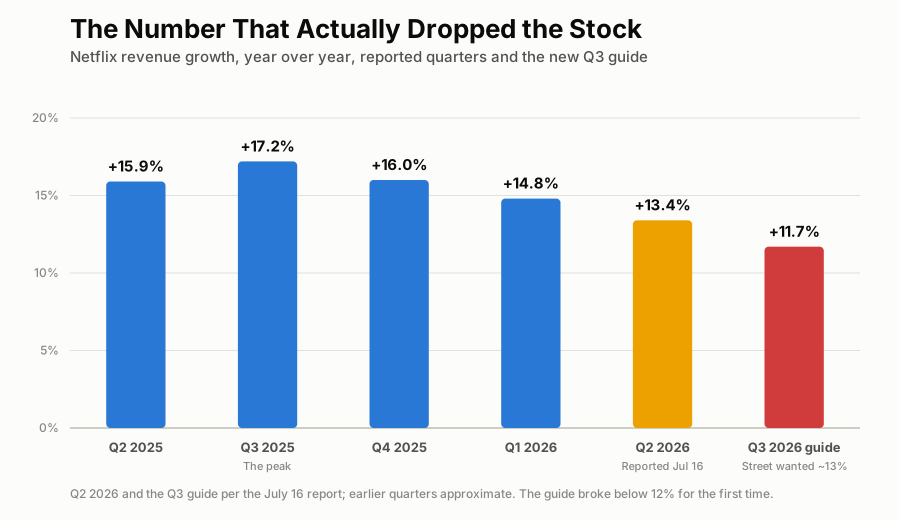
Every bar shorter than the last since the Q3 2025 peak. The red bar is the one the market sold.
Growth peaked at 17.2% in late 2025 and has stepped down every quarter since: 16%, then 14.8%, then 13.4%, and now a guide that starts with an 11. Deceleration is the one chart pattern growth investors will not forgive, because the entire premium multiple is a bet on the slope. When the slope rolls over for four straight quarters, the multiple gets marked down with mechanical certainty, and that's exactly what the past year's chart shows: the business grew every single quarter while the stock lost half its value. The market wasn't repricing Netflix's revenue. It was repricing what it would pay for each dollar of it.
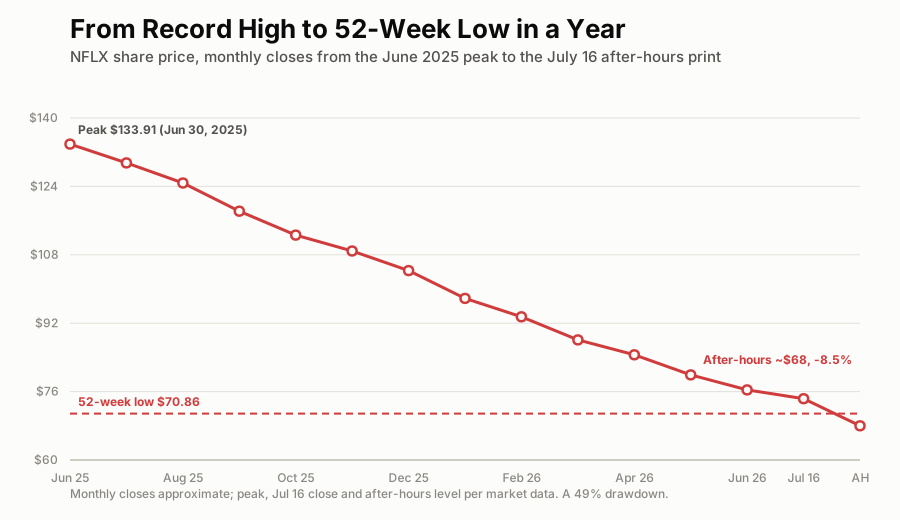
Thirteen months, no meaningful bounce, and an after-hours print through the 52-week low. Trends this orderly don't reverse on their own; they reverse on a catalyst.
What Management Actually Said, Translated
The shareholder letter and the call gave us three quotes worth decoding.
On engagement: members watched 97 billion hours in the first half, up 2% year over year, which the company called healthy given "the competitive impact of the Winter Olympics and the World Cup." Then management started arguing with its own metric. It argued that "time spent is just one aspect of strong engagement," that quality and variety matter too, and the co-CEO added that not all views are "created equal." Translation: hours grew 2% while revenue grew 13%, someone was going to ask about that gap, and the company answered it before the question came. When a metric stops flattering you, you reframe the metric. Netflix is also scaling back its viewership reporting, which is what companies do with numbers they no longer want graded on.
On live events: the letter flagged the lineup (Women's World Cup, an expanded NFL slate, WWE, MLB) and dropped the most interesting stat of the whole report: live programming is over 5% of 2026 content spend but only about 1% of viewing hours, yet live events accounted for six of the top ten new-member sign-up days of the past five years. Read that again. Live is wildly inefficient as content and wildly efficient as marketing. That's not a contradiction; it's the strategy. They're buying subscriber acquisition and calling it programming.
On advertising: on track for roughly $3 billion in ads revenue in 2026, with US upfront commitments closing "in the next few weeks." That's the real growth engine hiding under the decelerating headline, and at 2% monthly churn (still the lowest of any major premium service, per industry trackers) it's layered on the stickiest subscriber base in streaming.
Why the Reaction Was This Violent
Three reasons, stacking:
- The whisper regime. This earnings season punishes in-line results like misses and sells good guidance that isn't perfect guidance. Netflix walked into that regime with the one thing the regime executes on sight: a guide below consensus.
- No cushion left. A stock down 43% from its peak before the print has no valuation buffer, but it also has no patience buffer. Holders who rode it from $134 to $74 were holding for the quarter that proved the bottom. They got an 11.7% guide instead, and the last patient money left the building after hours.
- The Bernstein problem is real but temporary. Analyst work into the print flagged the 48-team World Cup lifting churn and softening Q2 subscriber momentum, with spillover into early Q3. The guide effectively confirmed it. The market treated a one-tournament effect as a trend change, which is the kind of error that creates entries.
Sooo... Where Does It Go?
Short term (days to weeks): lower first. The after-hours print at ~$68 broke the $70.86 52-week low, and broken 52-week lows on guidance cuts don't V-bounce; they flush. The pattern all season, from IBM to the memory names, is that day two and three follow through before anything stabilizes. Expect a probe into the low $60s. The 13-month downtrend line has repelled every rally attempt, and it will repel the first one here too.
Longer term (quarters): the reset is nearly done, and the math says so. Strip the multiple story out and look at what you're buying at ~$68: a business growing revenue 12-13%, running 33% operating margins, converting $3 billion-plus of profit a quarter, with 325 million subscribers churning at 2% a month, a $3 billion ad business compounding fast, and management that just bought back $4.7 billion of stock in a single quarter, at prices well above today's. The drawdown took the stock from pricing hypergrowth forever to pricing low-teens growth, roughly in line with what the company now guides. That's what the end of a derate looks like: expectations finally landing on reality. The bear case from here requires growth to break below 10% or margins to crack. Nothing in this report shows either.
Our streaming-war take from February argued NFLX was cheap relative to its franchise and early in its derate. Half right: the franchise held up, the derate had further to run. The difference now is the guide has finally caught down to the multiple.
The Options Angle
- Don't buy puts here. The 8.5% drop already happened, IV is pumped, and you'd be paying top-dollar premium for the tail end of a move. Shorting the hole on day two is the season's most reliable donation.
- The entry trade: sell cash-secured puts at $60, September expiry. Post-earnings IV is inflated, $60 is below any reasonable flush target, and assignment hands you the franchise at 12-13% growth prices. You're being paid to name the panic price.
- The bounce trade, for later: two-month $70/$80 call spreads, but only after the stock closes back above $70.86. A reclaimed 52-week low is the confirmation that the flush is done; buying before it is catching the knife this tape keeps dropping.
- For trapped longs: sell covered calls at $75-78, four to six weeks out. The downtrend line caps rallies there, the elevated IV pays well, and you lower cost basis while the base builds.
The One-Line Read
Netflix printed a fine quarter, guided like a 12% grower, and got repriced like one: that's not a business breaking, it's a multiple finishing the job it started thirteen months ago. Let the flush run, sell the panic premium at $60, and buy the reclaim, not the hole.
Next up:PPI, tomorrow at 8:30am ET →
More on $NFLX
Updated Every Saturday
The Week Ahead
Every earnings date, Fed event and setup for the current trading week, on one page.
Refreshed Weekly
Earnings Calendar
Who reports next, when, and what consensus and the whisper expect.
The Week-Ahead Brief
Don’t miss next week’s setups. Get the Sunday brief.
Latest issue, Sep 7“Week ahead in the stock market...”
Every Sunday: next week’s earnings dates, Fed days and the trades worth watching, from the same desk that writes the week-ahead hub. Free, built for retail investors.