Why Did CPHI Jump 790% Today? China Pharma Holdings' Monster Move, Explained
China Pharma Holdings (CPHI) rocketed 790% from $0.91 to $8.10 on 21x average volume. The company says it has no idea why. What CPHI is and if there's a play.
TL;DR
- China Pharma Holdings (CPHI) closed Tuesday at $8.10, up 790% from Monday's $0.91 close, then tacked on another 9.7% after hours to $8.89.
- Volume hit 93.6 million shares, roughly 21 times the daily average. This was the fourth burst of unusual trading this month: NYSE American had already contacted the company about the action on July 10, 13, and 15.
- The company's official explanation, issued twice in press releases: it knows of no material news or undisclosed development that explains any of it.
- This is not a short squeeze (short interest was about 0.09%) and not a fundamentals story (2025 revenue: $4.1 million, with a net loss). It walks and quacks like a low-float speculative ramp.
- The play: for almost everyone, no position. Chasing is buying a lottery ticket after the drawing, and shorting it is stepping in front of a stock that just proved it can move 790% in a day.
More on Single Stocks: Why Is Nayax Stock Up? A $350 Million Bet on Parking Meters →
The Board
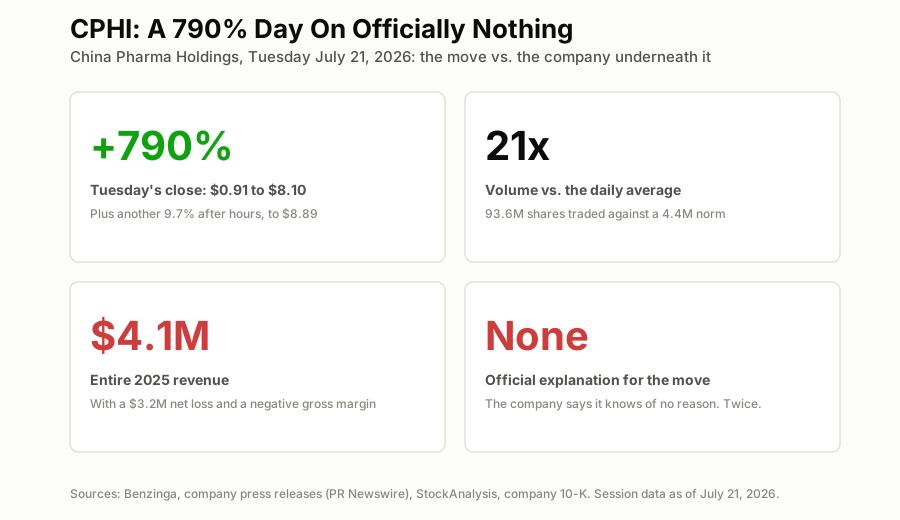
The move on the left, the company on the right. Those two columns describe different planets.
What Is China Pharma Holdings?
CPHI is a small Chinese generic drug maker listed on NYSE American. Through its wholly owned subsidiary Hainan Helpson, founded in 1993 and based in Haikou on China's Hainan island, it manufactures around 19 products: basic generics, first-to-market generics for the Chinese market, and modern traditional Chinese medicines, aimed at cardiovascular, infectious, CNS, and digestive diseases.
The business is tiny and shrinking. Full-year 2025 revenue was $4.14 million, down 8.5% from 2024, with a net loss of $3.19 million and a negative gross margin that the company attributes to idle capacity and inventory writedowns. It sells drugs for less than it costs to make them.
The stock chart tells the same story. CPHI has done a 1-for-5 reverse split (March 2024) and a 1-for-10 reverse split (April 2025) just to stay listed, and its 52-week range before this week ran from $0.38 to $2.03. As of Monday, the whole company was worth about $37 million. Tuesday's close values it at roughly nine times that, north of $300 million, which is about 80 times revenue for an unprofitable generics maker. For scale, that multiple is what markets pay for hypergrowth software, not for a company whose gross margin is negative.
What Actually Happened On Tuesday
The mechanics, as far as anyone can see them:
- CPHI opened the week at penny-stock prices and went vertical Tuesday, with an intraday rally that Benzinga clocked at nearly 700% before the stock settled at $8.10, up 790% from the prior close.
- 93.61 million shares traded against an average of 4.39 million. On a float this small, that means the entire tradable share count churned many times over in one session.
- After hours, it kept going: up another 9.7% to $8.89.
Here's the strange part: this wasn't even the first episode. NYSE American formally contacted the company about unusual trading on July 10, 13, and 15, and again after Tuesday's fireworks on July 21. Both times, China Pharma responded with press releases stating it is not aware of any material nonpublic information or undisclosed business development that would explain the activity.
Read that again. The company that would profit most from a good story is publicly saying there is no story.
The Explanations, Ranked By Plausibility
It's a low-float momentum ramp. This is the boring answer and almost certainly the right one. Tiny float, sub-$1 price, a China-listed ticker, repeated bursts of coordinated volume across multiple sessions, and zero news. That's the standard anatomy of a speculative pump: early buyers build positions before the crowd notices (the July 10-15 "unusual activity"), the stock gets pushed hard enough to trip momentum scanners, day traders and algos pile in, and the price detaches from anything resembling valuation.
It's a short squeeze. No. Short interest was about 0.09% of the float going into the move. There was nobody to squeeze. Whatever GameStop reflex you have, put it away; this rally was built entirely out of buyers, which matters because it means there's no forced-buying fuel left when they stop.
There's real hidden news. Possible in theory, but the company has now denied it twice in writing, in responses to its own exchange. If an acquisition or a licensing deal surfaces later, the disclosures get very awkward. Betting on secret good news that management formally denies exists is not a thesis, it's a hope.
We've seen this movie in other costumes this cycle. The Wendy's meme squeeze at least had short interest and a story. The 2026 retail trading playbook runs on attention, and attention is exactly what a 790% day manufactures. CPHI has the attention now. What it doesn't have is a reason.
Is There A Play Here?
Honestly: for most people, the play is to watch. But let's go through the doors.
- Buying here is the worst risk/reward on the board. You'd be paying 80x revenue for a money-losing generics maker, after a 790% day the company itself can't explain, in a stock where the first wave of buyers is looking for exit liquidity. That exit liquidity is you. History with no-news vertical moves on NYSE American small caps is brutal: they tend to round-trip, and the round trip can start with a 40-60% down day or a trading halt.
- Dilution risk is live. China Pharma has shelf registration filings on record, and a company burning cash whose stock is suddenly up ninefold has every incentive to sell shares into the strength. An offering announcement is the classic ending to this exact setup.
- Shorting is theoretically right and practically dangerous. Borrow on a name like this becomes scarce and expensive precisely when you want it, and a stock that did 790% on nothing can do another 100% on nothing before it dies. If you're wrong for even a day, the loss is unbounded. Structures that cap risk barely exist here: CPHI's option chain, where it trades at all, is illiquid with spreads that eat the edge. If you don't know why that matters, start with how calls and puts actually work.
- If you somehow own it from under $1: congratulations, you won the lottery. Winning the lottery twice is not a strategy. Selling most or all into strength, and letting a small remainder ride only with a hard stop, is the adult move.
If any part of you is itching to click buy anyway, run it through our trading or gambling checklist first. A position with no thesis, no catalyst, and no valuation case fails all three questions, and that's fine, as long as you size it like the casino bet it is.
The One-Line Read
CPHI is a $4 million-revenue generics maker that nine-folded in a day on 21x volume while its own management said, twice and in writing, that nothing happened: that's not a stock story, it's a crowd story, and crowds like this don't leave the room slowly.
Next up:PPI, tomorrow at 8:30am ET →
More on Single Stocks
Updated Every Saturday
The Week Ahead
Every earnings date, Fed event and setup for the current trading week, on one page.
Refreshed Weekly
Earnings Calendar
Who reports next, when, and what consensus and the whisper expect.
The Week-Ahead Brief
Don’t miss next week’s setups. Get the Sunday brief.
Latest issue, Sep 7“Week ahead in the stock market...”
Every Sunday: next week’s earnings dates, Fed days and the trades worth watching, from the same desk that writes the week-ahead hub. Free, built for retail investors.