Reverse Iron Condor Explained: Betting On A Big Move With A Fixed Bill
The Condor, Run Backwards
The iron condor collects rent by betting a stock stays in its lane. The reverse iron condor is its restless twin: you pay a little now, and get paid if the stock breaks out of the lane (either direction) with your worst case chiseled in stone before you ever click buy.
Build it one piece at a time. Stock's at $100, and you think it's about to move hard but you don't know which way. So you buy the $95 put and the $105 call: that pair alone is a strangle, and it costs real money. To knock the price down, you sell the $90 put and the $110 call against them. Those short wings hand you back some premium in exchange for capping your upside. Net bill: $200. Drag the slider:
At $100 you lose $200: about the worst this trade can do.
Read The Inverted Mesa
Park the slider in the middle, between $95 and $105. The number sits at −$200 and doesn't move: both spreads are worthless and you've lost your whole debit. That's the entire downside. Not a margin call, not a blowup: a known, prepaid $200.
Now push it past $90 on the low side or $110 on the high side. The profit tops out at +$300 and stays flat: one spread has hit its full $5 width, you paid $2 of it, you keep $3. That's a 150% return on a move where you didn't even have to call the direction. The break-evens land at $93 and $107, so the stock needs roughly a 7% move for the trade to start paying. Compare that to the $800 straddle, which needed an 8% move just to break even and put far more premium at risk.
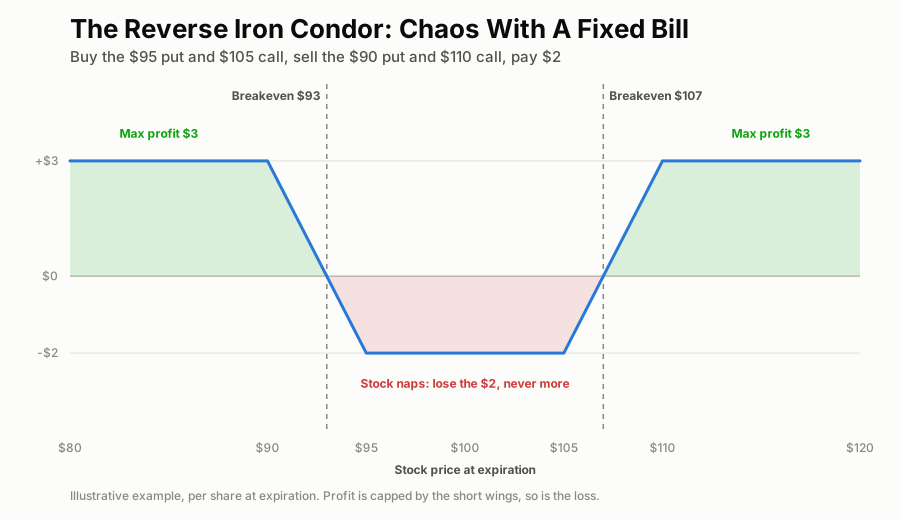
The inverted mesa: lose $200 in the middle, make $300 past either wing, nothing worse and nothing better.
The Two-Line Version
- A reverse iron condor buys a put spread and a call spread around the stock, paying a small debit.
- You profit on a big move in either direction; you lose the debit if the stock stalls in the middle.
- Both sides are spreads, so profit and loss are both capped. No premium bonfire, no jackpot.
- It's the budget version of the strangle: a cheaper hurdle, in exchange for selling away the moonshot.
Why Not Just Buy The Strangle?
Because the strangle's greatest strength (unlimited upside) is a lottery ticket you pay for on every single trade and cash maybe once a year. The reverse condor sells that ticket to someone else. On the 40% collapse, the strangle holder retires and you make your $300. On the far more common 8–12% move, you both profit, and you paid less to be there.
The trade-off: the reverse condor is for moves that are big but not biblical. If your thesis is total detonation, buy the strangle, or a straddle if you want the earlier break-even. If your thesis is "this pin is coming out but I don't know which wall it hits," the reverse condor is the cleaner and cheaper bet, especially when volatility is already elevated, since the short wings hand some of that inflated premium right back to you. That also makes it one of the few long-move structures that doesn't get gutted by IV crush after an event: whatever the crush takes from your long strikes, it also takes from the ones you sold.
The Catch
Capped profit cuts both ways. The gap you prayed for arrives, the stock is down 30%, and your reward is the same $300 you'd have made at down 11%. Watching a strangle holder print twenty times your payout on the exact move you both called is the reverse condor's signature emotional damage. The other catch is the middle: a 4% move, respectable by any normal standard, still parks you at max loss. Like every long-volatility trade, this one dies of boredom.
Four legs also means four bid-ask spreads. On liquid tickers with penny-wide options that's a rounding error. On some sleepy small cap it can eat half your edge before the trade even starts, so keep this structure on names where the options actually trade.
Chaos, But Make It Budgeted
The reverse iron condor is the grown-up way to bet on fireworks: direction-agnostic, risk fixed at a number you chose, and priced for the realistic breakout instead of the miracle. Use it when you're confident the calm breaks, honest about not knowing which way, and disciplined enough to accept a capped win. Buy the drama, skip the debt, keep the bill on the fridge.
The Week-Ahead Brief
Don’t miss next week’s setups. Get the Sunday brief.
Latest issue, Oct 11“September CPI, the big banks and TSMC: earnings season starts”
Every Sunday: next week’s earnings dates, Fed days and the trades worth watching, from the same desk that writes the week-ahead hub. Free, built for retail investors.