AI Compute Futures Launch Oct 5. One H100, Two Prices.
CME lists compute futures on October 5, with ICE close behind. The same H100 rents for $2.74 on neo-clouds and $7.20 at hyperscalers, and the two exchanges measure that gap by incompatible methods.
TL;DR
- CME lists two compute futures contracts on October 5, pending regulatory review. Silicon Data H100 and B200 Rental Index Futures trade on NYMEX, and each contract is one month's rent for a single GPU.
- The same H100 rents for $2.74 an hour on neo-clouds and $7.20 at hyperscalers, a 2.6x spread on identical silicon. Silicon Data's readings are dated August 13-14.
- ICE announced first and still has no launch date. ICE and Ornn went public on May 19 with a rival index built only from printed transactions.
- These rates swing hard in both directions. Ornn's Blackwell index ran $2.75 to $4.08 between mid-February and mid-April, +48%.
- Nvidia is reported to be guaranteeing the residual value of GPUs pledged as collateral inside its $500 billion financing framework. From October there is a public forward curve on what that collateral earns.
More on AI & Semiconductors: Akamai's $11.6 Billion Anthropic Deal Pushes the AI Ledger Past $900B →
The Board
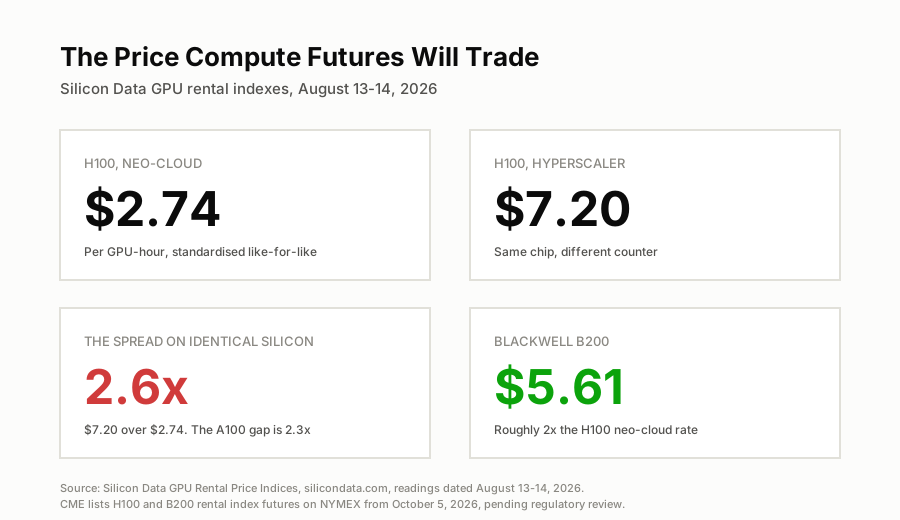
That gap on identical silicon is why a futures market is being built.
What Are Compute Futures?
They are contracts on the rental price of a GPU. CME's two contracts settle against Silicon Data indexes that track what it costs per hour to rent an Nvidia H100 or a Blackwell B200, and one contract represents a month of rent for one chip. Pete Keavey, CME's global head of energy and environmental products, put the pitch in one line: "Compute has become the currency of the AI age."
Filing them under the energy desk is the correct instinct. This is the same machinery that lets an airline fix jet fuel a year out, pointed at the biggest input cost in the AI buildout.
One H100, Two Prices
Here is the problem those contracts exist to solve. On Silicon Data's own indexes, dated August 13-14, an H100 rents for $2.74 per GPU-hour from a neo-cloud and $7.20 from a hyperscaler. Same chip, 2.6x the price. The A100 carries a 2.3x gap, $1.65 against $3.72. The B200 sits at $5.61, roughly double the H100 neo-cloud rate.
Silicon Data's chief executive Carmen Li describes the consequence plainly: "two companies buying the exact same GPU capacity could pay wildly different prices with no way to know who got the better deal."
Some of that spread is real. Hyperscalers sell support, networking, compliance and uptime that a marketplace does not. But a gap that wide, persisting across chip generations, is usually a market with no reference price rather than one with genuine quality tiers. Oil looked like this before Brent.
And the direction has surprised people. The consensus reflex on GPUs is that rental rates only fall, which is the whole depreciation worry. Ornn's Blackwell index went the other way this spring, $2.75 to $4.08 from mid-February to mid-April, a 48% move in two months. Rates that swing 48% in a quarter are rates somebody wants to hedge.
Assessed or Printed
CME and ICE disagree about something that decides whether either contract works.
Silicon Data builds its index from daily observations across cloud providers, colocation markets, brokered cluster sales and private platforms, standardised for machine specs and rental terms, filtered for outliers, then validated. It claims coverage of more than 80% of the global GPU rental market. That is an assessed benchmark, the Platts model, and it can cover a thin market because it does not need every price to be a completed trade.
Ornn's index takes the opposite route: the first compute index built only from printed transactions, distributed on Bloomberg. Its backers put $33 million behind that view in a June seed round led by a16z crypto.
Assessed benchmarks cover more ground and depend on judgement. Transaction benchmarks cannot be argued with and go quiet when nobody trades. Finance has run a version of this before: LIBOR rested on submitted estimates rather than completed trades, and prising the system off it and onto SOFR took the best part of a decade. I would not assume the same verdict here, because printed GPU transactions really are sparse, but anyone settling money against either index in October is picking a side of that argument whether they know it or not.
The nearer risk is duller. Overlapping contracts on rival venues split the order book, and a futures contract that never finds liquidity is worse than no contract at all. Neither has CFTC clearance yet.
What Nvidia Is Underwriting
Nvidia's financing framework with Apollo, BlackRock, Blackstone, Brookfield, Goldman Sachs and KKR rests, according to reporting on the arrangement, on Nvidia guaranteeing the residual value of the GPUs used as collateral. That guarantee has never had a public market price. Rental rates are the cash flow those assets throw off, so a forward curve on rents is the closest visible proxy for what the collateral is worth in three, six or twelve months.
From October a lender can look up a number rather than take the manufacturer's word for it. My read is that this helps the financing structure if rates hold, and gets uncomfortable if the curve slopes down hard into 2027. Either way it stops being a private conversation. Our AI Compute Deal Ledger tracks the same distinction: announced numbers and contracted numbers are different things, and somebody has to keep score.
Nvidia's next real test arrives before the contracts do, at the August 26 print.
The One-Line Read
Compute futures give the AI trade something it has never had, a public price for what a GPU earns. Two exchanges are racing to set it, and they cannot both be right about how to measure it.
Next up:PCE inflation, today at 8:30am ET →
More on AI & Semiconductors
Updated Every Saturday
The Week Ahead
Every earnings date, Fed event and setup for the current trading week, on one page.
Refreshed Weekly
Earnings Calendar
Who reports next, when, and what consensus and the whisper expect.
The Week-Ahead Brief
Don’t miss next week’s setups. Get the Sunday brief.
Latest issue, Sep 27“Micron, PCE and the jobs report that decides October”
Every Sunday: next week’s earnings dates, Fed days and the trades worth watching, from the same desk that writes the week-ahead hub. Free, built for retail investors.