Ingenic Semiconductor IPO: HK$100 Price, 689x Demand, Aug. 25 Debut
Ingenic Semiconductor's Hong Kong debut closed flat at HK$100, unchanged from its IPO price, despite a 689x-oversubscribed retail book. The chipmaker now trades as 3223.HK.
TL;DR
- Ingenic's Hong Kong debut closed dead flat on August 25: HK$100.00, exactly its IPO price, after trading as low as HK$97.10 (down 2.9%) and as high as HK$100.40 intraday. That kind of retail demand usually buys a pop. This time it bought nothing.
- The retail tranche was oversubscribed 689 times before pricing. HK$222 billion chased a HK$322 million slice of the deal, a scale of demand almost no US-listed IPO this year has matched, and none of it carried through to the first day's price.
- This isn't a new company going public. Ingenic has traded on Shenzhen's ChiNext board as 300223 since 2011. Hong Kong gets it a second, internationally reachable listing on top of an existing one.
- The company guided first-half 2026 net profit up 431% to 531% year over year, riding the same memory chip pricing surge that pushed Micron above $900 and SanDisk up double digits this summer.
- It joins GigaDevice and Montage Technology as the third mainland chipmaker to add an H-share listing this year. GigaDevice's own January debut, on a smaller 542x book, closed up about 37.5%. Ingenic's didn't move at all.
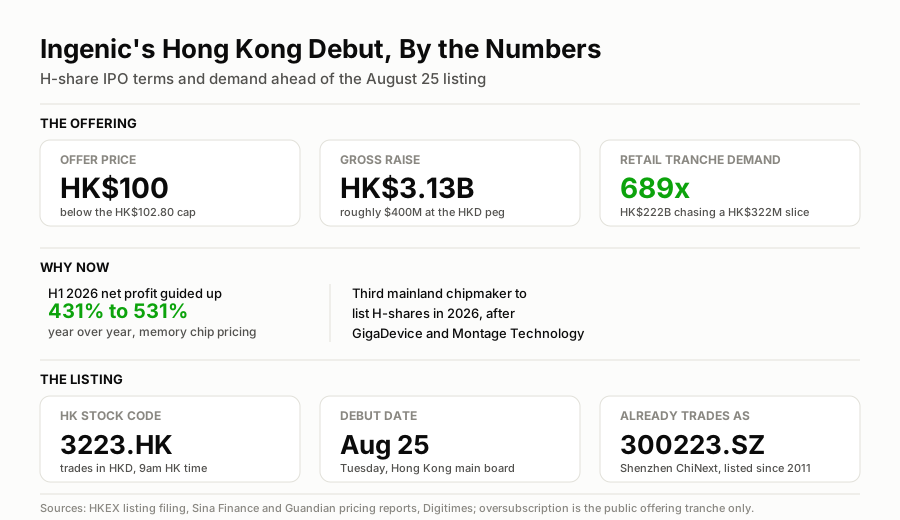
HK$100 a share, HK$3.13 billion raised, a 689x retail book. Ingenic's Hong Kong terms, set August 21.
More on AI & Semiconductors: Micron Earnings Expectations Tracker: Guidance, Estimates, Results and Stock Moves Every Quarter →
Who Ingenic Actually Is
The name means nothing to most US readers, which is exactly the point of writing about it. Ingenic was founded in Beijing in 2005 and built its early business on licensed MIPS processor cores, the kind of low-power chip that ran e-readers, handheld game consoles and portable media players a decade ago. It is not a leading-edge AI GPU company and I'm not going to write it up as one.
The pivot that matters happened in 2020, when Ingenic acquired Integrated Silicon Solution Inc (ISSI), a California-based memory chip maker, and folded it into a "Memory + Computing + Analog" product structure: NOR and NAND flash and DRAM on one side, embedded processors on the other, analog and interconnect chips filling out automotive, industrial, medical and security applications. That acquisition is why a company most people have never heard of is now catching the same pricing wave as Micron.
Why Now: A Memory Cycle and a Fundraising Wave, at the Same Time
Two separate things are converging on this listing, and both are real.
The first is the memory supercycle this site has tracked all summer: Micron broke $900 as China's CXMT priced its own IPO, and the thesis check on where that leaves the trade still holds. Ingenic's memory segment sits inside the same pricing cycle. In its Q1 2026 filing, memory chip revenue rose 53.63% year over year, and the company's own guidance puts first-half 2026 net profit up 431% to 531% from a year earlier. I'd treat a guided range that wide as just that: a range. The final number won't be confirmed until Ingenic reports.
The second is a fundraising pattern specific to Chinese chip companies right now: list a second time in Hong Kong to reach capital that mainland exchanges can't. GigaDevice and Montage Technology both did versions of this earlier in 2026, and CXMT's own Shanghai listing (explained in full here) was the domestic-market version of the same instinct: raise money while memory prices are up and international investors are paying attention to Chinese semiconductor self-sufficiency. Ingenic is the third name to run this playbook in 2026, and that history is worth knowing before treating this as a one-off event.
The Number That Actually Says Something: 689 Times
A lot of IPO coverage leads with the raise size, and HK$3.13 billion (about $400 million) is a mid-sized deal by any standard, smaller than SK Hynix's $26.5 billion Nasdaq listing or SpaceX's $86 billion raise, both covered on this site already. The raise size isn't the interesting number here.
The oversubscription is. Hong Kong's retail public offering tranche took in HK$222.01 billion in margin-financed subscriptions against a public allocation of roughly HK$322 million. Divide one by the other and the multiple is 689.3x, a figure that two independent Chinese financial outlets (Sina Finance and Guandian) both reported the same day, which is why I'm comfortable printing it. That kind of demand doesn't happen for a company nobody wants; it happens when a name with an established earnings record shows up in a market starved for fresh, profitable Chinese tech supply.
Worth being precise about what got priced where. The HK$102.80 figure that's floated around in early English-language coverage was the top of the book-building range, not the final price. Ingenic priced at HK$100, the low end, which is a little unusual for a deal this oversubscribed and probably reflects a deliberate pricing decision to leave room for a first-day pop rather than the book actually being soft.
Can US Investors Actually Buy This?
This is the part most of the coverage skips, and it's the part that matters if you're reading this from a US brokerage account.
3223.HK trades in Hong Kong dollars on the Hong Kong Stock Exchange. Most mainstream US retail brokers, the Schwabs, Fidelitys and Robinhoods of the world, don't offer direct HKEX market access. A handful of brokers with international trading desks (Interactive Brokers is the one most retail traders reach for) do, and that's currently the realistic path for a US-based reader who wants the H-shares directly. There is no US ADR for Ingenic as of this listing, and I haven't found one pending.
That's a real constraint. It's a milder version of the one CXMT ran into on Shanghai's STAR Market: Hong Kong is genuinely open to international capital in a way mainland exchanges aren't, and that access is why Ingenic chose this listing. If your broker doesn't have a Hong Kong desk, the practical way to get exposure to this theme stays through names that already trade in the US and sit in the same memory cycle, tracked in the memory supercycle coverage on this site.
What I'm Watching Now That Tuesday Happened
No options chain exists on this stock, on any exchange a US reader can reach, so there's still no play to log here, and I'm not going to manufacture one. What I am watching:
- Whether the flat debut holds or the stock drifts lower once the day-one order flow clears. A stock that closes exactly at issue price on huge demand can go either way from here: it can mean the deal was priced right, or it can mean the buyers who chased the 689x book got their fill and there's nobody left behind them.
- Whether the H-share premium or discount to the 300223 Shenzhen line settles the way SK Hynix's US ADR did against its Seoul shares, where a structural conversion cap kept a 20%-plus gap open for weeks. Dual-listed Chinese and Korean names don't always converge quickly, and there's no reason to assume this one will either.
- Whether Montage Technology's own H-share performance since its 2026 listing gives any read on how this one trades from here, now that GigaDevice's 37.5% pop and Ingenic's flat close have shown the same playbook can produce opposite first days.
The One-Line Read
Barely anyone in US financial media covered a 20-year-old chip company's secondary Hong Kong listing, and the 689x-oversubscribed book that got almost no coverage also got almost no first-day pop: it closed exactly flat.
Next up:Fed minutes, today at 2:00pm ET →
More on AI & Semiconductors
Updated Every Saturday
The Week Ahead
Every earnings date, Fed event and setup for the current trading week, on one page.
Refreshed Weekly
Earnings Calendar
Who reports next, when, and what consensus and the whisper expect.
The Week-Ahead Brief
Don’t miss next week’s setups. Get the Sunday brief.
Latest issue, Sep 27“Micron, PCE and the jobs report that decides October”
Every Sunday: next week’s earnings dates, Fed days and the trades worth watching, from the same desk that writes the week-ahead hub. Free, built for retail investors.