Unitree Stock Popped 460%. You Still Can't Buy It.
Unitree Robotics shares jumped 460% on their Shanghai debut, then fell 18.7% the next day. Here's what US investors can actually buy: no ADR, no Nasdaq listing, just two thin ETFs.
TL;DR
- Unitree Robotics, the Hangzhou humanoid robot maker, closed its first day on Shanghai's STAR Market up 460% on August 19, from a ¥150.80 ($22.40) IPO price to ¥845, after briefly trading as high as ¥1,100 (+629%) intraday.
- Day two undid a chunk of it: shares closed ¥687 on August 20, down 18.7% from the debut close, still 355.6% above the IPO price.
- There is no US ticker for Unitree. No ADR, no Nasdaq or NYSE listing, nothing an ordinary brokerage account can type into a search box.
- The two real indirect routes, KOID (a humanoid-robotics ETF) and KSTR (a STAR Market index ETF), either don't hold the stock yet or might never get to at a size that matters. I'll walk through both.
- Three weeks before this IPO, the FCC banned new imports of Chinese-made humanoid and quadruped robots. The stock trade and the product ban are happening at the same time, to the same company.
More on Single Stocks: Options Scorecard: A Reddit Put and a Nutanix Pass, Both Right at Expiry →
The Board
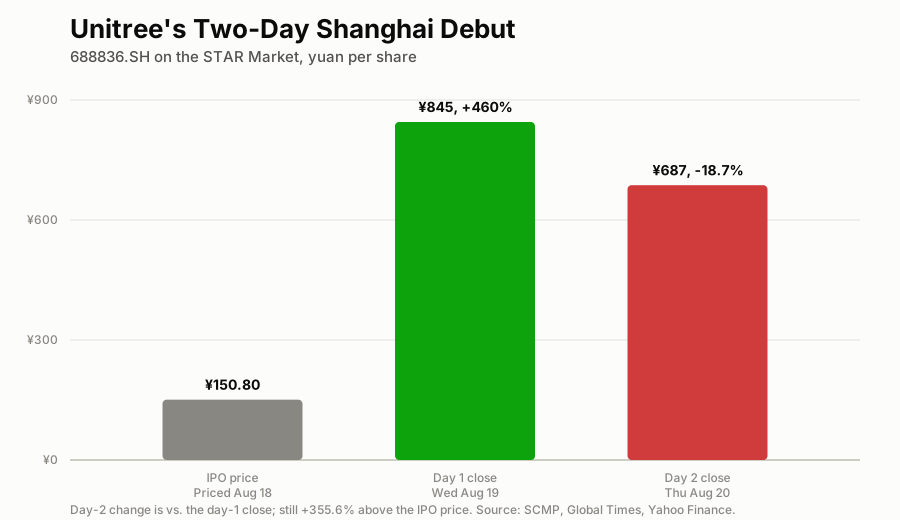
Two trading days, three very different prices. All three are the same stock.
What Actually Happened On the STAR Market
Unitree priced its Shanghai IPO at ¥150.80 a share on August 18, selling 40.45 million shares (10% of the company post-listing) to raise ¥6.1 billion, about $904 million at the roughly 6.73 yuan-per-dollar rate that week. That valued the company at about ¥61 billion, close to $9 billion, going in.
Then it opened for trading on August 19 and the order book did something IPO pricing committees dread and underwriters privately hope for: it went vertical. Shares touched ¥1,100 intraday, a 629% gain, before settling to close at ¥845, up 460% on 23.2 billion yuan of turnover. Founder Wang Xingxing's stake was worth roughly ¥103 billion on paper by the close. Meituan, an early backer, was sitting on a stake worth about ¥30 billion, something like a 70-fold return on its original check.
Day two brought it back to earth, a little. Shares closed ¥687 on August 20, down 18.7% from the debut close. Chinese state media called it a "normal adjustment" after an overheated debut, which is one way to describe giving back a fifth of your value in a single session. The stock is still up 355.6% from where it priced two days ago.
Why Two Outlets Can Both Be Right About the Valuation
Here's a small but useful lesson in reading these numbers: you'll see Unitree's day-one valuation reported as both roughly $51 billion and roughly $66 billion, and both figures are correct, they're just describing different moments. Multiply the roughly 404.5 million shares outstanding by the ¥845 close and convert at 6.73 yuan/dollar, and you get about $51 billion, the number tied to where the stock actually settled. Do the same multiplication against the ¥1,100 intraday high instead, and you land close to $66 billion, the number that shows up in headlines built around the 629% figure.
Neither outlet is wrong. They're quoting the peak and the close of the same session, which is exactly the kind of distinction that turns into a comment-section argument if nobody says which one they mean. I'm using the close, ¥845 and about $51 billion, as the number that matters, because that's the price the market actually agreed to hold overnight.
Can US Investors Actually Buy This?
No, not directly, and probably not for a while. Unitree's A-shares trade only on the Shanghai Stock Exchange, and STAR Market shares are open to two groups: mainland Chinese retail and institutional accounts, and foreign institutions holding a Qualified Foreign Institutional Investor (QFII) license. An ordinary US brokerage account is neither.
The other door, Stock Connect, the mechanism that lets Hong Kong and overseas investors trade certain mainland shares northbound, isn't open here either. Connect eligibility for STAR Market names generally requires inclusion in the SSE 180 or SSE 380 index, or a dual listing in Hong Kong, and that kind of qualification typically takes months of trading history to earn after a listing this fresh. Unitree isn't there yet, and there's no dual Hong Kong listing announced.
So: no ADR, no Nasdaq or NYSE ticker, no Stock Connect access on day two. If a website or app is offering you a way to trade "Unitree stock" that isn't one of the two ETF routes below, look closely at what you're actually buying. A couple of crypto exchanges list synthetic price-tracking instruments tied to Unitree's share price, and pre-IPO marketplaces sold SPV exposure to accredited investors before the listing. None of that is the same as owning STAR Market equity, and I'm not going to pretend it is.
The Two Indirect Routes, and Why Neither Is a Clean Trade Yet
KOID, the KraneShares Global Humanoid Robotics and Physical AI ETF, is the first US-listed ETF built specifically for this theme. It trades at $37.96 with a market cap around $324 million, small for an ETF, and Unitree is modeled at roughly an 8% weight in the index KOID tracks once the fund's methodology actually adds the stock. That "once" is doing real work in that sentence: getting Unitree into a US-listed fund at all requires the fund manager to hold QFII status, or wait for the same Stock Connect eligibility that blocks direct retail access. There's a real lag between "Unitree IPO'd" and "KOID owns Unitree," and I couldn't pin down that it's closed yet.
KSTR, KraneShares' STAR Market 50 ETF, tracks the 50 largest STAR Market names by market cap and trades around $23.91. Unitree could plausibly qualify given its size, but STAR 50 index reviews happen on a schedule, and the next one lands around December 2026, months after this listing priced. Until then, KSTR doesn't hold it either.
Neither ETF has a liquid, verifiable options chain. Nasdaq's own data shows no options listed on KOID, a $324 million fund trading a few thousand dollars a day, and I couldn't source a live, quotable KSTR chain either. Writing a structure against either name right now would mean pricing an illiquid options market on an ETF that may not even hold the stock you're trying to get exposure to. That's not a trade, that's two guesses stacked on top of each other.
The Part That Complicates the Bull Case
Unitree makes physical humanoid and quadruped robots, and on July 28, 2026, roughly three weeks before this IPO, the FCC voted to ban new imports of Chinese-made humanoid and quadruped robots into the US, citing supply-chain, cybersecurity, and national-security risk. The Pentagon separately lists Unitree among Chinese companies it says have ties to China's military. Existing US-sold Unitree units keep their FCC approval; new ones don't get one.
That's the tension sitting underneath this entire stock story: American capital, through KOID, through pre-IPO SPVs, through synthetic price trackers, is racing to get exposure to a company whose actual hardware just got locked out of the American market it would otherwise be selling into. China dominates humanoid robot shipments globally, with something like 85% share, and Unitree is one of the two largest shippers in that market. The valuation the STAR Market just put on the stock, roughly 857 times management's own projected 2026 earnings per multiple reports, prices in a growth story that increasingly runs through markets the US isn't part of. That's not necessarily bearish. It's a different bull case than "Americans will buy the robots," and it's worth knowing which one you're actually betting on before you buy KOID.
Unitree's AI partner on this listing is DeepSeek, which put in ¥140.8 million for a 2.31% strategic-placement stake, now worth roughly ¥789 million on paper (a gain that tracks the stock's own 460% move, since it's the same locked-up shares) as the two companies build shared AI models for the robots. That pairing matters beyond the trivia: it's the same DeepSeek whose inference-pricing move this week read as evidence AI compute demand is still climbing, the same story implicit in a robotics IPO getting bid to 629% over its offer price.
Not the First Hot Foreign Listing This Year
This isn't the first time a foreign listing has scrambled the usual "just buy the ticker" playbook for US readers this year. When SK Hynix chose a direct Nasdaq listing instead of staying gray-market, it was explicitly to give US investors a clean, liquid way in, and $26.5 billion of demand showed up for exactly that reason. Unitree did the opposite: it listed on the one exchange that keeps US retail out by design, then delivered the kind of pop that makes people search for a way in anyway.
The contrast with SpaceX is different but related. SpaceX's lockup schedule is a calendar problem, a known date when more shares become sellable. Unitree's access problem isn't a date on a calendar at all; it's a market-structure wall that doesn't move until Stock Connect eligibility or a QFII-licensed fund manager clears it, on a timeline nobody involved has committed to. The August unlock dynamics around SpaceX are a supply problem you can count down to. This one, you can't.
The access problem itself isn't new. Our explainer on CXMT, the Chinese DRAM maker competing with Micron and SanDisk, ran into the same wall: a name US investors keep asking about with no US-listed way to own it.
The Options Angle
There isn't a real one, and saying that plainly is more useful than forcing a structure onto two ETFs that don't have tradeable chains. What follows is the honest version of "what would I do."
Trade log
| # | Stance | Structure | Strikes and expiry | Cost or credit | Spot at writing | Implied move | Conviction | Breakeven |
|---|---|---|---|---|---|---|---|---|
| 1 | Pass | KOID common stock, as a diversified Unitree proxy | n/a (equity) | $37.96/share | $37.96 | n/a | 4/10 | n/a |
| 2 | Pass | KSTR common stock, as a STAR Market proxy | n/a (equity) | $23.91/share | $23.91 | n/a | 3/10 | n/a |
I'm passing on both as a way to trade this specific story. KOID is a real, diversified basket if you want broad humanoid-robotics exposure and can live with Unitree possibly not being in it yet at any meaningful weight. KSTR is a real way to own STAR Market breadth, with the same "maybe December" uncertainty on this one name. Buying either one today as a bet on Unitree specifically is buying a basket to express a single-stock view, with a fund manager's index methodology standing between your dollar and the company you actually want exposure to. I'd rather wait for confirmation that either fund actually holds the position, or that Unitree clears Stock Connect, before sizing anything around this name.
The One-Line Read
Unitree's stock did what STAR Market debuts do, it ran 460% and then gave back a fifth of it. The more durable fact for US readers has nothing to do with the percentage: there's still no clean way to own this one, and the two ETFs that come closest don't clearly hold it yet either.
Next up:ISM Services PMI, today at 10:00am ET →
More on Single Stocks
Updated Every Saturday
The Week Ahead
Every earnings date, Fed event and setup for the current trading week, on one page.
Refreshed Weekly
Earnings Calendar
Who reports next, when, and what consensus and the whisper expect.
The Week-Ahead Brief
Don’t miss next week’s setups. Get the Sunday brief.
Latest issue, Sep 27“Micron, PCE and the jobs report that decides October”
Every Sunday: next week’s earnings dates, Fed days and the trades worth watching, from the same desk that writes the week-ahead hub. Free, built for retail investors.