What Is CXMT? The Chinese DRAM Maker That Broke Micron, and Whether You Can Actually Buy It
CXMT explained: China's state-backed DRAM maker grew revenue sevenfold, filed an $8.5 billion IPO and got Apple testing its chips. What it threatens, and why you can't buy the stock.
TL;DR
- CXMT (ChangXin Memory Technologies) is China's state-backed DRAM maker, now the world's #4 DRAM producer, with revenue up sevenfold in the first half of 2026 and an $8.5 billion IPO filed to add capacity.
- It is the single fundamental reason Micron broke $900 after a year in which every other memory selloff was just positioning.
- You almost certainly cannot buy it. It's a domestic Chinese listing, not a US-listed stock, so retail exposure runs through proxies and, more realistically, through what you don't own.
- The distinction that decides everything: CXMT threatens commodity DRAM. It cannot yet touch HBM, and HBM is the entire AI memory trade. Apple's call Thursday is the next real catalyst.
What Is CXMT?
The short answer: CXMT, or ChangXin Memory Technologies, is China's national champion in DRAM, the commodity memory that goes in phones, PCs and standard servers. It is state-backed, it has scaled faster than anyone in the industry expected, and it exists specifically to end China's dependence on Micron, Samsung and SK Hynix for memory chips.
Three numbers tell you why the market suddenly cares. Revenue grew sevenfold in the first half of 2026. It is already the fourth-largest DRAM producer on earth. And it filed an $8.5 billion IPO, the biggest in China this year, with the explicit purpose of building more capacity.
That is not a rumor or a roadmap. That is funded, scheduled supply.
The Board
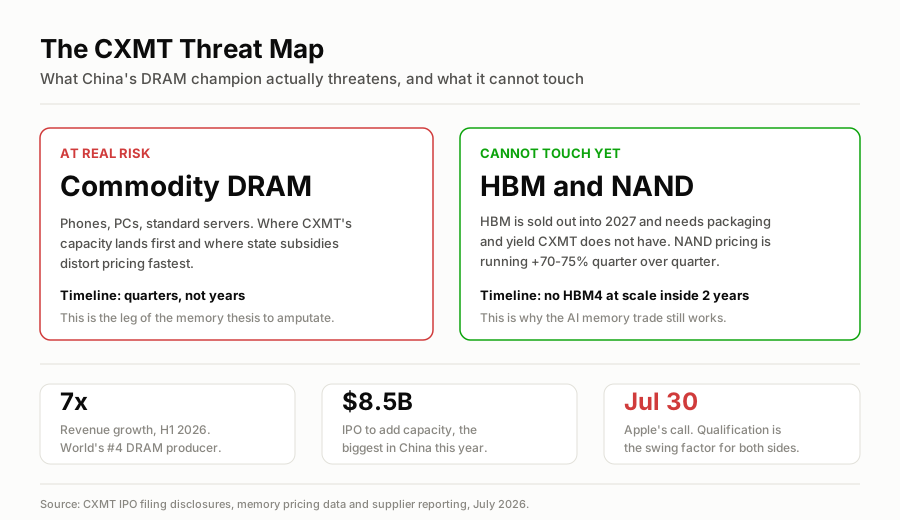
The left column is genuinely at risk. The right column is why the AI memory trade still works. Most of the July selloff sold both.
Can You Buy CXMT Stock?
The short answer: no, not from an ordinary US brokerage account. This is the question people search most about CXMT and the honest answer disappoints them.
CXMT's IPO is a domestic Chinese listing, aimed at mainland investors and institutions. There is no US ticker, no ADR, and no ordinary path for a retail investor in the US or UK to own shares directly. The workarounds people reach for are worse than they look:
- Broad China tech funds give you a homeopathic dose of CXMT wrapped in a hundred unrelated companies. You are not buying the thesis, you are buying China beta.
- Chinese semiconductor funds get you closer, but still dilute a specific supply story into a sector bet that includes the very companies CXMT competes with.
- Waiting for an ADR is not a plan. Geopolitics makes a US listing for a state-backed strategic chipmaker unlikely.
Which leads to the important reframe: for almost everyone, CXMT is not something you buy. It's something you price into what you already own. The tradeable expression of a CXMT view is your position in Micron, SK Hynix and the rest of the memory complex, not a line item called CXMT.
What CXMT Actually Threatens (and What It Can't)
This is the part the market keeps getting wrong, and getting it right is the whole edge.
At real risk: commodity DRAM. The standard memory in phones, PCs and ordinary servers. This is where CXMT's capacity lands first and where state subsidies distort pricing fastest. It is also where Micron's margin recovery came from. This threat is real and it arrives over quarters, not years.
Not at risk yet: HBM. High-bandwidth memory, the product that feeds AI servers, is sold out into 2027 and requires packaging and yield capability CXMT does not have. Nobody credible puts Chinese HBM4 at scale inside two years. The AI memory trade runs through HBM, and CXMT's IPO does not touch it.
Also insulated: NAND. A different product on a different cycle, with pricing running up 70-75% quarter over quarter. CXMT's DRAM capacity is not a NAND story, which is why SanDisk's shortage thesis survived the same week Micron cracked.
So the question that determines your position size is narrow: how much of a memory stock's multiple was commodity-DRAM pricing power, and how much was HBM growth? The July selloff priced the threat as though it hit everything. It doesn't. We marked our own memory thesis to market on exactly this split: the supercycle survives, narrowed to HBM and NAND, with the commodity-DRAM leg amputated.
Why Apple's Thursday Call Is the Real CXMT Catalyst
Here's the detail that turns a Chinese IPO into a US trading event. Apple is testing CXMT chips for China-market devices, and Apple reports Thursday, July 30.
Supplier qualification at Apple is the industry's gold standard. A yes converts CXMT from "subsidized capacity threat" into "validated tier-one supplier" overnight, and commodity DRAM pricing power dies a year early. A no, or a narrow "low-end only" characterization, walls the threat off and the most beaten-down memory names get relief.
Tim Cook will not volunteer any of this. But analysts have one job this quarter, and his answer, even a non-answer, gets parsed by every memory desk within seconds. That's why we've argued the sleepiest print of the fortnight is carrying live ammunition for the market's most volatile sector.
The Bear Case for CXMT Itself
Be fair to the other side, because "state-backed" is not a synonym for "succeeds."
Scaling DRAM is brutally hard. Yield, not capacity, is what makes a memory business profitable. Announcing $8.5 billion of investment is the easy part; converting wafers into sellable chips at competitive yields is where most national champions have historically stalled.
Export controls bite at the tooling layer. Advanced memory needs advanced lithography and process equipment, and access to the best of it is restricted. That constraint is precisely why the HBM gap is measured in years rather than quarters.
Subsidized supply can be irrational supply. A state-backed producer that keeps building through a downturn hurts everyone's pricing, including its own. That's bad for Micron's margins, but it isn't necessarily a good business, and it's worth remembering that the thing damaging your holdings may not be a thing you'd want to own anyway.
The Options Angle
- Trade the split, not the headline. The edge is separating CXMT-exposed commodity DRAM from the HBM and NAND stories it can't touch. Long the insulated names against the exposed ones expresses the actual thesis; selling the whole complex expresses panic.
- Apple week is a memory-volatility event that memory options aren't fully pricing. The market files July 30 under "Apple news," so a cheap two-week strangle on a memory name ahead of the call buys a binary the crowd is looking past. Small size: it's a bet on one sentence being said out loud.
- Put-selling on Micron stays suspended. We sold fear on every dip this year because those dips were flows. This one has a funded fundamental attached, and selling puts into a live supply threat is picking up dimes in front of a bulldozer that announced its route.
- The re-entry is a level plus a fact, not a feeling. Micron near the market's $840 number with the CXMT question answered benignly is the spot where an AI-memory story is on sale because of a commodity-memory scare. That is a real setup. Guessing ahead of it is the gambling side of the line.
The One-Line Read
CXMT is a genuinely funded, state-backed threat to commodity DRAM that you cannot buy and therefore have to trade through what you already own, and the only question that matters is whether the market keeps mistaking a commodity-memory problem for an AI-memory problem, because HBM stays sold out into 2027 no matter how many fabs China builds, and Apple's Thursday call is where the next piece of evidence lands.
More on AI & Semiconductors
$ARM · 2026-07-28
Arm Earnings Preview (July 29): The Purest AI Royalty Play, at the Least Forgiving Valuation
$QCOM · 2026-07-28
Qualcomm Earnings Preview (July 29): The Apple Countdown Clock Is the Whole Story
$MU · 2026-07-27
MU and SNDK: Up 210% and 503% This Year, Down Every Day Since June. Is This the Dip to Buy?
The Sunday Setup
Enjoyed this breakdown? Don’t miss the next market setup.
Get deep-dive analyses delivered to your inbox every Sunday. Free, and built for retail investors.
Comments
0 totalNo comments yet. Be the first to drop a take.