$1,000 of Moderna Calls on Tuesday Is $9.4 Million Today. Could Anyone Have Seen It Coming?
Moderna's $80 weekly calls closed Tuesday at $0.01. After the cancer vaccine win they closed at $94.43, so $1,000 became about $9.4 million. Whether anyone could have known is the real question.
TL;DR
- Moderna's $80 calls expiring August 21 closed Tuesday at $0.01 and closed Wednesday at $94.43, a gain of 944,200%. $1,000 spent on them at Tuesday's close was worth about $9.4 million at Wednesday's bell.
- The same $1,000 in Moderna shares became $2,770. The stock nearly tripled; the two-day option multiplied 9,443 times, because its entire value was the accident of expiring 48 hours after the news.
- Could anyone have known? The catalyst, yes. The date, no. The INTerpath-001 readout was guided only "potentially in 2026", and the trial is event-driven, so even a diligent reader had no week to circle. The penny price itself says nobody visible in that chain knew either.
- After hours the stock kept climbing: $186.58 at 4:39pm, $183.97 on a later broker print, against a $174.38 close. Every published analyst target sits below the market; the highest is RBC's $130, raised today from $45.
- Would I buy calls at Thursday's open? No. The trade log below says why, and logs the call I am willing to be graded on instead.
More on $MRNA: Moderna Closed Up 177% on the First mRNA Cancer Vaccine Win. The Effect Size Is Still Unpublished →
The Board
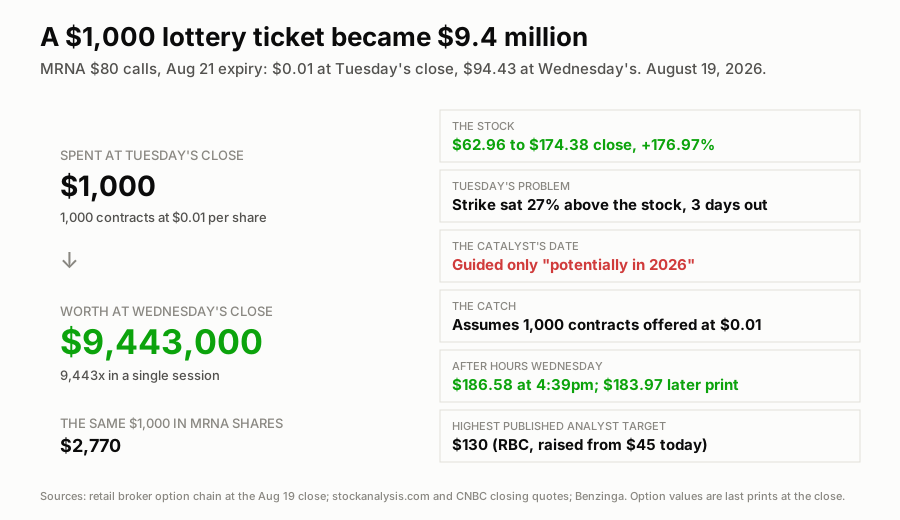
The best-case ticket on the whole board, priced at a penny because the market saw no reason for it to exist.
What Would $1,000 of Moderna Calls Bought Tuesday Be Worth Now?
About $9.4 million, on the best contract available.
The numbers come from a retail broker's option chain captured at Wednesday's close. The $80 strike call expiring August 21, two days out, last traded Tuesday at $0.01 per share, or $1 per contract. $1,000 bought 1,000 contracts, which is the right to buy 100,000 Moderna shares at $80. On Tuesday that right was worthless: the stock closed at $62.96, so the calls needed a 27% rally inside three days just to touch the strike.
Then Wednesday happened. Moderna closed at $174.38, up 176.97%, after its Merck-partnered melanoma vaccine became the first mRNA cancer therapy to pass a Phase 3 trial. The $80 calls last traded at $94.43: 1,000 contracts times 100 shares times $94.43 is $9,443,000. The broker's own change column reconciles, +$94.42 and +944,200% only work against a $0.01 prior close, and the $94.43 print sits five cents over the option's intrinsic value against the close. The arithmetic is sound.
The $85 strike was the same penny and finished at $89.43. The $75s cost six cents Tuesday and returned a comparatively modest 165,700%. Every strike on the board ran the same trade at a different exchange rate.
Read the Fine Print Before Envying Anyone
Three things stand between that headline and a real $9.4 million.
Someone had to sell you 1,000 contracts at a penny. Open interest in a 27%-out-of-the-money call with three days to live is thin, and a $0.01 offer usually comes from a market maker quoting the minimum tick out of obligation, with little resting size behind it. Buying 10 contracts at that price is realistic. Buying 1,000, which is 100,000 shares of notional for $1,000, assumes a counterparty this thought experiment never had to find.
Fees eat penny options alive. At the standard 65 cents per contract, the commission on 1,000 contracts is $650, on $1,000 of premium. The zero-commission broker whose chain produced these quotes is the only venue where the round number survives intact.
And the seller's side of this trade is the cautionary half. Whoever wrote those calls collected $1 per contract on Tuesday and owed $9,443 per contract by Wednesday's close. Selling far-out-of-the-money weeklies for pennies looks like free money for years at a time, until a Phase 3 readout lands on your strike.
Could Anyone Without Inside Information Have Seen It Coming?
The event, yes. The week, no.
Nothing about the catalyst was secret. INTerpath-001 was a registered Phase 3 with published design, the Phase 2b behind it reported a 49% cut in recurrence risk at ASCO in June, and Leerink had publicly called the readout make-or-break for the stock. Moderna itself told investors results were coming "potentially in 2026". A reader doing ordinary diligence knew a binary of this size was live.
What no reader had was a date. The trial is event-driven: the analysis triggers when enough recurrences have accumulated across 1,137 patients, and until the statisticians lock the database even the companies hold a window rather than a day. Compare the flu vaccine decision two weeks ago, which had a scheduled FDA action date you could buy dated options against. This announcement had no calendar entry anywhere.
The chain is the strongest evidence. If the timing had leaked to anyone willing to trade on it, the $80 calls do not close Tuesday at $0.01; someone lifts every penny offer on the board, and that buying would be visible in Tuesday's prices. It isn't there. Even during Wednesday's session, with the news out, Schwab's options desk counted Moderna option volume at 52 times average with puts outpacing calls 1.5 to 1, which reads as holders buying protection and skeptics fading the move, not a crowd that saw it coming.
So the realistic version of foresight was never the weeklies. It was believing the Phase 2b effect would replicate, owning calls dated far enough out to survive the wait, and bleeding premium for however many months the window stayed open. That position also repriced violently on Wednesday. It just returns a number with two or three digits fewer, because you paid real premium for the time. The 9,443x required guessing the week, and the week was not guessable. That is a lottery ticket, and lottery tickets that hit do not become investment strategies in hindsight.
Where It Goes From Here
The stock did not stop at the close. It printed $186.58 at 4:39pm and $183.97 on the broker feed later in the evening, both extended-hours readings that will move overnight. The session itself had a striking shape: opened at $121.90, climbed all day, closed within striking distance of the $176.66 high on 191 million shares. My read of that tape is real institutional size being put on, funds that could not own a cash-burning $25 billion Moderna finding they can own a twice-validated $70 billion one. That is an inference from the tape; the 13F filings that would confirm it are months away.
The sell side is now chasing the price. RBC went to $130 from $45 today, per Benzinga; the pre-news consensus was about $49 with Piper Sandler's $77 the highest published target. Every one of those numbers is below where the stock trades this evening.
Then there are the round numbers circulating anywhere Moderna is being discussed tonight: $500, even $1,000. Neither is an analyst target. They are the size of the platform bet with no model attached, and they can still be checked against the share count: at roughly 400 million shares, $500 is a $200 billion company, which is approximately Moderna's COVID-era peak (the all-time high is $497.49, August 2021). $1,000 is a $400 billion company, larger than Merck ($333-346 billion today). Getting there requires the other eight INTerpath trials, in lung, bladder, kidney, pancreatic and gastric cancer, to read out the way melanoma just did, plus commercial-scale manufacturing of a drug built one patient at a time. That is a multi-year path, and none of it resolves by Friday.
The nearest thing to a dated catalyst is the full dataset at a medical meeting, and it has no date yet. The number it contains, the hazard ratio, is the whole argument about whether $174 was cheap or generous.
The Options Angle
Would I buy calls at Thursday's open? No. Three things about this chain decide it for me.
- The weeklies have nothing left to offer. At Wednesday's close the deep in-the-money $80 call asked $95.45 against $94.38 of intrinsic value: about a dollar of time premium on a $174 stock. The chain has already collapsed to parity for Friday. Any out-of-the-money weekly bought at Thursday's open is a 48-hour bet that an extended-hours print extends further, with no scheduled news before expiry to force it.
- The undated catalyst cuts against short-dated anything. The next real mover is the hazard ratio at a medical meeting. No date, so no expiry to aim at. Premium bought this week is time decay purchased for an event that almost certainly does not land this week.
- Direction is the view worth grading. I think the repricing holds: the platform validated twice in fourteen days, the tape absorbed 191 million shares without a meaningful dip, and the Phase 2b prior (hazard ratio 0.51) gives the unpublished number a favorable starting distribution. So the logged call is the common stock at the close, held into the data presentation, graded against $174.38. If the effect size disappoints, that call loses and the record will say so on the track record ledger.
Trade log
| # | Stance | Structure | Strikes and expiry | Cost or credit | Spot at writing | Implied move | Conviction | Breakeven |
|---|---|---|---|---|---|---|---|---|
| 1 | Pass | Long weekly calls at Thursday's open | Any Aug 21 strike | No Thursday quote exists yet; at Wednesday's close the $80C asked $95.45 vs $94.38 intrinsic | $174.38 close Aug 19; $183.97 after-hours broker print | Not sourced for Thursday strikes | 7/10 | n/a |
| 2 | Long | Common stock into the full INTerpath-001 data presentation | n/a | n/a | $174.38 close Aug 19 | n/a | 5/10 | $174.38 |
The One-Line Read
The ticket paid 9,443 to 1 because nobody, buyer included, knew the date. The thesis was researchable all year; the timing never was. I would not spend Thursday's open trying to relive Wednesday.
Next up:ISM Services PMI, tomorrow at 10:00am ET →
More on $MRNA
$MRNA · 2026-08-19
Moderna Closed Up 177% on the First mRNA Cancer Vaccine Win. The Effect Size Is Still Unpublished
$MRNA · 2026-07-31
Moderna Beat and the Stock Fell. The Whole Company Now Rests on an FDA Decision on August 5
$MRNA · 2026-07-28
Moderna Earnings Preview (July 31): Revenue Near $103 Million, and the Only Question Is the Runway
Updated Every Saturday
The Week Ahead
Every earnings date, Fed event and setup for the current trading week, on one page.
Refreshed Weekly
Earnings Calendar
Who reports next, when, and what consensus and the whisper expect.
The Week-Ahead Brief
Don’t miss next week’s setups. Get the Sunday brief.
Latest issue, Sep 27“Micron, PCE and the jobs report that decides October”
Every Sunday: next week’s earnings dates, Fed days and the trades worth watching, from the same desk that writes the week-ahead hub. Free, built for retail investors.