Is It Time to Buy the KOSPI Dip?
The KOSPI just crashed 25% to 6,807, deeper than its 20% Feb-April war dip. Recovery, dead cat bounce, or more downside? Here's the data-driven case, with strong conviction and the one thing that changes it.
TL;DR
- Updated July 29: this call was wrong, and the condition we set for it has been met. We named exactly one thing that would break the thesis: SK Hynix's actual earnings confirming the ₩60.4 trillion whisper. On July 29 the print landed at ₩60.54 trillion, the Kospi closed at 5,663.24, and the 6,650 floor argued for below did not hold. The re-underwriting is in why the Korean market is crashing. The original July 14 argument stands unedited below.
- The KOSPI has crashed ~25% to 6,807, deeper and faster than the ~20% dip it took from February to April.
- The lazy read is "falling knife, stay away." The data says the opposite.
- This recovers. The February dip was the same kind of war-driven shock and it round-tripped to new highs in ten weeks, the physical memory shortage driving the whole index is untouched, and the crash bottomed on the exact floor the last one did.
- One thing, and only one thing, changes that call: SK Hynix's actual earnings. Everything else is noise. Here's the proof and the plan.
More on $EWY: Why Is the Korean Stock Market Crashing? The Kospi Has Lost 40% Since June, and Samsung and SK Hynix Are Most of It →
Two Crashes, One Floor
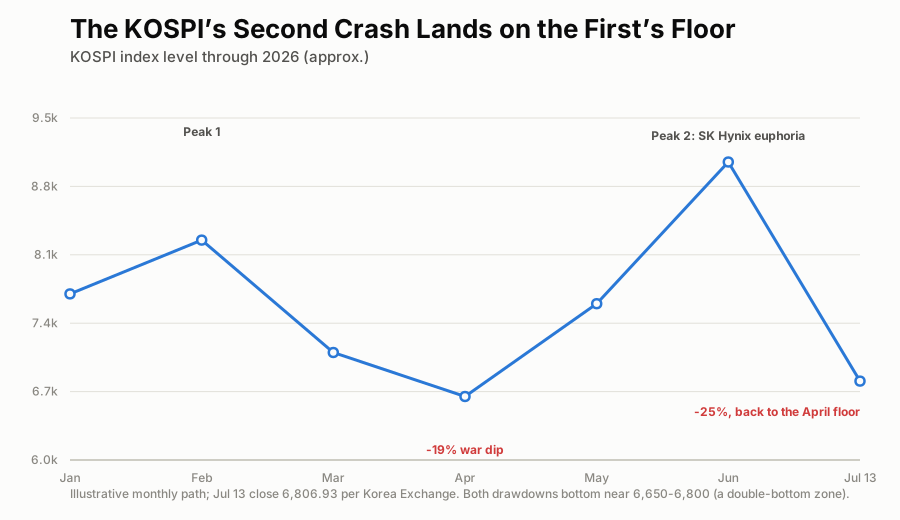
The second crash is deeper in percentage terms only because the run-up was bigger. It landed on the exact floor the first one did.
Look at the shape, because the shape is the argument. The KOSPI dipped ~19% from its February peak into an April low around 6,650, on the first Iran-war shock. Then it didn't just recover, it ran to a record high above 9,000 by June on the SK Hynix and AI-memory euphoria. Now it's crashed 25% from that record, and it bottomed at 6,807, essentially the same floor as April.
That's not a chart that's breaking down. That's a chart that has tested the same support twice and held. A 25% drop that lands on a prior, defended low is a double-bottom setup, not a breakdown, until proven otherwise.
Why It Dipped (And Why None of It Is Fatal)
The 25% crash has three causes, and I've broken each down. Run them against the "does this recover" question:
- Post-IPO profit-taking. Korean investors rode SK Hynix up into its $26.5 billion Nasdaq listing, then sold the local shares once the champagne popped. That's mechanical, it's finite, and it's the single largest chunk of the move. Profit-taking ends when the profit-takers are done. It doesn't compound.
- The war and the won. The weekend escalation and a weaker won amplified foreign selling (2.8 trillion won of it). But Korea is the most oil-sensitive developed market on Earth, which cuts both ways: it sells off hardest on an oil shock and rebounds hardest when the shock fades. And the shock is fading. Trump is calling the US the "guardian of Hormuz" and running a blockade-and-fee pressure play, not a closure. Oil is contained.
- The earnings whisper. One Korean brokerage pegged SK Hynix Q2 operating profit at 60.4 trillion won versus 65 consensus. This is the only cause that attacks the actual thesis, and it's one note, not a confirmed miss.
Two of the three causes are mechanical and self-exhausting. The third is a single analyst's estimate. None of them is "the memory cycle is over."
The Proof It Recovers
I'm not hedging this, so here's the evidence stack:
1. The exact same setup just V-recovered ten weeks ago. The Feb-April dip was war-driven, ~20%, and it fully round-tripped to new highs by June. Same index, same kind of catalyst, same magnitude. The base rate for "KOSPI recovers from a war-shock drawdown" in 2026 is 100%, sample size the whole rest of the year.
2. The fundamental engine is untouched. The KOSPI is a memory-and-tech index, and the thing that drove it to records (the NAND/HBM shortage) hasn't moved. NAND contract prices are up 70-75% quarter over quarter, supply is sold out into 2027-2028, and not one hyperscaler canceled an order because Seoul had a bad Monday. The memory-stocks breakdown lays out the physical shortage in full. Price crashed; physics didn't.
3. It bottomed on a defended floor. 6,807 is April's low. The market has now bought this level twice. Double-tested support with the fundamentals intact is where recoveries start, not where crashes accelerate.
4. The seller list is finite; the buyer list isn't. Post-IPO flippers, momentum stop-outs, and won-driven foreign redemptions all run out. The structural buyers underneath (anyone who needs memory exposure and just got it 25% cheaper) don't.
The Case It Keeps Dipping (And Why It Loses)
Steelman the bears, because conviction without the other side is just cheerleading:
- "The index is too concentrated." Samsung and SK Hynix are a huge share of the KOSPI, so if memory earnings miss, there's no other engine. True. But that concentration is why it rips when memory works, and memory is working everywhere except one brokerage's spreadsheet.
- "The second dip is sharper, so there's more air underneath." The 25% is bigger than the 19% only because the June peak was a euphoric record. Measured from fair value rather than from the blow-off top, the drawdown is far less dramatic, and it still landed on support.
- "Foreign flows could keep leaving." They could, until the won stabilizes, and the won stabilizes when oil calms, which is already happening. Foreign selling driven by a currency move reverses when the currency does.
Every bear argument depends on the memory earnings actually missing. That's the whole ballgame, and it's a scheduled, knowable event.
The One Thing That Changes My Mind
SK Hynix's actual Q2 report. If the print confirms the 60.4-trillion-won whisper and management guides the shortage as softening, then this stops being a war-and-positioning flush and becomes a fundamental de-rate, and you wait. That's the falsification condition, stated plainly. Until that number lands, every other data point says the same thing the February dip said: this is a shock, not a cycle-ender.
The Plan (Strong Conviction, Defined Risk)
- In tranches, not all at once. EWY, the US-listed Korea ETF, is the cleanest vehicle I can access. I am starting at the double-bottom and adding on any retest of the 6,650 April floor, which is scaling into defended support with the fundamentals intact rather than calling a low.
- SK Hynix earnings are the confirmation, not the entry. A starter position through the print, then adding hard if it beats the lowered whisper and stopping dead if it confirms the miss. The point of sizing it small first is that the miss scenario costs little.
- The leveraged version and what it gives up. Two-to-three-month EWY calls capture the V-recovery that February suggests is the base case, with the downside capped at the premium. They also expire, which the shares do not, so a right thesis on a slower timetable still pays nothing.
Recovery, Dead Cat, or More Pain?
Recovery. Not a dead cat, not a slow bleed. A war-shock-plus-profit-taking crash that landed on a twice-defended floor, in an index whose fundamental engine is running at record shortage pricing, that already showed you this exact movie ten weeks ago and it ended at new highs. The bears need an earnings miss to be right, and they don't have one yet. I am buying this dip, sized for the one number that could prove the whole thesis wrong.
Next up:PPI, today at 8:30am ET →
More on $EWY
Updated Every Saturday
The Week Ahead
Every earnings date, Fed event and setup for the current trading week, on one page.
Refreshed Weekly
Earnings Calendar
Who reports next, when, and what consensus and the whisper expect.
The Week-Ahead Brief
Don’t miss next week’s setups. Get the Sunday brief.
Latest issue, Sep 7“Week ahead in the stock market...”
Every Sunday: next week’s earnings dates, Fed days and the trades worth watching, from the same desk that writes the week-ahead hub. Free, built for retail investors.