Why Is the Korean Stock Market Crashing? The Kospi Has Lost 40% Since June, and Samsung and SK Hynix Are Most of It
The Kospi closed at 5,663.24 on July 29, down 39.7% from its June record, with circuit breakers halting Seoul two days running. Why Korea is crashing, and why Samsung and SK Hynix are most of it.
TL;DR
- The Kospi closed at 5,663.24 on Wednesday, July 29, down 5.98%, after falling as much as 8.2% intraday and triggering a market-wide circuit breaker at around 12:32pm Seoul time. The Kosdaq fell 5.20%.
- That is the second straight day both Korean markets were halted, which has never happened before. Tuesday's session closed down 10.84% at 6,023.66. Two days: down 16.2%.
- From its June 19 record close of 9,385.59, the Kospi is now down 39.7%. July to this point is a loss of more than 30%. (July eventually closed down 22.19% after the July 31 rebound, the worst month since 1997 and the second worst on record.)
- Samsung and SK Hynix are more than half the index by weight. Over the two sessions SK Hynix fell 22.9% and Samsung 17.9%. This is not a Korea story wearing a chip costume. It is a chip story wearing a country's flag.
- The trigger was SK Hynix's Q2 print: a record ₩60.54 trillion operating profit that still missed the ₩64.1 trillion consensus. The bearish whisper that started this in mid-July called it to within 0.2%.
More on $EWY: Is It Time to Buy the KOSPI Dip? →
Why Is the Korean Stock Market Crashing?
Because two semiconductor companies make up more than half of the Kospi, both of them are priced for an AI memory boom that never stops accelerating, and on Wednesday morning one of them reported the best quarter in its history and still came up short.
Everything else is detail. Important detail, and it is below, but if you only read one paragraph, that is the paragraph.
The Board
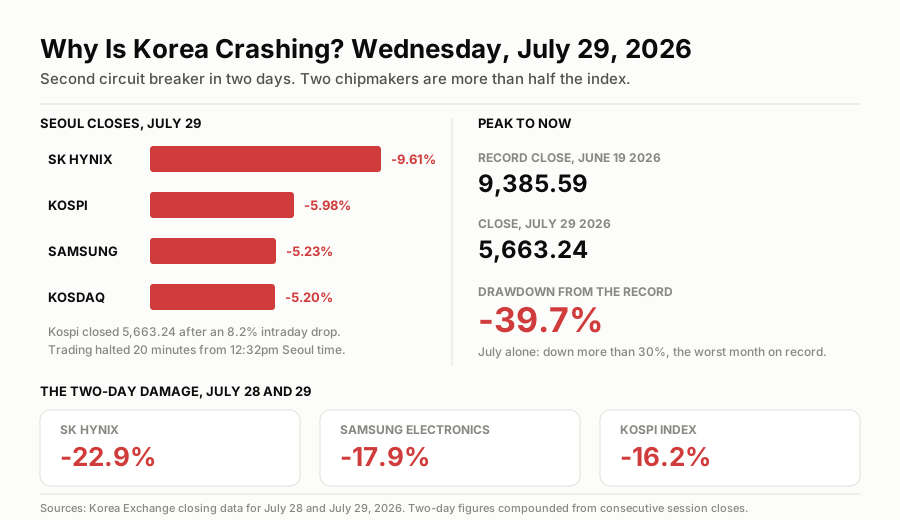
Two sessions, two circuit breakers, and a 39.7% drawdown from the record. The July column is the one that goes in the history books.
Two Days That Broke the Record Book
Korea has circuit breakers for the same reason every exchange does: to interrupt a panic long enough for someone to think. The Kospi halts for 20 minutes when it falls 8% and holds there for a minute. In a normal year it happens never.
This week it happened twice, on consecutive days, in both the Kospi and the Kosdaq at once. That combination has no precedent in Korean market history.
Here is the sequence, because the order matters:
- Tuesday, July 28. The Kospi fell 10.84% to 6,023.66 on a report that a Chinese state-backed firm has begun mass-producing immersion DUV lithography machines, landing on top of CXMT's 466% Shanghai debut. SK Hynix fell 14.7%. Samsung fell 13.4%. We covered the global version of that session in why everything was crashing on July 28.
- Wednesday, July 29, before the open. SK Hynix reported Q2 results. Revenue ₩79.32 trillion against roughly ₩84.1 trillion expected. Operating profit ₩60.54 trillion against roughly ₩64.1 trillion expected. Records on both lines. Misses on both lines.
- Wednesday, 12:32pm Seoul. Circuit breaker. The index reopened and closed at 5,663.24, down 5.98%, with SK Hynix down 9.61% and Samsung down 5.23%.
Note what changed between the two days. Tuesday was a fear about the future: China might build the tools, China might build the chips. Wednesday was an audited fact about the past quarter. Fear you can argue with. A filing you cannot.
The Concentration Problem: Two Stocks, Half an Index
This is the part most coverage skips, and it is the whole mechanism.
Samsung Electronics and SK Hynix together account for more than half of the Kospi's total weight. There is no other major national index on earth with that shape. The S&P 500's largest company is a single-digit percentage of the index. In Seoul, two companies in the same industry, selling the same product, to the same customers, are the majority of the market.
That has two consequences, and Korean investors have now experienced both inside six weeks:
On the way up, it is a leveraged bet on one theme. The Kospi more than doubled in 2026, up over 100% year to date at the June peak, because DRAM and HBM pricing went vertical. On June 22, SK Hynix overtook Samsung as Korea's most valuable company, the first time in more than 25 years that anyone had taken the top spot. That is one trade, expressed as a country, rather than a diversified market repricing.
On the way down, there is nothing else in the index to catch it. When memory earnings disappoint, the Kospi has no financials rally, no energy rotation, no defensive ballast big enough to matter. The thing that made Korea the world's best-performing major market is the thing making it the world's worst one now. Same coin.
So the question "why is Korea crashing" has the wrong subject. Korea is not really crashing. The global memory trade is crashing, and Korea is the highest-beta way to own it.
The Four Things Stacked On Top of Each Other
Untangle the causes, because they have very different half-lives.
1. The earnings miss (the trigger, and the only one that is a fact). SK Hynix delivered its fifth consecutive record quarter, with operating profit up 557% year over year and a 76% operating margin, and the stock fell 9.61%. Read that twice. When a company posts numbers like that and gets sold, the market is repricing what it will pay for them. Nobody is disputing the results. The full breakdown is in our teardown of the print.
2. The China supply threat (real, but slow). CXMT raised about $8.6 billion to build DRAM capacity, and Chinese domestic lithography is reportedly moving from zero to roughly 5 machines in 2026 and 20 in 2027. Both are genuine. Both are also aimed at commodity DRAM and 28nm-class production, not at the high-bandwidth memory where the AI margin actually lives. This is a 2029 problem being priced in July 2026.
3. Positioning unwind (mechanical, self-exhausting). Foreign investors net sold ₩15.53 trillion of Samsung and ₩21.92 trillion of SK Hynix between mid-June and mid-July. Momentum funds do not have a view on HBM4 yield. They have a stop-loss. When an index doubles and then breaks, the same flows that levered the ascent lever the descent, and they run out of stock to sell eventually.
4. The valuation reset nobody wants to name. At the June peak, the market paid a boom multiple on boom earnings. That is the compounding error every cycle makes. The earnings were real. The multiple on top of them was the bet. What has broken in the last two weeks is the multiple, and it was always the more fragile of the two.
Only the first of those is settled. The other three are arguments.
What Would Actually Stop This
Be specific about the falsification conditions, because "it's oversold" is not a thesis.
- Samsung's full Q2 segment breakdown, Thursday July 30 at 10:00am KST. Preliminary guidance was ₩171 trillion revenue and ₩89.4 trillion operating profit, which beat the ₩84.16 trillion consensus by about 6.2%. If the segment detail shows the memory division carrying it with HBM shipments accelerating, then SK Hynix's miss looks company-specific rather than cycle-wide. That is a genuinely different world. Our preview is here.
- A hyperscaler capex number. Microsoft and Meta report Wednesday evening US time, Amazon on Friday. Korea's entire bull case is that AI infrastructure spending keeps compounding. Those calls are where that gets confirmed or denied, and we mapped the timing in Wednesday's hour-by-hour guide.
- HBM contract pricing holding. The bear case requires memory pricing to roll over. So far it has not: SK Hynix reported DRAM average selling prices up about 30% quarter over quarter and NAND up in the mid-50s percent. Prices that strong alongside a stock this weak is the central tension of the whole trade.
Two of those three land within 48 hours of this article. That is unusually fast resolution for a crash of this size.
The Options Angle
Korea is now a volatility problem before it is a valuation problem, and the instruments follow from that.
- EWY is the retail-accessible vehicle, and it is a diluted one. The US-listed Korea ETF gives you the index, which means it gives you Samsung and SK Hynix plus a lot of names that had nothing to do with this. If your thesis is "memory is oversold", EWY expresses it at roughly half strength. That is a feature if you want the crash without the single-name gap risk, a bug if you want the rebound at full torque.
- Do not sell puts into day two of a circuit-breaker sequence. Selling premium after a volatility spike is usually the highest-expectancy trade on the board. Not when the halts are consecutive and the catalyst calendar is still live. You would be short volatility into Samsung's segment breakdown and two megacap capex prints inside 48 hours. Wait for the events, then get paid.
- The dispersion is the actual opportunity. Samsung fell 5.23% Wednesday; SK Hynix fell 9.61%. Same country, same product, same customers, roughly double the move. If you think the miss is company-specific, the trade is relative, not directional: the pair, not the index.
- Calls two to three months out are how I would be long here, if at all. Defined risk matters when the underlying can gap 10% overnight on a Seoul headline you were asleep for. Anything shorter than the August catalyst window is paying for events you will not be around to collect.
- If you already own the memory complex, the hedge is SMH or SOXX, not SPY. The S&P barely moved through all of this. An index hedge would have paid you almost nothing against the thing that actually hurt.
Is the Kospi a Buy Here?
Not yet, and the reason is discipline rather than fear. We made the bull case at 6,807 on July 14 and named exactly one thing that would break it: SK Hynix's actual earnings confirming the ₩60.4 trillion whisper. On Wednesday the print came in at ₩60.54 trillion. The falsification condition we set was met, almost to the decimal.
When your stated kill switch trips, you honour it. That call was wrong, so I am saying so and re-underwriting from here rather than reaching for a new reason to like it at a lower price.
What has not changed: the physical shortage, the 76% operating margin, the ASPs still climbing 30% and 50% a quarter. What has changed: the market has decided those facts are worth a much smaller multiple, and it has not finished deciding how much smaller. Buying before that process finishes is buying a falling multiple, not a cheap asset. Wait for Samsung's segments and the hyperscaler capex, then commit with something to point at. The full four-way breakdown of dip, puts, cash-secured puts or wait is in our SKHY strategy piece.
The One-Line Read
Korea is having a concentration crisis rather than a country one: two chipmakers are more than half the Kospi, one of them just posted the best quarter in its history and missed anyway, and an index that doubled on the belief that AI memory demand compounds forever is now discovering what it is worth if that demand merely grows fast, which is a great deal less than 9,385.59.
Next up:Fed decision, Tuesday →
More on $EWY
Updated Every Saturday
The Week Ahead
Every earnings date, Fed event and setup for the current trading week, on one page.
Refreshed Weekly
Earnings Calendar
Who reports next, when, and what consensus and the whisper expect.
The Week-Ahead Brief
Don’t miss next week’s setups. Get the Sunday brief.
Latest issue, Sep 7“Week ahead in the stock market...”
Every Sunday: next week’s earnings dates, Fed days and the trades worth watching, from the same desk that writes the week-ahead hub. Free, built for retail investors.