Japan PPI 7.2%: A September BOJ Hike Now Lands the Day After the Fed
Japan's July producer prices rose 7.2% and the yen sits near 159.3, half its intervention gain gone. The BOJ meets September 17, one day after the Fed decides.
TL;DR
- Japan's July corporate goods price index rose 7.2% year over year, under the 7.4% the Reuters poll wanted and just below June's revised 7.3%. Month over month it was +0.1% after +0.5%.
- The weak currency is doing most of the work: yen-based import prices ran 29.1% higher, nonferrous metals 40.6% and chemicals 12.9%.
- The yen traded near 159.3 per dollar on Thursday, having given back roughly half the gain from the rare US-Japan joint intervention on August 1.
- The BOJ meets September 17-18, one day after the September 16 FOMC. Policy is at 1%, and most economists polled by Reuters see 1.25% by year end.
- The ten-year gap is down to 1.81 points: US at 4.67%, Japan at 2.86%, a 25-year high for JGBs. In August 2024 the gap was far wider and the carry trade still came apart.
More on $SPY: Stock Market Week Ahead (Sep 21-25): Costco, AutoZone, KB Home and a 5% Ten-Year →
Why Japan's Wholesale Inflation Matters to US Stocks
It sets the clock on the next Bank of Japan rate rise, and a BOJ hike is the one foreign policy move with a track record of pulling money out of US risk assets. Cheap yen funds leveraged positions all over the world. When Japanese rates rise and the yen strengthens, those positions get more expensive to hold and some of them get closed, which is what happened on August 5, 2024, when the Nikkei fell 12.4% in a single session and the S&P 500 dropped about 3%.
The Board
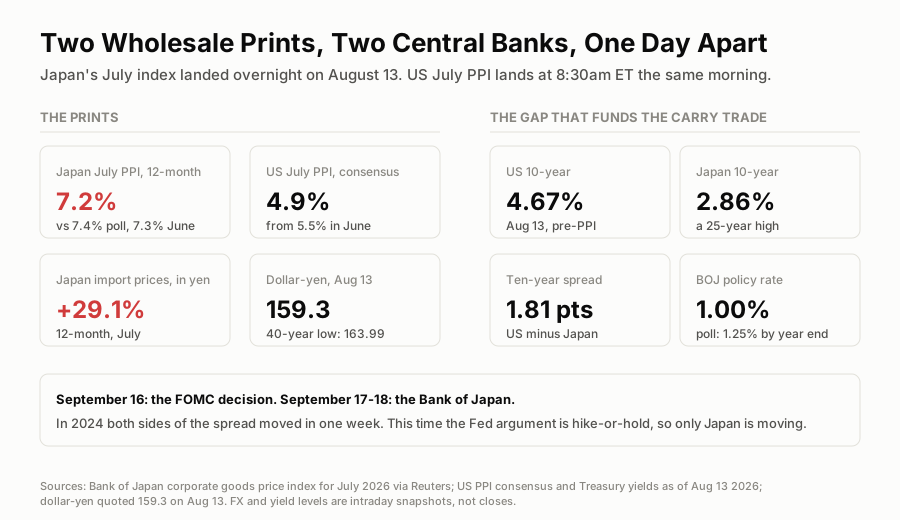
Two wholesale inflation prints on the same day, pointing at two central banks meeting 24 hours apart.
The Print Itself Was Soft. The Level Is Not.
Seven point two percent is a miss against forecast and a slight cooling from June. Read as a monthly data point it argues for patience. Read as a level it does nothing of the sort, because Japanese producers are absorbing costs rising at more than three times the pace of Tokyo core consumer inflation, which was 1.9% in July.
The composition is where the currency shows up. Import prices measured in yen were up 29.1%. That is not a commodity story on its own, it is what happens when a country buys nearly all of its energy and much of its food in dollars and its currency sits at a four-decade low. Masato Koike at Sompo Institute Plus expects wholesale inflation to re-accelerate from here, with Middle East tension pushing crude higher.
So the print cuts one way for the monthly narrative and the other way for the policy path. The policy path is what the BOJ board is arguing about.
Half an Intervention
On August 1 the US Treasury bought yen alongside Japan, the first time Washington has done that in over a decade. The New York Fed sold euros for yen through Goldman Sachs and Morgan Stanley. Scott Bessent confirmed it two days later, said the coordinated action "countered disorderly yen movements", and went further than a Treasury Secretary usually does by backing "Japan's decisive market and monetary steps to correct the substantial undervaluation of the yen".
That last phrase is an endorsement of BOJ tightening from the country whose currency is on the other side of the trade.
It has not worked especially well. The yen touched 163.99 in late July, a 40-year low, and was pressing toward 165. It rallied on the intervention and has since handed back about half of that move, sitting near 159.3 on Thursday. The 160 line is now political rather than technical, and a fast move through it invites the next round.
I would not read that as intervention failing. Currency intervention has never fixed a rate differential; it buys time for policy to do the work. The policy in question is the September meeting.
1.81 Points
The carry trade lives or dies on the gap between what you pay to borrow yen and what you earn holding dollars. That gap has been closing from both ends for two years.
The Japanese ten-year yield sits at 2.86%, described by market commentary as a 25-year high, up about 1.30 points from a year ago. The US ten-year eased to 4.67% on Thursday ahead of the PPI release. The spread is 1.81 points, which is roughly half what funded the trade at its most profitable.
Here is the part I think gets missed. In 2024 the squeeze came from both directions at once: the BOJ hiked on July 31 and a weak US jobs report had markets pricing Fed cuts days later. That combination collapsed the differential in a week. The 2026 setup is lopsided. After July CPI landed at 3.4%, September is a hike-or-hold argument at the Fed, not a cut-or-hold one, with hold odds near 60% on CME FedWatch. Only one side of the spread is moving.
That makes a repeat of August 2024 less likely and a slow grind more likely. It also means the yen has no obvious path back below 150 unless the Fed turns, which is the reason so much speculative short-yen positioning has survived an intervention.
Two Meetings, 24 Hours Apart
The Fed decides on September 16. The BOJ decides on September 17-18. Prime Minister Takaichi's government is publicly comfortable with a near-term rise, which removes the political cover the BOJ has occasionally used to wait, and the July summary of opinions had at least one board member arguing the pace of hikes could pick up.
For a US portfolio the sequencing is the interesting part. A hawkish Fed followed by a hawkish BOJ compresses the differential from one end only and the yen probably firms modestly. A dovish Fed followed by a hawkish BOJ compresses it from both ends inside 48 hours, which is the 2024 pattern, and that is the scenario I would want to be positioned calmly for rather than reacting to.
Today's July PPI at 8:30am ET is the American half of the same question, with consensus at 4.9% year over year against Japan's 7.2%. The full session timetable has the rest, and the sector heatmap is where a rate repricing shows up first.
The One-Line Read
Japan's wholesale inflation is cooling at the margin and brutal at the level, which points the BOJ at September. The differential only closes from one side this time, so expect grind rather than a 2024-style break.
Next up:PCE inflation, Wednesday at 8:30am ET →
More on $SPY
$SPY · 2026-09-19
Stock Market Week Ahead (Sep 21-25): Costco, AutoZone, KB Home and a 5% Ten-Year
$SPY · 2026-09-18
Options Scorecard: A Reddit Put and a Nutanix Pass, Both Right at Expiry
$SPY · 2026-09-13
Fed Decision September 16 Hour by Hour: Retail Sales at 8:30am, Statement at 2:00pm, Warsh at 2:30pm
Updated Every Saturday
The Week Ahead
Every earnings date, Fed event and setup for the current trading week, on one page.
Refreshed Weekly
Earnings Calendar
Who reports next, when, and what consensus and the whisper expect.
The Week-Ahead Brief
Don’t miss next week’s setups. Get the Sunday brief.
Latest issue, Sep 20“The week after the hike: two housing reads and Costco earnings...”
Every Sunday: next week’s earnings dates, Fed days and the trades worth watching, from the same desk that writes the week-ahead hub. Free, built for retail investors.