Stock Market Week Ahead (Sep 21-25): Costco, AutoZone, KB Home and a 5% Ten-Year
Week ahead September 21-25: no Fed meeting, no CPI and no jobs report. KB Home reports Tuesday, flash PMIs land Wednesday, new home sales and Costco Thursday, with the 10-year Treasury yield near 5%.
UPDATE (September 22): AutoZone, Thor and MillerKnoll Beat Before the Open; KB Home and Worthington Beat After the Close, and Worthington's Stock Jumped 16%
AutoZone's headline beat was mostly tariff refunds and buybacks, not the operating quarter. Fiscal Q4 EPS came in at $56.05, above the $54.22 this piece quoted from the consensus of 21, on revenue of $6.595 billion, a bit light of the $6.71 billion analysts wanted, per AutoZone's release. Revenue grew 5.6% and EPS grew 15.0% against the year-ago quarter, and the gap is buybacks, confirming the read this piece flagged before the print: AutoZone repurchased 579,000 shares for $2.0 billion over the fiscal year, which cut the diluted share count by about 3.3% year over year. Gross margin expanded 182 basis points to 53.3%, but 145 of those points came from tariff refunds and another 105 from a non-cash LIFO gain, partly offset by commercial mix, per 24/7 Wall St's read of the same release. Strip the refund and the LIFO gain out and the underlying margin move is negative. AZO closed the regular session at $2,894.73, up 3.26%, well inside the 9.6% options had priced.
Thor Industries missed EPS by 14% and the stock rose anyway. Fiscal Q4 EPS was $0.78 against a Street estimate near $0.91, a 67% decline from $2.36 a year ago, on gross margin pressure the company tied to affordability strain and material costs. Revenue beat, at $2.31 billion against roughly $2.17 billion expected, per Thor's release, and that beat is what the stock traded on: THO closed at $73.80, up 5.52% from Monday's $69.94, inside the 11% options had priced. Thor did not issue numbered FY2027 guidance, saying only that it expects a "relatively flat retail environment" and over $100 million of annualized cost savings once its restructuring is complete; a dollar guide follows industry events later this month.
MillerKnoll's EPS beat was real, and about a fifth of it was a tariff refund. Adjusted EPS was $0.53 against a $0.35 consensus, and MillerKnoll's own release states an $0.11 per share benefit from first-quarter tariff refunds, so the organic beat is closer to $0.42, still comfortably ahead of consensus but a smaller one, per MillerKnoll's 8-K exhibit. Revenue missed, at $923.4 million against roughly $940-943 million expected. The company also cut its FY2027 revenue guide to $3.88-$4.03 billion from $3.93-$4.13 billion (down at both ends, not the raise a few wire summaries described), while holding adjusted EPS guidance unchanged at $1.85-$2.15, and flagged a $0.07 per share headwind from Canada-related tariffs over the next three quarters. The stock popped as high as $21.12 intraday on the EPS number, then gave nearly all of it back once the guide printed: MLKN closed at $20.29, down 0.15% on the day.
KB Home beat on both lines and held its full-year guide, and the stock still fell. Diluted EPS was $1.05 against the $0.90 this piece quoted, on revenue of $1.30 billion, matching the "about $1.3 billion" this piece expected, per KB Home's release. The company delivered 2,732 homes, inside the 2,600-2,800 range it had already guided, and reaffirmed its full-year target of 10,500-11,000 deliveries rather than cutting it. Executive Chairman Jeffrey Mezger still called conditions "weakening since our June earnings report," with higher mortgage rates further pressuring affordability. KBH closed the regular session up 1.53% at $48.59, which predates the report since KB Home reports after the close; the stock popped in early after-hours trading, then reversed. By around 6:30pm ET, Yahoo Finance had it at $47.94 (-1.34%) and stockanalysis.com had it at $47.85 (-1.52%), both after-hours, not a settled next-day print. That is a mixed verdict on the scenario this piece leaned toward: the print itself, a beat with the guide held, argues for incentives absorbing the rate move, while the stock's after-hours reaction to Mezger's own words argues for the housing market rolling over. Thursday's new home sales figure is still the number that settles it.
Worthington Enterprises beat, and its stock jumped 16% after hours on a data-center line, not the housing business this hub was tracking it for. EPS was $0.87 (adjusted $0.82) against a $0.75 consensus, on revenue of $343.9 million, up 13% and above the roughly $331 million analysts wanted, per Worthington's release, which went out at 4:10pm ET, after the bell. CEO commentary singled out "rapidly growing demand for our engineered ASME tanks used in liquid cooling systems for data centers," and that is almost certainly what moved the stock: both Yahoo Finance and stockanalysis.com had it near $68.17-$68.22 by 6:30pm ET, up about 15.7% after hours, against a regular-session close of $58.94 that only rose 1.36% because the report hadn't landed yet. Worthington's own call is tomorrow morning at 8:30am ET, so this is a first reaction, not a settled number.
None of Tuesday's five reports carried a priced options play in this piece, so there is nothing to score in the Track Record ledger.
More on $SPY: Stock Market Week Ahead (Nov 2-6): Apple and Palantir Monday, Midterms Tuesday, AMD, Then the October Jobs Report →
TL;DR
- The Fed raised rates a quarter point on Wednesday to 3.75%-4.00%, on a 12-0 vote. The dot plotThe dot plot is a chart the Fed publishes four times a year showing where each of its 19 policymakers expects interest rates to be at the end of this year and the next few. Each dot is one anonymous official. Markets watch the median dot, because it shows whether the committee as a whole still expects to raise or cut. pencilled in one more hike this year. Stocks ended the week close to flat, with the Dow down 1.7% and the Nasdaq up 0.7%.
- This week has no Fed meeting, no CPI and no jobs report. The 10-year Treasury yieldThe 10-year Treasury yield is the interest rate the US government pays to borrow for ten years. Mortgage rates and most long-term borrowing costs are set off it, which is why a move in this one number reaches housing, corporate borrowing and stock valuations. sits near 5%, its highest since 2007, and the 30-year mortgage is at 6.95%.
- Tuesday's five earnings are in. AutoZone, Thor Industries and MillerKnoll beat before the open; KB Home and Worthington Enterprises beat after the close. KB Home held its full-year delivery guide and its stock still fell after hours; Worthington's stock jumped 16% after hours on data-center demand for its cooling tanks, not the housing story this hub was tracking it for.
- Wednesday's flash PMI ran hot, and the 10-year Treasury yield hit its highest level since 2007. The composite reading jumped to 58.4 and a 5-year auction found weak demand; five of the day's six earnings (Cintas, General Mills, Paychex, Cracker Barrel, Stitch Fix) beat estimates and one (H.B. Fuller) also beat, but Cintas and Paychex still fell on valuation and growth concerns.
- Thursday's results are in. New home sales jumped 6.4% to a 684,000 annual rate. BlackBerry, TD Synnex and Darden reported before the open; BlackBerry beat and raised guidance, TD Synnex beat and fell almost 10% anyway, Darden was in line with a soft Olive Garden comp. Costco beat after the close on a muted after-hours reaction. SpaceX's day-105 lock-up, 319 million shares, became eligible and barely moved the stock.
- Friday's data is in, and the week closed higher. Durable goods orders were flat against a forecast 0.4% decline, and the final September Michigan sentiment reading rose to 48.1 but stayed near a multi-year low. Costco's settled move landed at 2.93%, under the 3.6% options had priced. The S&P 500 gained 0.51%, the Dow 0.93% and the Nasdaq 0.48%.
The Fed Raised Rates and Markets Went Up, Then Warsh Spoke
The hike was expected and priced in. A quarter point to 3.75%-4.00%, voted 12-0 and already priced above 90% by Tuesday. Stocks rose into the statement and held their gains for about half an hour.
Then Warsh started speaking. "This summer's inflation readings do not tell me that underlying trends have meaningfully improved." The S&P 500 immediately gave back the morning's gains and closed down 0.45%. The Dow lost 1.2%. The Fed hub has the full timeline, the dot plot table and the close.
The projections didn't help. June's median had the Fed at 3.8% by year-end, which Wednesday's hike satisfied. September's median changed that and now says 4.1%. That is one more quarter point, at either the October 28 or the December 9 meeting. The 2027 line moved from 3.6% to 4.1%, so the rate cut June's projections had planned for next year is gone. The dot plot preview has what changed from June.
The bond market behaved as you'd expect, given bonds compete with interest rates from banks: a higher Fed rate means less demand for bonds, so the government must pay higher rates to sell them. The 10-year yield touched 5.02% on Tuesday, its highest since 2007, and was back above 5% at Friday's close.
The other two central banks went as expected. The Bank of England held at 3.75% on Thursday, 6-3, with three members voting for a rise. The Bank of Japan raised to 1.25% overnight into Friday, 7-2, its highest rate since 1995.
Stocks ended the week close to where they started it. The S&P 500 closed Friday's regular session at 7,650.50, up 0.17% on the day. The Nasdaq Composite finished at 26,522.55 and the Dow at 51,682.64, per Yahoo Finance. Over the five sessions the Dow lost 1.7% and the Nasdaq gained 0.7%. What a bear steepener does to stocks explains why the two indexes split, and the sector heatmap has the detail.
Last week, it was all about the hike and projections. This week the question is what a 5% ten-year does to housing, the sector most sensitive to it. That is why KB Home and new home sales are the reports to watch.
The Board
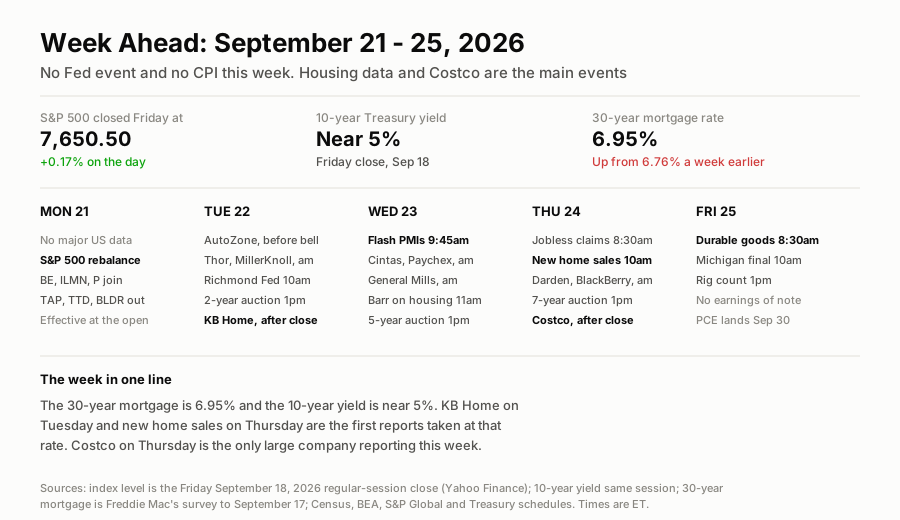
Two housing reports, one Costco report, and a 10-year yield near 5%.
KB Home Tuesday, New Home Sales Thursday
Mortgage rates follow the 10-year. The 30-year fixed mortgage averaged 6.95% in the week to September 17, per Freddie Mac. That is up from 6.76% a week earlier and 6.26% a year ago. Nineteen basis pointsA basis point is one hundredth of a percentage point, so 25 basis points is 0.25%. Rates are quoted this way because the moves are small and "a quarter point" can be misread as a quarter of the rate itself. in seven days is a big move for a mortgage.
Builders were already struggling before that move. New-home sales fell 10.5% in July to a 607,000 annual rate, and unsold inventory reached 9.6 months of supply, per the Census Bureau and HUD. Then Lennar reported on Wednesday, hours after the Fed. Earnings of $1.19 a share against $2.29 a year ago and the $1.30 analysts wanted. Orders down 9%. Incentives offered to attract buyers at around 12% of the sale price. The full-year delivery target cut for the second time, to 80,000-81,000 homes, as last week's edition recorded. The stock fell about 4% on Thursday morning, per Quiver Quantitative, an intraday read rather than the close.
KB Home is next, after Tuesday's close. Analysts want $0.90 EPS on about $1.3 billion revenue, against about $1.6 billion a year ago, per Zacks via Yahoo Finance. Revenue falls 20% and earnings fall by nearly half. The company already guided 2,600-2,800 deliveries, so the quarter itself should hold few surprises. The full-year guideGuidance is the forecast a company gives for its own coming results, such as revenue, profit or homes delivered. It is the only bar management is on the hook for, and a cut to it usually moves a stock more than the quarter just reported. is what will move the stock, and options price a 10% move.
Thursday's new home sales are the other half of housing this week. August is the first month measured with the mortgage rate close to 7%. July's 607,000 sales is the number to beat.
My read: if KB Home holds its guide and August sales beat July, that means incentives are absorbing most of the rate move. If both come in soft, the Fed is tightening into a housing market that's already rolling over. I lean toward the second, just based on Lennar's earnings last week. And the rate has gone up since then.
Costco: Options Price a 3.6% Move, the Stock Usually Moves 1.4%
Costco reports Thursday after the close. Analysts want about $6.55 a share on $94.9 billion of revenue, up roughly 12% and 10% on last year's $5.87 and $86.16 billion. The company has matched or beaten expectations for the last five quarters.
Options price a move of about 3.6%. Over its last eight reports the stock has averaged a 1.4% move, per TipRanks. The market is expecting more than double what Costco usually does.
There is a reason. Costco reports sales monthly, so revenue is rarely a surprise, and most of its profit is membership fees. What remains is margin. Oppenheimer thinks core earnings could land below consensus once tariff refunds are stripped out.
Myself, I think paying 3.6% for a stock that moves 1.4% is expensive. I wouldn't buy options in either direction. This view gets graded in the track record so the failures and successes are public.
Update, Thursday evening: Costco reported after the close and beat, with EPS of $6.75 against the $6.53 this piece quoted, though $0.15 of that was a one-time tariff-refund benefit. The first after-hours tick was up just 0.17%, well inside the 3.6% options had priced, which is the read this piece leaned toward, but the settled grade waits for Friday's regular-session close rather than an extended-hours tick.
Update, Friday: the settled grade is in, and the pass holds. COST closed the regular session at $922.77, up 2.93% from Thursday's pre-earnings close of $896.48, per StockAnalysis.com and Investing.com. That is under the 3.6% options had priced, though more than double the stock's own 1.4% historical average reaction. Paying 3.6% for the move that actually happened lost money in either direction, which is the case this piece made going in. There is no Track Record ledger row for this pass: it was written as a qualitative call rather than a priced structure with a logged entry, so there is nothing to update in the ledger beyond stating the result here.
SpaceX: The Fourth Lock-Up Tranche Is Thursday
Thursday is SpaceX's day-105 lock-up, around 319 million more shares becoming sellable. It is the fourth trancheA tranche is one scheduled slice of a lock-up release. Rather than freeing every insider share at once, an IPO prospectus can release them in steps on fixed day counts, so each tranche is a date when a set number of shares becomes sellable. since the June IPO. The first three all did the same thing: a dip on the day the shares became eligible, then a recovery once they actually traded. August 6 actually rose 6% on the day. August 20 fell about 6.5%, then bounced. September 9 fell 3.9% and recovered within two sessions.
The stock has been steady into this one. SPCX traded around $153 on Friday, per Investing.com, back above where it sat before the day-90 tranche. The options market priced a 7.2% move for the week of the unlock, which is larger than either of the last two lock-up days delivered.
My read: three uneventful unlocks have trained the market, and I expect a modest dip and a recovery again. The tranche that might break the pattern comes later. It is the 28% release tied to Q3 earnings, roughly four times any step so far, and it arrives with an earnings print attached. The lock-up hub keeps track of every date and share count, and the lock-up calendar has the full schedule.
Update, Thursday evening: the modest dip came, just a day earlier than expected, and eligibility day itself was quiet. SPCX fell 4.11% on Wednesday, the same session as a broad rate-driven market selloff, then closed Thursday down just 0.22% at $148.03 on elevated volume once the shares actually became eligible. The dedicated lock-up hub has the full account.
Monday, September 21
No US data of note. The Chicago Fed National Activity IndexThe regional Fed banks each survey businesses in their district every month about orders, shipments, hiring and prices. None moves markets on its own; together they are an early read on the national ISM and PMI numbers that follow. lands at 8:30am ET, and Chicago Fed President Goolsbee speaks in London at 6:30am ET, per the Chicago Fed.
Bloom Energy, Illumina and Everpure trade as S&P 500 members from the open. Molson Coors, The Trade Desk and Builders FirstSource are out, per S&P Dow Jones Indices. Index funds did the buying and selling for the rebalanceAn index rebalance is the scheduled day when companies are added to or dropped from an index like the S&P 500. Funds that track the index must buy the new names and sell the old ones, usually in the closing auction, which moves a lot of stock with no view on any of the businesses. in Friday's closing auction, so Monday itself should be quiet.
Tuesday, September 22
Earnings before the open: AutoZone (call 10:00am ET, implied moveThe implied move is how far the options market expects a stock to move on an event, up or down, worked out from options prices. A 12% implied move on a $50 stock means traders are paying for a swing to roughly $44 or $56. It is what is already priced in, so the stock has to beat it for an options bet to pay. 9.6%), Thor Industries (11.0%), MillerKnoll. Analysts expect AutoZone to earn $54.22 a share on $6.71 billion of revenue, per the consensus of 21, against $48.71 on $6.24 billion a year ago. My read is that most of that gap comes from AutoZone buying back its own shares, and the buyback figure in the release will confirm or disprove it.
10:00am ET: Richmond Fed survey. 10:20am: Fed Vice Chair Jefferson speaks on Treasury market functioning, per the Fed's calendar. 1:00pm: 2-year Treasury auctionA Treasury auction is the government selling new bonds to raise money. The yield it has to offer to sell them all shows what investors demand to lend to the US that day, and a weak auction can push yields up across the bond market..
Earnings after the close: KB Home (implied 10.1%), Worthington Enterprises (10.8%).
Wednesday, September 23
9:45am ET: September flash PMIs from S&P Global, the first broad read on the month. August's flash composite came in at 56.0, the highest reading in 52 months, per S&P Global's August release, and prices cooled in the same survey. Another month like that would weaken the case for the extra rate rise the Fed's projections now show.
Earnings before the open: Cintas (implied 4.6%), General Mills (8.8%), Paychex (7.6%), Cracker Barrel (15.5%).
11:05am ET: Fed Governor Barr speaks on housing affordability (10:05am Central, per the Fed's calendar). 1:00pm: 5-year Treasury auction.
Earnings after the close: Stitch Fix (22.9%), H.B. Fuller. The earnings calendar has the confirmed dates for the rest of the month.
Thursday, September 24
8:30am ET: weekly jobless claimsWeekly jobless claims count how many people filed for unemployment benefits, published every Thursday. They are the fastest official read on layoffs: monthly reports describe last month, claims describe last week. and the Q2 current accountThe current account is the quarterly tally of what the US earned from the rest of the world against what it paid out, in trade, investment income and transfers. A deficit means the country borrowed from abroad to cover the gap.. 10:00am: August new home sales. 11:00am: Kansas City Fed survey.
Before the open: Darden Restaurants (implied 7.6%), TD Synnex (9.2%), BlackBerry (12.8%).
SpaceX's day-105 lock-up: about 319 million more shares become sellable. More above, and on the lock-up calendar.
After the close: Costco (implied about 3.6%).
Friday, September 25
8:30am ET: August durable goods orders. 10:00am: the final September Michigan surveyThe University of Michigan survey asks households how they feel about their finances and the economy. Markets watch its inflation-expectations question most, because people who expect higher prices tend to spend and bargain as if they are coming., with its inflation expectations. 1:00pm: Baker Hughes rig countThe Baker Hughes rig count is a weekly tally of drilling rigs at work in the US. More rigs means producers expect oil and gas prices to hold up; fewer means they are cutting back, which shows up in supply months later..
No earnings of note.
The One-Line Read
The 10-year yield touched its highest level since 2007 this week, near 5%, with the 30-year mortgage at 6.95%. New home sales beat and KB Home held its guide anyway; Costco beat and settled at a smaller move than options had priced. The day's times are on /today.
Next up:Jobs report, tomorrow at 8:30am ET →
More on $SPY
$SPY · 2026-10-31
Stock Market Week Ahead (Nov 2-6): Apple and Palantir Monday, Midterms Tuesday, AMD, Then the October Jobs Report
$SPY · 2026-10-24
Stock Market Week Ahead (Oct 26-30): The Fed Decides Wednesday, Microsoft and Alphabet Report Hours Later, Then GDP and PCE
$SPY · 2026-10-10
Stock Market Week Ahead (Oct 12-16): JPMorgan and the Big Banks, September CPI, TSMC, and the Last Fed Speeches Before October 28
Updated Every Saturday
The Week Ahead
Every earnings date, Fed event and setup for the current trading week, on one page.
Refreshed Weekly
Earnings Calendar
Who reports next, when, and what consensus and the whisper expect.
The Week-Ahead Brief
Don’t miss next week’s setups. Get the Sunday brief.
Latest issue, Oct 25“The Fed, Microsoft, Alphabet and Amazon: the busiest week of earnings season”
Every Sunday: next week’s earnings dates, Fed days and the trades worth watching, from the same desk that writes the week-ahead hub. Free, built for retail investors.