SpaceX Broke Its IPO Price. Time to Talk About the $890 Billion Elon Premium
SPCX sits at $126.76 after hours, below its $135 IPO price, after Starship flight 13 was scrubbed minutes before liftoff. The full valuation teardown: what the parts are worth on real space-stock multiples, what you're actually paying, and where the stock should trade.
TL;DR
- SPCX fell to $126.76 after hours on July 16, below its $135 IPO price, after Starship flight 13 was aborted minutes before liftoff, the company's first launch attempt since going public June 12.
- The stock is down 44% from its June 16 all-time high of $225.64, hit four days after a debut that opened at $150 and topped a $2 trillion market cap.
- Here's the part nobody selling wants to compute: even at a broken IPO price, SPCX trades at roughly 90x trailing sales. Rocket Lab costs 63x and grows 38%. Legacy aerospace costs 2x.
- Sum the parts on genuinely aggressive multiples and you get about $800 billion, which happens to match the last private-market mark. The market cap at $126.76 is $1.69 trillion. The other $890 billion is the Elon premium, and a scrubbed launch just started marking it to market.
- Fair value math, the December lock-up problem, and the trades below.
More on $SPCX: SPCX Is Above Its IPO Price Again. 319 Million Shares Land Next Week, and I'm Still Not Buying →
Five Weeks, Round Trip
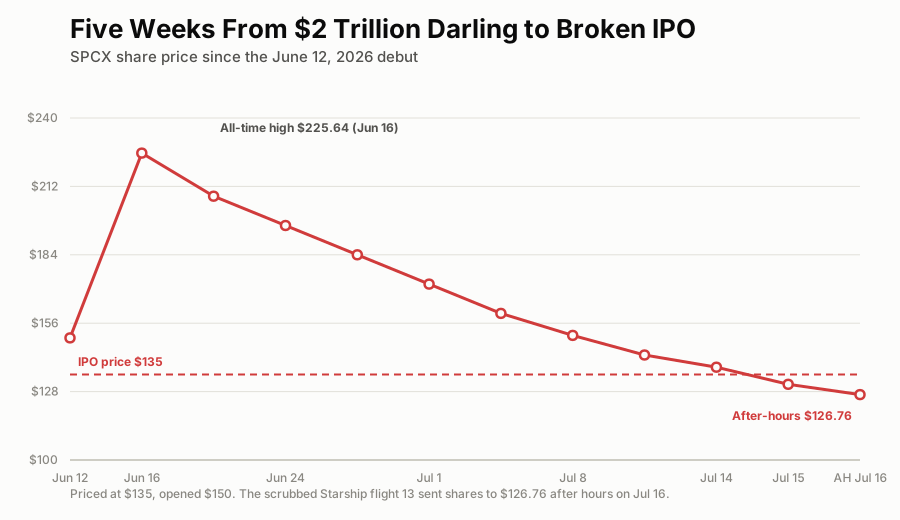
The most hyped IPO since the memory wave, below issue in five weeks. Day-one buyers at $150 are down 15%. ATH buyers are down 44%.
The sequence matters. SpaceX priced at $135, opened at $150, and printed a $2 trillion market cap on day one, the retail event of the summer. Four sessions later it touched $225.64. Then five straight weeks of lower highs, a first close below the IPO price on July 15, and on July 16 the catalyst that turned a slide into a break: flight 13 of Starship, the upgraded V3 and the first launch attempt of the public-company era, scrubbed minutes before liftoff at Starbase. The stock traded as low as $124 after hours and sits at $126.76.
A scrub is routine rocketry; SpaceX has scrubbed dozens and flown the next window. As a stock event it's something else entirely: the first time public shareholders experienced the core SpaceX reality that hardware sets the schedule, not guidance. Private investors absorbed twenty years of that with quarterly marks. Public ones get it live, at 4pm, with a sell button.
The Numbers Under the Story
The S-1 era finally gave us real financials, so use them:
- 2025 revenue: $18.7 billion. The street's 2026 forecast: $36.8 billion, which assumes revenue roughly doubles in one year.
- Starlink is the company. It did $11.4 billion in 2025, up 50%, about 61% of revenue, and produced $4.42 billion of income as the only profitable division.
- The launch business, the thing in the name, lost $657 million last year. NASA and DoD contracts, Falcon dominance, all of it, still a money-loser subsidizing Starship development.
- At $126.76 the market cap is roughly $1.69 trillion. That's 90x trailing revenue, 46x the forecast, and about 380x the earnings of the only division that has any.
The Elon Premium, Itemized
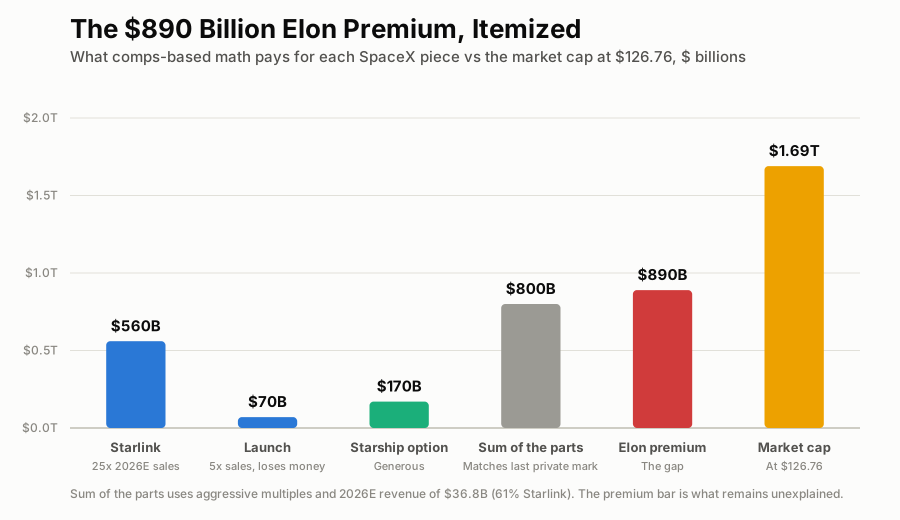
Generous math on every line, and it still only explains half the market cap.
Value each piece the way you'd value it if it weren't attached to Elon Musk, using multiples the market actually pays elsewhere, tilted generous:
- Starlink: $560 billion. That's 25x its ~$22 billion 2026E revenue slice, a multiple reserved for hypergrowth platforms, for a business that is part telecom, part consumer subscription. Nothing in public markets gets 25x sales at that scale. Starlink gets it here anyway, because it's genuinely the best asset in the sky.
- Launch: $70 billion. Call it 5x sales for a division that loses money but owns 80%-plus of Western launch. That's more than double the multiple defense primes get, granted for the monopoly position.
- Starship optionality: $170 billion. A nine-figure gift for a rocket that hasn't reached its operational cadence, priced like it already changed the economics of orbit.
That sums to $800 billion, and here's the uncomfortable rhyme: $800 billion is almost exactly where the last private-market marks had SpaceX before the IPO machine took over. Private money, with the best information access on Earth, said $800B. Public money said $2 trillion by lunchtime. The $890 billion gap between the itemized company and the ticker is the Elon premium: the surcharge for Mars, for the memes, for the man. TSLA has carried its own version at 204x forward earnings for years, so the premium is real and it can persist. But TSLA's premium survives because delivery numbers keep showing up. SPCX's premium just met its first scrubbed countdown, and premiums built on flawless execution reprice on the first flaw.
Even Broken, It Isn't Cheap
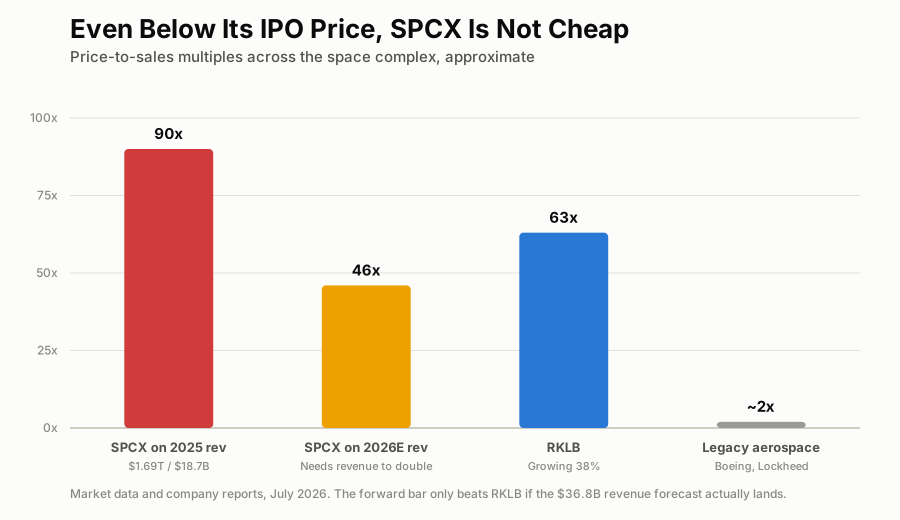
"Below IPO price" and "cheap" are different sentences.
The bull reflex says below-IPO equals bargain. The comps say otherwise. Rocket Lab, the closest real comparable, trades at 63x sales on a $48 billion cap with 38% growth and a diversified space-systems book. SPCX at 46x forward undercuts that only if revenue actually doubles to $36.8 billion this year, a forecast that leans hard on Starlink subscriber adds that get harder as the easy geographies saturate. On the revenue that has actually been reported, you're paying 90x. An IPO price is not a valuation floor; it's the number the banks decided the market would swallow in June. The market swallowed it, ran it up 67%, and has been spitting it back out for five weeks.
And 27 of 31 analysts still rate it a buy with a $242 average target, 91% above the after-hours price. When the sell side is that unanimous on a name down 44%, the marginal seller has stopped listening, which is exactly the setup that keeps a downtrend alive.
Sooo... What Should It Be Worth?
Start from the parts: $800 billion of company, roughly $60 a share, plus whatever premium the track record has legitimately earned. Twenty years of doing the impossible on schedule deserves something real; call it 50% on top of the parts, not 110%. That lands fair value around $85-95. The stock doesn't have to go there, premiums deflate slowly when the asset is this loved, but that's the gravity under the chart, and it's a long way below $126.76.
The nearer-term problem is mechanical: the IPO lock-up expires in early December, six months post-listing, and this float sits under a mountain of twenty years of private shareholders, employees and tender-offer funds holding stock at marks a fraction of today's price. Every broken-IPO playbook says the same thing: the low isn't in before the lock-up clears.
Short term: the scrub gets resolved, flight 13 flies within weeks, and a clean flight rips the stock 10-15% off whatever base it's found, because the premium reinflates on every proof of execution. Into December: rallies get sold and $100 gets tested, because supply is coming and everyone holding since 2015 knows it. Long term: Starlink compounds into the valuation, and somewhere in the $90s the math and the myth finally agree.
The Options Angle
- Don't catch this knife on cash shares. Below-IPO breaks with a lock-up ahead don't V-bounce; the season's whole pattern is day-two follow-through.
- The event trade: short-dated call spreads when the flight 13 window is officially announced, buy near the money, sell 12-15% up, sized as a lottery ticket. A clean flight is the one catalyst that reliably reinflates the premium, and spreads cap the binary risk of another scrub.
- The structural trade: December $110/$90 put spreads. They express the lock-up flush directly, expiring right as six months of pent-up supply hits the tape. This is the highest-conviction structure on the whole chain.
- The patient entry: cash-secured puts at $95, but only after the lock-up expires. That's where aggressive sum-of-parts math plus an earned premium says the real floor lives, and post-lockup IV will still pay handsomely for waiting there.
The One-Line Read
SpaceX below its IPO price is not a bargain, it's a beginning: the market has started itemizing an $890 billion premium one scrubbed countdown at a time, and the math, the comps and the December calendar all point to lower before launched rockets and Starlink's compounding make the ticker worth the myth.
Next up:PPI, tomorrow at 8:30am ET →
More on $SPCX
$SPCX · 2026-08-13
SPCX Is Above Its IPO Price Again. 319 Million Shares Land Next Week, and I'm Still Not Buying
$SPCX · 2026-08-10
Is SPCX About to Rocket, or Is the August 20 Unlock About to Land on It?
$SPCX · 2026-08-07
Why Is SpaceX Stock Up After the Lock-Up? 911.5 Million Shares Came Free and the Selling Never Came
Updated Every Saturday
The Week Ahead
Every earnings date, Fed event and setup for the current trading week, on one page.
Refreshed Weekly
Earnings Calendar
Who reports next, when, and what consensus and the whisper expect.
The Week-Ahead Brief
Don’t miss next week’s setups. Get the Sunday brief.
Latest issue, Sep 7“Week ahead in the stock market...”
Every Sunday: next week’s earnings dates, Fed days and the trades worth watching, from the same desk that writes the week-ahead hub. Free, built for retail investors.