Why Is SpaceX Stock Up After the Lock-Up? 911.5 Million Shares Came Free and the Selling Never Came
SPCX rose 6.1% to $114.92 on August 6, the day 911.5 million shares unlocked and the float grew 143%. Why the crash never came, what we got wrong, and why September's rebalance matters.
TL;DR
- SPCX closed August 6 at $114.92, up 6.1%, on the day roughly 911.5 million shares became eligible to trade. The day before, it closed at $108.27, down 13.6%, an all-time low.
- The float went from 638.9 million shares to about 1.55 billion, a 143% increase, taking the tradeable slice of the company from 4.9% to 11.8% of shares outstanding. The biggest supply event in the stock's short life produced a green candle.
- We argued against this outcome and we were wrong. Our August 1 piece said the Facebook-style relief rally would not repeat here. It repeated.
- The overhang is not cleared. Seven percent tranches keep releasing every 15 to 20 days through October, about 28% after Q3 earnings, the rest on December 8. Thursday resolved one date, not the calendar.
- The genuinely underpriced thing is mechanical: a bigger float means a bigger index weight, and SPCX's Nasdaq-100 weight could go from about 1% to above 3.5% at the September rebalance. That bid has not arrived yet.
More on $SPCX: SPCX Is Above Its IPO Price Again. 319 Million Shares Land Next Week, and I'm Still Not Buying →
Why Is SpaceX Stock Up After the Lock-Up Expired?
Because a lock-up expiry makes shares sellable, not sold, and the people who could finally sell mostly did not. Roughly 911.5 million shares became eligible on Thursday. Eligibility is permission. It creates no obligation, no deadline and no forced seller, and the holders in question are venture funds and employees sitting on returns measured in multiples rather than percentages, none of whom had to hit a bid at an all-time low.
The second half of the answer is that the fear had already been charged for. SPCX fell 13.6% on Wednesday to $108.27, its second-worst session on record and an all-time closing low, in a stock that had already given back its entire post-IPO gain. By Thursday morning the market had spent six weeks pricing an event that then arrived and did nothing. Removing a known risk is itself bullish news when the price has been marked down for it.
The Board
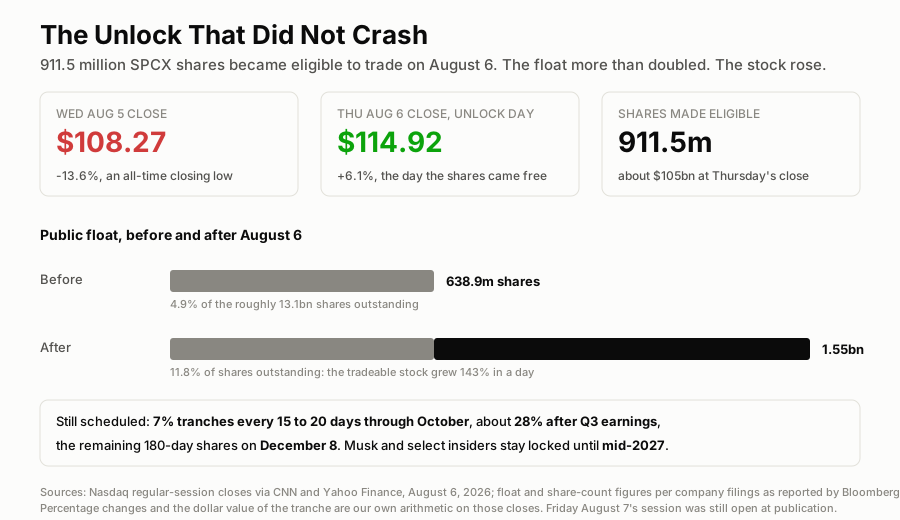
The largest supply event in the stock's life, and it closed green.
What We Got Wrong
Losses first, because that is the deal on this site.
Our August 1 piece laid out the Facebook precedent in full: Facebook's two smaller 2012 unlocks knocked 5% and 4.1% off the stock, and then its largest, 777 million shares in November, sent it up 12.6% because the release cleared the overhang and the uncertainty premium collapsed.
We then explained why SpaceX would not do that. The argument was that Facebook's November unlock was final while August 6 is the first step of a staircase, so nothing would actually be resolved and holders would have four months of exits with no reason to rush the first one. We wrote that "a final unlock removes uncertainty, a first unlock schedules it," and we declined the contrarian call on that basis.
The stock rose 6.1% anyway. The mechanism we said was absent turned out to be present in a weaker but sufficient form: traders were not waiting to learn whether the supply was permanently gone, only whether it was going to arrive on Thursday. It did not, and that was enough. Our error was treating the uncertainty as binary when the market was pricing it date by date.
What the call got right is worth keeping, because it is the same lesson in reverse: we said do not buy the weekly put, and the put was worthless. The distinction we drew between direction and magnitude held. The distinction we drew between a first unlock and a final one did not.
What Actually Came Free, and Against What
Every number in this story needs its denominator, because the same event looks like a catastrophe or a rounding error depending on which base you pick.
Against the float, it is enormous. SpaceX sold 555,555,555 Class A shares at $135 in June and underwriters took a further 83,333,333, so 638.9 million shares made up the public float. Thursday added 911.5 million on top. That is a 143% increase, taking the float to roughly 1.55 billion shares, or 2.4 times its previous size in a single session.
Against the company, it is small. SpaceX has roughly 13.1 billion shares outstanding. The float went from 4.9% to 11.8% of that. Almost 90% of the company still cannot trade.
One correction to our own arithmetic while we are here. Our unlock calendar put the increase at 164%, measured against the 555.6 million share base offering. That leaves out the greenshoe the same article documented, and the correct denominator is the full 638.9 million shares sold. The increase is 143%, not 164%. It does not change the direction of anything, and it is still the number that matters most.
And note what happened to the dollar figure attached to that block. It was reported at $123 billion, then $116 billion, then about $100 billion, and it was worth roughly $105 billion at Thursday's close. Nobody was wrong. The share count is the durable number and the dollar value is a snapshot of whatever the stock happened to be doing that morning.
The Part Nobody Is Pricing: September
Here is where the float expansion stops being a threat and turns into a bid.
Index weights are calculated on free float, not shares outstanding, which is precisely why SPCX joined the Nasdaq-100 on July 7 at a weight of only about 1.3% despite a market capitalisation near a trillion and a half dollars. Nasdaq had to write new float-multiplier rules to fit a company this large with a float this thin.
Thursday changed the input. With the float up 143%, SpaceX's Nasdaq-100 weight could rise above 3.5% at the September rebalance, per the reporting around the unlock. Against the more than $800 billion benchmarked to that index globally, a weight change of that size is a very large amount of mechanical, price-insensitive buying.
Two things follow, and the timing is the whole point.
It is not a Thursday story. Some of the coverage attributed Thursday's rally to index funds buying the newly freed shares. That is not how it works. Index weights change on scheduled rebalance dates, not on the day a lock-up lapses, so whatever bought SPCX on Thursday, it was not the passive complex rebalancing. The index bid is still ahead.
It lands into the middle of the supply staircase. The September rebalance sits alongside the day-90 and day-105 tranches. My read is that this is the single most interesting asymmetry in the name right now: the same float expansion that creates the supply also creates a scheduled, mechanical buyer of it, and those two forces meet in September rather than cancelling out in August.
What Is Still Coming
Thursday resolved one date. The full lock-up calendar is intact, and it stays the canonical schedule for this story:
- 7% tranches every 15 to 20 days through October, landing around August 20, September 9, September 24, October 9 and October 24 on the prospectus-date count the lock-up calendar now uses.
- About 28% of the restricted pool after Q3 earnings.
- All remaining 180-day shares on December 8, 2026.
- Musk and select insiders stay locked until mid-2027. The largest holder, with roughly 42% of the equity, is absent from every date above.
There is also a live question Thursday did not answer: how much stock actually changed hands, and whose. Coverage through Thursday's close established that the feared wave did not arrive. It did not establish that Founders Fund, Sequoia or the employee base sat still. Large positions get distributed to limited partners in kind or placed in negotiated blocks, and both routes are invisible on the day and show up over weeks. A quiet Thursday is consistent with holders waiting and equally consistent with holders distributing carefully. I would not treat the absence of a crash as proof of conviction until the filings say so.
Does This Make SPCX Cheap?
No, and the fundamentals did not move on Thursday.
At $114.92 the market capitalisation is roughly $1.51 trillion, about 80 times 2025's $18.7 billion of revenue. The stock is 14.9% below its $135 IPO price and 49% below its $225.64 June high. Our valuation teardown put the sum of the parts near $800 billion on genuinely generous multiples, and that gap has narrowed by price rather than by anything the company did.
What did change is the quarter underneath it. The first earnings report in company history delivered $7.81 billion of revenue against $6.93 billion expected, up 92% year over year, and a 9-cent loss against the 26 cents the street modelled, with Starlink subscribers reported at around 12 million. Morgan Stanley's Adam Jonas carries an Overweight rating and a $300 target for mid-2027, calling the company a "potential generational compounder." That is his target and his horizon, not ours, and it implies the stock nearly triples.
Our view is narrower and more falsifiable: the supply overhang is now a known, dated, half-tested quantity rather than an open-ended fear, and that is worth something. It is not worth 80 times sales. Both of those sentences are true at once.
The Options Angle
First, the open trade log gets marked, because today is the expiry it was written against.
The weekly chain priced ±12.5% against Friday July 31's $108.37 close, putting breakevens at roughly $121.92 and $94.82. SPCX closed Thursday at $114.92, which is +6.0% from that reference and comfortably inside both. On Tuesday the stock closed at $125.33 and that pass looked badly wrong; Wednesday's 13.6% drop put it back inside the range. If today settles anywhere near here, both legs expire worthless and the pass is scored a win.
That is a rare correction to the July calibration lesson. Through July, realised moves beat implied over and over and the house reflex of "implied options premium looks expensive" kept costing money. This week, in the single most anticipated event in the name, implied was expensive and the straddle buyer lost. One week does not overturn a season, and I would not carry "sell the premium" forward into the next tranche as a default. It does mean the July pattern is not a law.
- The conditional entry is triggered. The plan was a first third in shares only if the print showed losses narrowing and the unlock day absorbed the supply. Both conditions have now printed. It goes on the log struck against Thursday's close.
- Today's session is not a data point yet. SPCX was indicated up about 2.2% in Friday's premarket and the regular session is still running as this publishes. Nothing here is quoted against an unfinished tape.
- The next tranche is around August 20, and I do not want short-dated premium into it. The market has now seen one tranche pass without incident, which compresses the fear priced into the next one. Buying volatility into a repeat of an event that just underwhelmed is the wrong side of the same trade that just worked.
- The September rebalance is the play I actually want, and it is not a weekly. If the Nasdaq-100 weight moves as the reporting suggests, the mechanical bid arrives on a known date. That argues for October expiries rather than anything expiring in the next fortnight.
- The bear case has not gone away. Four more months of scheduled supply, 80 times sales, and a company that lost $4.28 billion in Q1. A stock can absorb one tranche and still be too expensive.
Trade log
| # | Stance | Structure | Strikes and expiry | Cost or credit | Spot at writing | Implied move | Breakeven |
|---|---|---|---|---|---|---|---|
| 1 | Bullish (conditional entry, now triggered) | Shares, first third | No expiry | Market, Aug 7 | $114.92, Aug 6 close | n/a | Scored from $114.92 |
| 2 | Pass, scored a loss | Long straddle, carried from Aug 4 | ~$108 weekly, Aug 7 | ~12.5% of spot | $108.37, Jul 31 close | ±12.5% | needed >$121.92 or <$94.82; Aug 7 close $133.11, straight through the upside breakeven |
| 3 | Pass | Short-dated premium, either side, into the ~Aug 21 tranche | Aug 21 weeklies | Live chain not sourced | $114.92, Aug 6 close | not sourced | n/a, logged as a pass to be scored |
| 4 | Bullish | Long call spread on the September index rebalance | October expiry, strikes not struck | Live chain not sourced | $114.92, Aug 6 close | not sourced | logged as intent; no entry until the chain is sourced |
Row 4 is deliberately incomplete and says so. The thesis is dated and specific, the structure is not priced, and a play with no entry price cannot be scored, so it stays an intention on the record rather than a call until there is a real quote against it.
The One-Line Read
SpaceX released 911.5 million shares into a stock sitting at an all-time low, grew its float by 143% in a single session, and closed up 6.1%. I take that as fear already priced, rather than the supply being gone: four more months of tranches are still scheduled, the valuation is still 80 times sales, and the thing worth watching now is September, when the same float expansion that created the supply turns into a mechanical index bid.
Next up:PCE inflation, Wed, Sep 30 at 8:30am ET →
More on $SPCX
$SPCX · 2026-08-13
SPCX Is Above Its IPO Price Again. 319 Million Shares Land Next Week, and I'm Still Not Buying
$SPCX · 2026-08-10
Is SPCX About to Rocket, or Is the August 20 Unlock About to Land on It?
$SPCX · 2026-08-05
SPCX Lock-Up Calendar: August 20's 319 Million Shares, and Every Unlock Still Ahead
Updated Every Saturday
The Week Ahead
Every earnings date, Fed event and setup for the current trading week, on one page.
Refreshed Weekly
Earnings Calendar
Who reports next, when, and what consensus and the whisper expect.
The Week-Ahead Brief
Don’t miss next week’s setups. Get the Sunday brief.
Latest issue, Sep 20“The week after the hike: two housing reads and Costco earnings...”
Every Sunday: next week’s earnings dates, Fed days and the trades worth watching, from the same desk that writes the week-ahead hub. Free, built for retail investors.