Walmart's $2.9 Billion Tariff Refund Flatters Q2. Q3 Pays for It.
Walmart received about $2.9bn of IEEPA tariff refunds and booked roughly 750 basis points of operating income growth from it. The Q3 guide of 2-4% shows what the price cuts it funded now cost.
TL;DR
- Walmart received about $2.9 billion of IEEPA tariff refunds in fiscal Q2 and told the call it has "received substantially all" of them. The net benefit to operating income growth was about 750 basis points, which works out somewhere between $550m and $590m. The distance between those two numbers is price cuts.
- Reported operating income rose 28.8% to $9.383 billion. On the adjusted constant-currency basis the guidance uses, it rose 17.4%. Take the refund out and you get 9.9%, which is exactly where CFO John David Rainey put underlying growth: the top of a guided 7-10% range.
- Q3 constant-currency operating income is guided to grow 2-4%. The refund does not repeat. The price investments it bought do, and Rainey said a large portion of them went in at the end of Q2, so Q3 carries a full quarter of cost against no matching refund.
- Deere ran the same shape the same morning. Its first quarterly profit rise in three years took net income up $90m to $1.379 billion, and the quarter contained $110m of tariff recoveries.
- Walmart traded at $103.93, down 9.07% from Wednesday's $114.30 close, at 10:45am ET Thursday. That is an intraday snapshot rather than the day's close.
- UPDATE (August 26): Kohl's ran the identical play six days later. $150m of tariff refunds, $100m of it through gross margin, works out to about 65 cents of EPS on the filing's own tax rate and share count. Strip that out and Kohl's still beat consensus by 6 cents, but the 80-cent full-year guidance raise needs all 91 cents of booked-and-expected refund money to clear it, none of it from the modest comp improvement underneath.
More on $WMT: Is Walmart a Buy Before Earnings? 41x and Still No Raise →
The Board
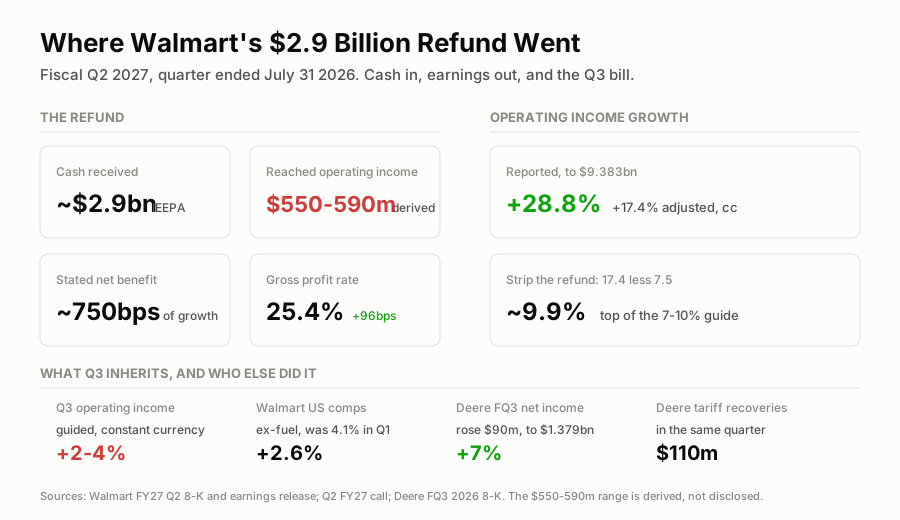
Cash in on the left, earnings out on the right, and the bill on the bottom row.
How Much of Walmart's Profit Jump Came From the Tariff Refund?
About 750 basis points of it, on management's own number. Reported operating income grew 28.8%; adjusted and in constant currency it grew 17.4%; strip the refund out of that and you are left with roughly 9.9%.
Rainey said it plainly on the call: "Operating income growth included a net benefit of approximately 750 basis points related to tariff refunds received in Q2," and "setting aside this benefit, underlying operating income growth was at the top end of our 7%-10% guidance."
So the underlying quarter was good. Walmart guided 7-10% and delivered near 10%, which is more than the preview on this site expected from a company that had held its year twice without raising it. Global e-commerce grew 23%, advertising grew 38% and membership fee revenue grew 17%, per the company's earnings release. None of those three lines needs a refund to explain it.
The 28.8% headline does.
$2.9 Billion Arrived. Under $600 Million Stayed.
Here is the arithmetic, and I want to show the working because the two figures get used interchangeably and they are an order of magnitude apart.
Seven hundred and fifty basis points of growth has to be measured against a prior-year base. Walmart's reported operating income in the year-ago quarter was $7.3 billion. On the adjusted constant-currency basis the guidance is framed in, the implied base is nearer $7.9 billion. Run 7.5% across that spread and the net benefit lands between $546m and $591m.
Walmart did not publish a dollar figure for the P&L effect, so that range is my arithmetic off management's basis-point number rather than a company disclosure. It is a range instead of a point estimate because I cannot tell from the outside which base the 750bps was struck against, and I would rather give you the spread than a false decimal.
Either way the shape holds. Roughly $2.9 billion of cash came in the door and something under $600 million of it showed up in operating income. The rest went where Rainey said it would go: "our intent was to deploy much of that back into price, and that's what we're doing," with the money "prioritizing investment in grocery and general merchandise."
That is a defensible use of a windfall. Walmart's entire competitive position is built on being the cheapest place to buy food, and a one-time refund spent on holding that position is better capital allocation than a buyback. My objection is narrower: $2.9 billion is the number in every headline this morning, and it is a cash figure, not an earnings figure. Quote it as the size of the beat and you will overstate the beat by roughly five times.
The gross margin line shows the same thing from the other end. The gross profit rate rose 96 basis points to 25.4%, which Walmart's 8-K presentation attributes primarily to tariff refund impacts. Ninety-six basis points is what survived after the price cuts. The gross number was much larger and you cannot see it.
The Part Q3 Inherits
Walmart guided Q3 constant-currency operating income growth of 2% to 4%.
Set that against underlying Q2 growth near 10% and you have a deceleration of about six points in a single quarter, announced by a company raising its full-year outlook in the same press release.
The mechanism is not complicated once you see it. A tariff refund is a one-off recovery of duties already paid. A price cut is permanent until it is reversed. Walmart converted the first into the second, and Rainey flagged the timing: "a large portion of the refunds were invested at the end of Q2, so the full quarter impact of these investments is more pronounced in Q3." Q2 got the refund and a few weeks of the price cuts. Q3 gets a full quarter of the price cuts and no refund.
The full-year raise looks smaller under that light too. Adjusted EPS guidance moved from $2.75-$2.85 to $2.80-$2.87, so the midpoint went up about 1.3%, against a company that had just banked a $2.9 billion windfall. This site's pre-print piece said the bear case weakened if the guide moved to something with a $2.9 handle. It topped out at $2.87.
That, more than the comp line, is what I think the tape is reacting to. US comparable sales of 2.6% ex-fuel against roughly 3.67% expected is a genuine miss and it has taken most of the coverage, but a comp miss of a point does not usually take 9% off a mega-cap. A six-point step down in guided profit growth on a stock that was carrying a 40-handle multiple might.
Deere, Same Morning, Same Shape
Deere reported into the same session and the pattern repeats at a smaller scale. Fiscal Q3 net income attributable to Deere came in at $1.379 billion against $1.289 billion a year earlier, the first quarterly profit rise in three years, on net sales and revenues of $12.608 billion. Those figures are in the company's 8-K.
The same quarter contained $110 million of tariff recoveries, with $382 million booked across the first nine months. Net income rose $90 million. The comparison is loose because the recovery is a pre-tax number and the profit increase is after tax, so they are not directly subtractable. Taxed at Deere's rough corporate rate, though, $110 million lands close enough to $90 million that the entire year-over-year profit improvement is the same size as the refund sitting inside it.
Deere's Q2 was the louder version: a $272 million recovery that lifted margins by around two and a half points. The preview on this site flagged the guide as the thing to watch, and the guide did move up, to $4.75-$5.0 billion of full-year net income. The construction and forestry recovery underneath it looks real. The tariff line is still doing work in the headline.
This is the third time the site has had to separate a refund from a result, after EnerSys and its 45x credit and Apple's 11 cents of refunds inside a $2.02 quarter. The Supreme Court struck the IEEPA tariffs down in February and Customs has been paying importers back ever since, out of a pool reported at roughly $165 billion. Every large importer reporting between now and the winter has some version of this in its numbers.
Kohl's Ran the Same Play, and the Raise Didn't Need a Better Quarter
Six days after Walmart, Kohl's filed the same shape of quarter, with a sharper number sitting inside it.
Kohl's collected $150 million of IEEPA tariff refunds in the quarter ended August 1, and $100 million of that flowed through gross margin, per the company's own 8-K. Run that $100 million through the same filing's own numbers, a 23.7% effective tax rate ($47m of tax against $198m of pretax income) on 118 million diluted shares, and it comes out to about 65 cents of earnings per share. That is my own arithmetic off Kohl's own filing, and it lands on the same 65 cents that multiple outlets reported from the earnings call, which is the kind of agreement that makes me trust both.
Kohl's posted $1.28 of adjusted diluted EPS against a $0.57 consensus, a beat of 71 cents. Pull the 65-cent refund back out and the underlying number is 63 cents, still 6 cents clear of what the Street wanted. Advance Auto Parts, three weeks into this same reporting season, lost its entire headline beat once its own tariff refund came out. Kohl's keeps its beat, smaller and real.
The guidance raise is where the refund does all the work. Full-year adjusted EPS guidance moved from $1.00-1.60 to $1.80-2.40, up 80 cents at the midpoint. Kohl's has already booked 65 of those cents, and management said on the call that another $40 million of refunds is coming in the second half, worth roughly 26 cents more at the same share count and tax rate. That is 91 cents of tariff money against an 80-cent raise. Full-year comparable sales are still guided to a decline of 1.5% to flat. The math does not need the business to get better. The refund already covers the whole raise.
The part that does look genuinely better: comps went from -1.1% in Q1 to -0.9% in Q2, which CEO Michael Bender called "another improvement in our comparable sales trend." I believe that trend is real, and I believe it is small. Neither figure paid for Wednesday's guidance raise. The refund did.
What Would Change My Mind
The bull answer to all of the above is that spending the refund on price buys traffic, traffic compounds, and the Q3 guide is a conservative bar from a management team that has made a habit of setting conservative bars. That is a real argument and the last two quarters support it.
So here is what I would watch rather than what I would predict. If Q3 comps re-accelerate above the 2.6% printed here while operating income lands at the top of that 2-4%, the price investment worked and the deceleration was the cost of buying it. If comps stay near 2.6% and profit growth lands at the bottom, Walmart spent a windfall to stand still. The November print settles it, and I do not think this morning's move does.
I have not logged a play on this. There was no live options chain in front of me at writing, and grading anything against a mid-session quote would be worse than useless when the day still has five hours to run.
The One-Line Read
Walmart got $2.9 billion in cash and kept under $600 million of it in earnings. The rest bought price cuts that Q3 pays for in full, which is why a raised year still guides profit growth down to 2-4%.
Next up:ISM Services PMI, tomorrow at 10:00am ET →
More on $WMT
$WMT · 2026-08-13
Is Walmart a Buy Before Earnings? 41x and Still No Raise
$WMT · 2026-08-10
Retail Earnings Week (August 18-20): Home Depot, Target, Lowe's, Walmart and Deere Dates, Times and What to Watch
$WMT · 2026-08-04
Walmart Earnings August 20: Consensus Sits on Top of the Guide While Tariffs Move the Price Tags
Updated Every Saturday
The Week Ahead
Every earnings date, Fed event and setup for the current trading week, on one page.
Refreshed Weekly
Earnings Calendar
Who reports next, when, and what consensus and the whisper expect.
The Week-Ahead Brief
Don’t miss next week’s setups. Get the Sunday brief.
Latest issue, Sep 27“Micron, PCE and the jobs report that decides October”
Every Sunday: next week’s earnings dates, Fed days and the trades worth watching, from the same desk that writes the week-ahead hub. Free, built for retail investors.