Is Walmart a Buy Before Earnings? 41x and Still No Raise
Walmart confirmed its Q2 call for August 20 at 7am ET. Options price a 4.6% move on a stock at $116.01 and roughly 41x a full-year guide management has now held twice.
TL;DR
- I would pass at $116.01. Walmart trades near 41x the midpoint of a full-year guide of $2.75-$2.85 that management has now reiterated twice without lifting. Paying a software multiple for guided operating income growth of 6-8% requires that raise to arrive.
- Walmart confirmed the date on Thursday. Results at 7:00am ET Thursday August 20, call at 8:00am ET, hosted by CEO John Furner and CFO John David Rainey. That closes the open question in this site's preview, which flagged the date as unconfirmed.
- The EPS number is close to pre-agreed. Management guided $0.72-$0.74; consensus sits at $0.74, the very top of the range, on revenue near $186.9bn against $177.4bn a year ago.
- Options price ±4.6%, roughly $5.30. Three of the last four prints went down, and the only one that broke its implied move broke it downward: about -7.3% in May against 4.1% priced.
- The stock is 13.6% under its $134.20 May record close and 21.6% above the $95.42 52-week low. I want it closer to the low end of that band before the multiple works.
More on $WMT: Walmart's $2.9 Billion Tariff Refund Flatters Q2. Q3 Pays for It. →
Is Walmart a Buy Before Earnings?
No. I would not buy Walmart at Thursday's $116.01 close going into next week's print, and my objection is narrow: the full-year guide is the only number that matters here, and Walmart has spent two quarters declining to move it.
The business is fine. That is most of the difficulty, because a fine business at 41x forward earnings has to keep clearing a bar it did not set for itself.
The Board
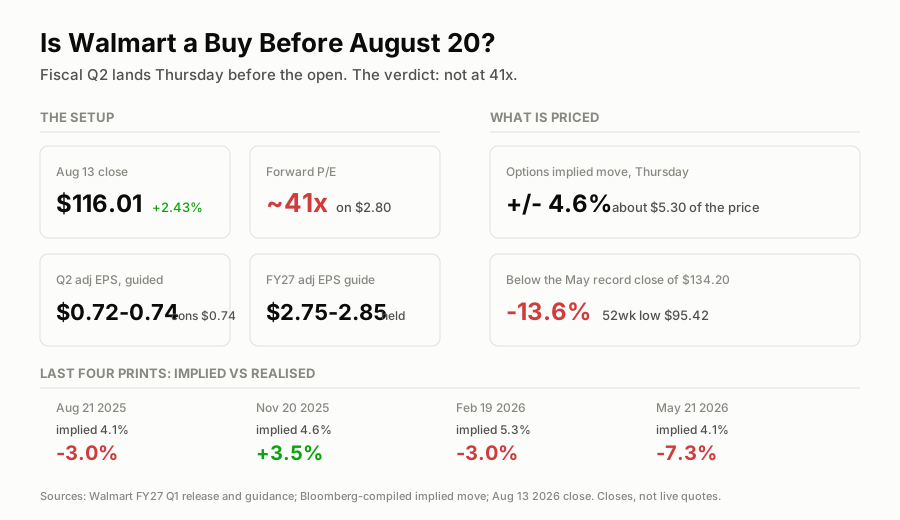
The last four reactions, against what the options market priced for each of them.
Twice Now, the Year Has Been Held Rather Than Lifted
In May, Walmart set full-year FY27 adjusted EPS at $2.75-$2.85 against a FactSet estimate then sitting at $2.92. It reiterated that range rather than raising it, alongside constant-currency sales growth of 3.5-4.5% and operating income growth of 6-8%.
The quarter underneath was good. Q1 revenue rose 7.3% to $177.8bn, ahead of a Street figure near $174.8bn. US comparable sales grew 4.1% and e-commerce grew 26%. Adjusted EPS of $0.66 landed in line.
The stock fell more than 7% anyway. Reported close-to-close figures for May 21 run from 7.26% to 7.7%, so I will not put a decimal on it; either way it roughly doubled the 4.1% the options market had priced. What did the damage was the shape of the guidance: a Q2 range of $0.72-$0.74 against a Street near $0.75, and a full year left untouched.
Operating income still grew 5% to $7.5bn, carrying a 250 basis point hit from higher fuel costs in distribution and fulfilment. Rainey said average gallons bought per visit to a Walmart fuel station fell below ten for the first time since 2022, which he called an indication of stress. I read that as a genuine demand signal from the company with the best view of the American wallet, and it is not the sort of detail that gets fixed in a quarter.
What 41x Actually Buys
Divide $116.01 by the $2.80 midpoint and you get 41.4x. On the low end of the guide it is 42.2x; on the high end, 40.7x.
That is the number I keep returning to. Walmart is guiding 6-8% operating income growth in constant currency. There are software companies compounding faster than that on similar multiples, and there are retailers growing at Walmart's rate on less than half of it. The bridge between those two facts is Walmart's advertising and membership income, which grows faster than the retail business and carries much better margins, and which is the reason the market stopped valuing this company on grocery economics.
I think that re-rating is largely done. The stock has already given back 13.6% from the $134.20 May record close, and it is still 21.6% above the $95.42 52-week low. So the de-rating has started without finishing, which is an awkward place to buy.
Retail's reporting fortnight gives three reads in three days: Home Depot on August 18, Target on August 19, then Walmart. The full slate is here, and dates for everything else sit on the earnings calendar.
The Market Prices 4.6%. Three of the Last Four Prints Went Down.
Here is the record, implied against realised: August 21 2025, 4.1% priced, -3.0% delivered. November 20 2025, 4.6% priced, +3.5%. February 19 2026, 5.3% priced, -3.0%. May 21 2026, 4.1% priced, roughly -7.3%.
Average that in absolute terms and you get about 4.2% realised against 4.4% priced. On magnitude alone the options market has had this stock roughly right, which is a different situation from the one this site has been writing about all summer in semiconductors, where realised kept beating implied by wide margins.
The asymmetry is what interests me. One of those four was positive. The single occasion the stock exceeded its implied move, it did so downward and by nearly double. Bloomberg-compiled data puts it at three of the last eight reports exceeding the priced move.
I would be careful reading too much into four observations. Four quarters is a small sample and I am drawing a distributional conclusion from it, which is the sort of thing that looks obvious until the fifth data point arrives. But the mechanism behind the skew is legible: management sets a conservative bar, the Street settles at the top of it, and the downside surprise comes from guidance rather than from the quarter.
Where I Would Buy It
The low $100s. A 4.6% down move from Thursday's close puts Walmart at about $110.70; a repeat of May puts it near $107.50. Somewhere in that zone the multiple drops toward the high 30s on a guide that would by then have survived another quarter.
The bull case deserves its hearing, and it rests on one event: Furner raising the full year. He took over from Doug McMillon on February 1, 2026 and has reorganised the company around what it calls enterprise platforms. A new chief executive has every incentive to set a beatable bar early and then clear it, which is a reasonable description of the last two quarters. If the August 20 guide moves up to something with a $2.9 handle, the argument I am making here weakens considerably, because the denominator finally starts moving.
The tariff whipsaw is the other live variable. Walmart raised prices citing import duties in the spring, then cut them on thousands of items in early July. Gross margin commentary on how much of that cost the company is absorbing is the most useful thing that will be said on the call, and it is the cleanest consumer read available this month. On the durability question underneath all of this, the case for Walmart surviving anything still stands; this piece is about the price, not the franchise.
The Options Angle
- The straddle is the play I would normally reach for into a print like this, and the numbers do not support it. Options price 4.6% and the four-quarter realised average is about 4.2%. A long straddle here needs the stock to do something it has managed once in four attempts.
- The skew is where the edge sits, if there is one. Three of four reactions were negative and the fat one was a downside guidance move, so I prefer a defined-risk put spread to a symmetric structure.
- A $114/$107 put spread for the August 21 weekly brackets the two scenarios that matter: the modal 4.6% down print lands near $110.70, inside the spread, and a May repeat lands near $107.50, at the lower strike.
- What kills it: a raised full-year guide. The stock gaps up, the spread expires worthless, and I would rather be wrong that way than long shares at 41x.
- Live option prices were not available to me at writing, so the rows below are struck against the implied move rather than a quoted premium, and the debit is left blank instead of guessed.
Trade log
| # | Stance | Structure | Strikes and expiry | Cost or credit | Spot at writing | Implied move | Breakeven |
|---|---|---|---|---|---|---|---|
| 1 | Bearish | Put spread | $114/$107 put spread, Aug 21 weekly | No live chain; debit not sourced | $116.01, Aug 13 close | ±4.6% | Needs a move below $114, about -1.7% |
| 2 | Pass | Long straddle | $116 straddle, Aug 21 weekly | ~4.6% of spot, derived from implied | $116.01, Aug 13 close | ±4.6% | Needs >4.6%; done once in four quarters |
| 3 | Pass | Long shares into the print | n/a, Aug 13 close of $116.01 | n/a | $116.01, Aug 13 close | ±4.6% | Waiting for the low $100s or a raised FY27 guide |
The One-Line Read
Walmart is a good business at 41x guiding 6-8% growth, and the guide has not moved in two quarters. I want the raise before I want the shares.
Next up:PCE inflation, Wednesday at 8:30am ET →
More on $WMT
$WMT · 2026-08-20
Walmart's $2.9 Billion Tariff Refund Flatters Q2. Q3 Pays for It.
$WMT · 2026-08-10
Retail Earnings Week (August 18-20): Home Depot, Target, Lowe's, Walmart and Deere Dates, Times and What to Watch
$WMT · 2026-08-04
Walmart Earnings August 20: Consensus Sits on Top of the Guide While Tariffs Move the Price Tags
Updated Every Saturday
The Week Ahead
Every earnings date, Fed event and setup for the current trading week, on one page.
Refreshed Weekly
Earnings Calendar
Who reports next, when, and what consensus and the whisper expect.
The Week-Ahead Brief
Don’t miss next week’s setups. Get the Sunday brief.
Latest issue, Sep 27“Micron, PCE and the jobs report that decides October”
Every Sunday: next week’s earnings dates, Fed days and the trades worth watching, from the same desk that writes the week-ahead hub. Free, built for retail investors.