Why Is Broadcom Stock Down? The $370B Number Isn't a Loss
Bank of America put $370 billion on Broadcom's AI financing backstop and AVGO closed down 5.92%. The figure in Broadcom's own 10-Q is $29 billion. What the gap between them actually measures.
TL;DR
- Broadcom closed Friday at $393.08, down 5.92%, after a Bank of America note attached $370 billion to the AI XPV financing platform by mid-2029.
- That $370bn is a peak notional guarantee under an assumed 2GW-per-quarter ramp. BofA's own modelled loss against it, assuming every single customer defaults, is $42 billion.
- The figure Broadcom has actually filed is $29 billion: maximum exposure on the first tranche, assuming complete default and zero recovery value on the hardware.
- The structure carries real risk and S&P has already called it credit negative. My argument is with the number that moved the stock, not with the concern behind it.
More on $AVGO: Broadcom Earnings Sept 2: The $16B AI Number Again →
The Board
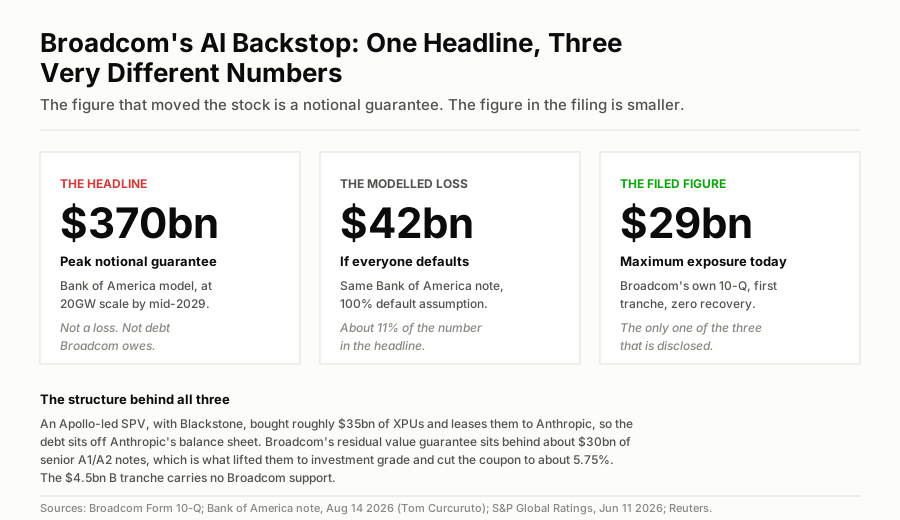
Three numbers, three different questions. Only one of them is disclosed.
Why Is Broadcom Stock Down Today?
A Bank of America credit note put a $370 billion figure on Broadcom's AI chip-financing vehicle, and the stock fell with it. Analyst Tom Curcuruto cut Broadcom's issuer and bond ratings, modelling that the AI XPV platform could carry $370bn by mid-2029 if it scales to 20 gigawatts, with roughly $150 billion of new issuance in 2027 alone.
Broadcom closed the regular session at $393.08, down 5.92% from Thursday's $417.82, having traded as low as $388.50. That is a settled close rather than an intraday read: stockanalysis.com and Yahoo Finance timestamp it at 4:00pm ET and differ by nine cents, with Yahoo at $392.99, down 5.94%. Both subtract exactly to Thursday's close.
A second, unrelated item hit the same tape: reports that a VMware vCenter flaw Broadcom disclosed on July 29 is being actively exploited. I would not attribute much of Friday's move to it. The financing note is what the desks were reading.
This is the second time this summer Broadcom has been sold on news that was not obviously bad for it. In July the company guided AI revenue up more than 200% and the stock fell anyway.
What the $370 Billion Is Counting
Reuters reported the figure as senior debt at the vehicle. Other write-ups described it as Broadcom's maximum residual value guarantee across 20GW. Those are different quantities, and the coverage did not settle which one BofA meant.
For a shareholder it matters less than it looks, because neither version is money Broadcom owes. The vehicle raises the debt. Broadcom guarantees a slice of it. A guarantee notional is the amount standing behind somebody else's obligation, and it converts into a loss only when the borrower stops paying and the collateral turns out to be worth nothing.
BofA modelled that too, and the answer is in the same note: $42 billion if every customer defaults. That is about 11% of the headline. The $370bn is also a peak outstanding figure rather than a running total, since these leases amortise across a five-year term while new tranches are written on top.
The Number in the Filing Is $29 Billion
Broadcom's own 10-Q discloses maximum exposure of up to $29 billion on the initial transaction, under an agreement to backstop lease payments for five years. That figure already assumes complete customer default and zero recovery on the equipment.
Here is the structure it describes. An Apollo-led vehicle, with Blackstone, bought roughly $35 billion of XPUs and leases them to Anthropic, which keeps the debt off Anthropic's balance sheet. Broadcom's residual value support sits behind the senior A1 and A2 notes, about $30 billion of the total. That support is what lifted the paper to investment grade and compressed the coupon to roughly 5.75%. The $4.5 billion B tranche has no Broadcom backing at all.
So the disclosed, filed, worst-case number is $29bn against a company that closed Friday at a $1.87 trillion market value. The $370bn belongs to a platform that does not exist yet at that scale.
Where the Real Risk Sits
I do not think this is a nothing story, and I would not want the correction above read as a defence of the structure.
Three things are genuinely uncomfortable. Broadcom is lending its balance sheet to make a customer's purchase financeable, which is vendor financing whatever else it gets called. S&P Global Ratings called the first tranche credit negative back on June 11, before any of this was a headline. And Anthropic has now stacked roughly $71 billion of chip-lease debt through these vehicles inside two months, none of it on its own books, against a revenue base that does not yet support it.
Readers who have followed the fine print in Hut 8's Beacon Point lease will recognise the shape. The headline number on these AI infrastructure deals is almost never the number that decides who takes the loss, and the wider capex build is increasingly financed this way rather than out of cash flow.
The bear case is not the $370bn. It is that a chip company's credit rating now travels with the fortunes of its largest customer, and that the equity is being asked to underwrite a lease book it does not control. That is a real change in what owning Broadcom means, and it deserved a repricing.
What I am unconvinced by is that Friday's repricing was the market working that out. A number got printed, the number was large, and the tape moved before anyone published what it measured.
For the contrast, AMD priced $4.75 billion of its own senior notes on August 13 and rose 6.50% on Friday. Same buildout, same need for capital, and the market charged a completely different price for it: the AMD side of that trade is here.
The One-Line Read
Broadcom's disclosed worst case is $29bn. The figure that moved the stock is a notional guarantee on a platform that has not been built. Both deserve attention. They are not the same risk.
Next up:PCE inflation, Wednesday at 8:30am ET →
More on $AVGO
Updated Every Saturday
The Week Ahead
Every earnings date, Fed event and setup for the current trading week, on one page.
Refreshed Weekly
Earnings Calendar
Who reports next, when, and what consensus and the whisper expect.
The Week-Ahead Brief
Don’t miss next week’s setups. Get the Sunday brief.
Latest issue, Sep 27“Micron, PCE and the jobs report that decides October”
Every Sunday: next week’s earnings dates, Fed days and the trades worth watching, from the same desk that writes the week-ahead hub. Free, built for retail investors.