Why Is Guzman y Gomez (GYG) Stock Up Today? Record Profit, a Bigger Dividend, and a $67 Million Bill for Quitting America
GYG rose more than 12% after FY26 underlying profit grew 29.7% to $53.4 million, but a $67.3 million charge for quitting the US turned the statutory result into a $26.7 million loss.
TL;DR
- Guzman y Gomez (ASX: GYG) shares were still up more than 12% inside the final half hour of Friday's Sydney session, against Thursday's $23.97 close, after touching roughly 13% intraday.
- Underlying EBITDA rose 28.7% to $85.0 million and underlying net profit rose 29.7% to $53.4 million, on network sales of $1.38 billion, up 17.9%, with comparable sales up 5.3%.
- The full-year dividend nearly quadrupled to 48.0 cents per share, from 12.6 cents in FY25, and the board approved a further $100 million buyback on top of $120 million already returned to shareholders this year.
- None of that reached the actual bottom line. A $67.3 million charge for shutting down the US business turned the company's total statutory result into a $26.7 million net loss.
- There's no options market on either listing. GYG trades on the ASX and, for US accounts, over the counter as GYGLF, where spreads run wide.
More on Single Stocks: Options Scorecard: A Reddit Put and a Nutanix Pass, Both Right at Expiry →
Why Is Guzman y Gomez Stock Up Today?
Guzman y Gomez's FY26 results, released Friday morning in Sydney, beat what the market had priced in on the numbers investors actually watch: EBITDA, underlying profit and the dividend. Shares opened higher and ran as much as 13% intraday, based on levels reported by ProactiveInvestors Australia, before settling to a gain a little above 12% in the closing stretch of trade, per pricing from stockanalysis.com and Google Finance taken around 3:50pm AEST, ten minutes ahead of the 4:00pm close.
That is a big one-day move for a company most US readers have never heard of. Guzman y Gomez runs a fast-growing Mexican-style quick-service chain across Australia and parts of Asia, often compared locally to Chipotle. It listed on the ASX in mid-2024, has never had a US options market, and briefly tried an actual US expansion before deciding this year that it wasn't worth running.
The Board
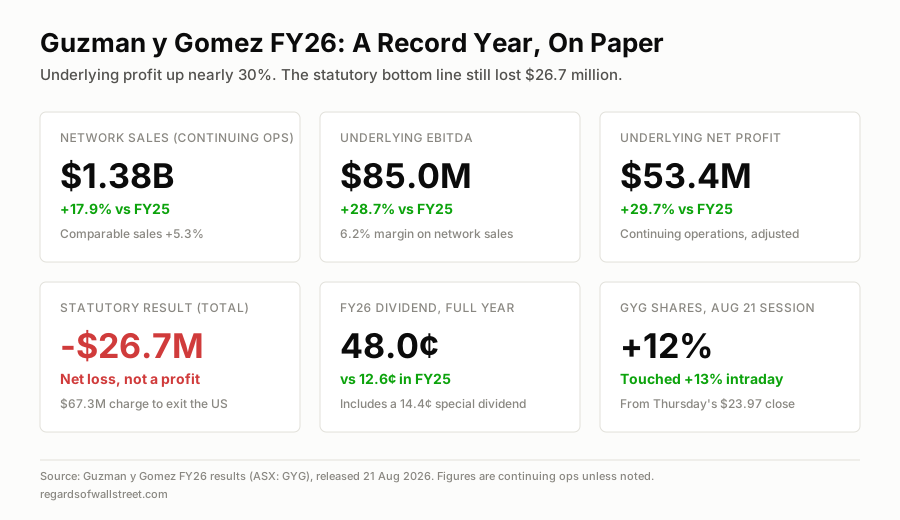
Every operating number moved the right way. The line that actually says "profit or loss" moved the other way, and the reason is a decision management made three months ago, not a bad quarter.
The Number That Grew, and the One That Didn't
Read the headline coverage of this result and you'd think Guzman y Gomez just had its best year yet. In the part of the business it's keeping, that's true. Underlying net profit rose 29.7% to $53.4 million, and the more conservative statutory profit figure for continuing operations, which excludes the discontinued US segment, rose 31.6% to $40.6 million.
Add the US business back in and the picture flips. The total statutory result for the full company was a net loss of $26.7 million, because Guzman y Gomez closed every US restaurant this year and had to write the decision into its accounts. The discontinued-operations charge came to $67.295 million, built from a $30.6 million write-off of US property and equipment, a $2.5 million write-down of leased assets, roughly $1.5 million in losses from surrendering two leases early, and a further $11.4 million of costs tied to exiting, on top of what the US stores had already lost operating through the year. I couldn't find a full public line-by-line reconciliation of that last piece, so treat the itemized figures as a partial breakdown of a total that two independent sources, Rask Media and a search of the company's own release, both put at $67.3 million.
A headline that only says "record profit" is describing the part of the business still operating. The number on page one of the actual accounts, the one that covers the whole company including what it just walked away from, is a loss.
Where the Growth Actually Came From
Strip out the US and the underlying Australian and Asian business is genuinely accelerating. A mature restaurant chain settles into mid-single-digit growth once it fills out its home market; GYG isn't there yet.
- Network sales hit $1.38 billion, up 17.9%, with comparable sales, the number that isolates growth from new store openings, up 5.3%.
- Underlying EBITDA margin, measured against network sales, came in at 6.2%, which is what you get dividing the reported $85.0 million of EBITDA by $1.38 billion of network sales. That arithmetic checks out on its own, and the company is guiding that margin to 6.7% to 6.9% in FY27.
- The chain opened 35 new restaurants across Australia and Asia during the year and added 62 sites to its Australian development pipeline, and guided to another 35 Australian openings in FY27 as it works toward a 40-store-a-year pace.
- Operating cash flow rose 33.4% to $76.4 million, per Rask Media's coverage of the release, funding the buyback and dividend without new debt.
That's the business the market is actually paying for now that the US distraction is gone. A single-country, still-growing restaurant chain with same-store sales growing faster than its store count is a straightforward story to price, which is presumably why the stock reacted the way it did.
The US Exit, and Why It Cost What It Cost
Guzman y Gomez announced in May that it was walking away from the United States entirely, closing its remaining Chicago restaurants and ending a market entry that never scaled the way the Australian business did. CNBC covered the announcement at the time, when the stock jumped as much as 20% on the news that management was cutting its losses.
Friday's result is the accounting bill for that decision landing in one quarter: write-offs on property and equipment, lease exit costs, and the operating losses the US stores had already run up before the doors closed. None of it is a cash outflow from here forward. It's the company formally recognizing that money already spent, or already lost, isn't coming back. Management said the charge would not affect the FY26 dividend, and the dividend did in fact go up, not down, which is the clearest signal that the underlying Australian cash generation was never actually at risk from the US misadventure.
The Dividend, the Buyback, and What They're Really Saying
The 48.0 cents per share full-year dividend is nearly four times FY25's maiden payout of 12.6 cents: a 7.4 cent interim plus a 40.6 cent final, and of that final payment, 14.4 cents is a special dividend sitting on top of a 26.2 cent ordinary one. Add the $100 million buyback extension the board just approved to the $120 million already returned this year through dividends and repurchases, and a company that only started paying a dividend last year is now returning capital aggressively.
The core Australian business is throwing off more cash than the store-opening plan needs, which is a good problem to have. And with the US written off, there's no growth-capital argument left for holding cash back. A payout ratio around 90% of underlying earnings is high for a company still opening dozens of stores a year, and it only makes sense if management is confident the US chapter is genuinely closed rather than a line item that reopens next year. The ex-dividend mechanics here are standard: the stock trades without the payment attached from 15 September, with the cash landing 30 September.
Is GYG a Buy?
I'd want exposure to the Australian business this result describes, and I'd be cautious about paying up for it after a 12% pop in one session.
The bull case is straightforward. Comparable sales growing faster than the store count, an EBITDA margin still expanding off a 6.2% base, a pipeline of 62 additional Australian sites already secured, and a management team that just proved it will cut a losing division rather than keep funding it. That's a better setup than the company had a year ago, US losses and all.
The bear case is that the good news is largely already in the price. The stock ran up in anticipation of this result and then again on the day, and a 6.2% margin business trading at the multiple GYG commands needs the FY27 guidance (35 more stores, margin toward 6.9%) to land close to exactly as promised. Any miss on comparable sales, which is the number that actually drives that margin expansion, gets punished hard on a stock priced for growth.
The practical constraint for US readers matters here too. There's no US-listed options market on GYG in either form, so there's no way to express a view with defined risk the way you could on a US name. The ASX listing needs a broker with international access; the OTC ticker GYGLF trades in US accounts but with the wider spreads that come with thin over-the-counter volume. Anyone weighing whether a foreign listing that trades in more than one place is worth the premium has run into a version of this problem before, in SK Hynix's Nasdaq ADR trading at a persistent markup to its Seoul shares; check what GYGLF is actually printing against the ASX price before assuming they move one-for-one.
The One-Line Read
The Australian business had a genuinely great year. The company as a whole reported a loss, because it finally stopped paying to find that out in America.
Next up:ISM Services PMI, today at 10:00am ET →
More on Single Stocks
Updated Every Saturday
The Week Ahead
Every earnings date, Fed event and setup for the current trading week, on one page.
Refreshed Weekly
Earnings Calendar
Who reports next, when, and what consensus and the whisper expect.
The Week-Ahead Brief
Don’t miss next week’s setups. Get the Sunday brief.
Latest issue, Sep 27“Micron, PCE and the jobs report that decides October”
Every Sunday: next week’s earnings dates, Fed days and the trades worth watching, from the same desk that writes the week-ahead hub. Free, built for retail investors.